Yields Near One-Year Highs Drive Risk-Off Tone Into Friday Close
Rising Treasury yields are doing the heavy lifting today — compressing equity valuations, amplifying oil's geopolitical premium, and setting a cautious tone heading into the weekend.
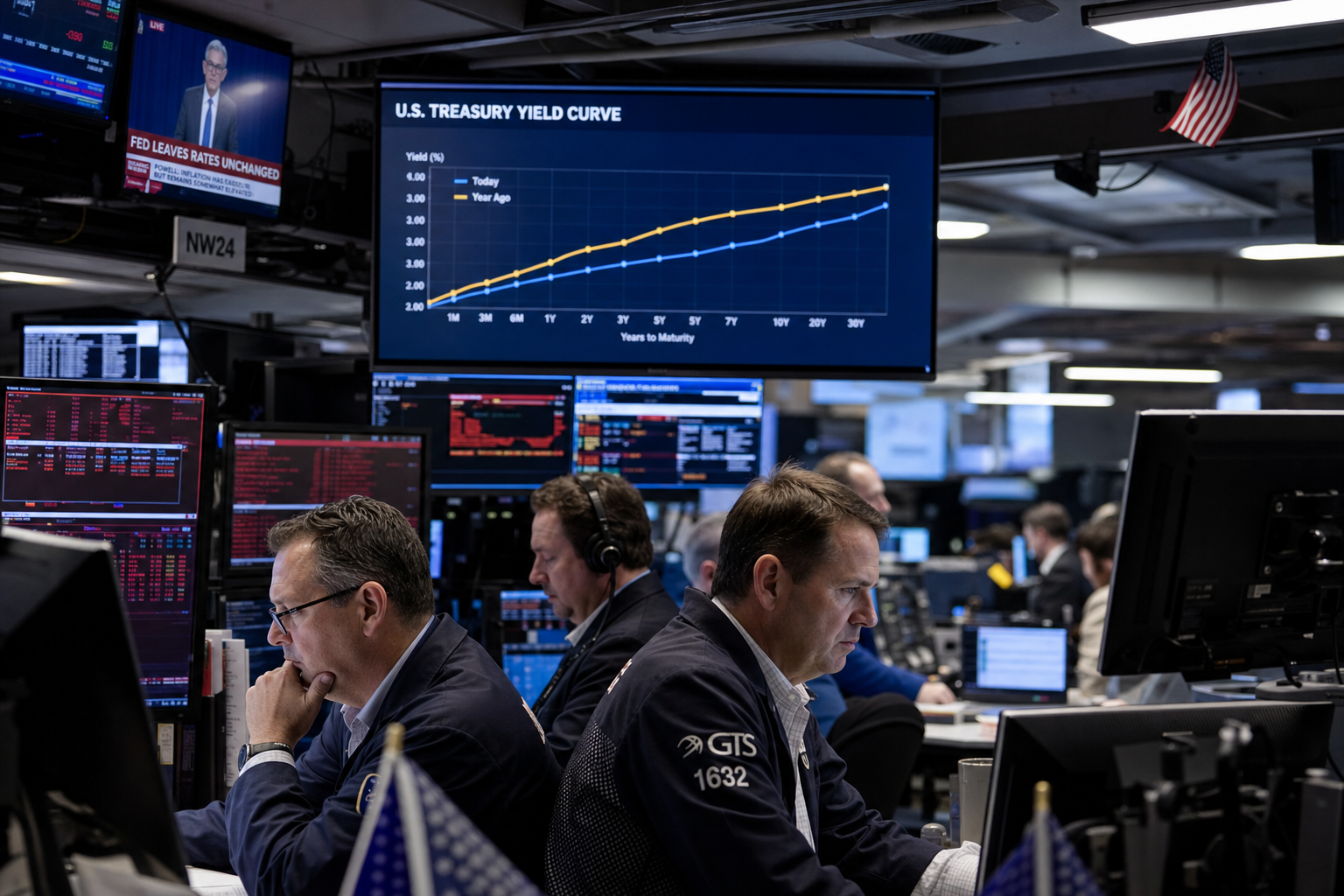
The Morning That Played Out as Feared
The inflation anxiety flagged in pre-market commentary materialized in full during Friday's session. Treasury yields pushed to their highest levels in roughly a year, the AI trade sold off hard, and crude oil extended its weekly surge on geopolitical supply fears. The session is unfolding largely as the macro setup warned — with one notable exception in the industrials sector.
By midday, the dominant market signal is the bond market. The 10-year Treasury yield — the benchmark rate that anchors valuations across equities, mortgages, and corporate credit — has climbed to its highest point since approximately May of last year. That move is not noise. It reflects a market repricing the Federal Reserve's path, with the central bank's own May inflation forecast reinforcing the view that rate cuts are not imminent. When the risk-free rate rises, the math on growth stocks deteriorates in real time: future earnings are discounted more heavily, and the relative appeal of equities versus bonds shrinks.
The AI Trade Under Pressure
NVDA and AMD are among the session's hardest-hit names, dragging the broader semiconductor complex lower. Marvell Technology also declined. The pattern is familiar: when inflation expectations rise and yields climb, high-multiple growth stocks — those priced on the assumption of strong earnings years into the future — absorb the most damage.
The AI trade is particularly exposed here. The premium valuations that NVDA and its peers carry were built on expectations of sustained, accelerating data center investment. That thesis has not changed fundamentally, but the discount rate applied to those future profits has. A stock worth $X at a 4% yield is worth less at a 4.5% yield, and the math compounds quickly at the valuations chip stocks have been carrying.
Nvidia's market cap had recently climbed to nearly $5.7 trillion, up from $4.7 trillion as recently as last Tuesday — a gain that itself created a high bar for any positive reaction. A separate disclosure that President Trump purchased up to $5 million of NVDA stock before approving AI export deals that subsequently lifted the shares drew scrutiny this week, though it provided no visible support to the stock in today's session.
AVGO and MSFT present a more nuanced picture. Both delivered strong AI-related results in their most recent quarters, but analysts are flagging a meaningful divergence in how the market is pricing their prospects. Broadcom's exposure to custom AI chips — application-specific integrated circuits used by hyperscalers building out data center infrastructure — may be seen as the relative value play compared to Microsoft's Azure and Copilot monetization story. That debate is secondary today, but it will matter when the rate environment stabilizes.
Oil's Geopolitical Premium Holds
Crude oil has surged roughly $7 over the course of the week, and that bid is holding into Friday's session. The driver is the Strait of Hormuz — the narrow waterway connecting the Persian Gulf to global shipping lanes, through which a substantial share of the world's seaborne crude exports passes. U.S.-Iran tensions have kept the threat of sustained disruption alive, and traders are pricing in a meaningful supply risk premium.
What makes this oil move notable is what it is overriding. Both OPEC and the International Energy Agency issued bearish demand forecasts this week. In a normal environment, that would cap crude prices. Instead, geopolitical fear is dominating fundamental supply-demand analysis — a pattern that historically persists until either the geopolitical situation resolves or demand destruction becomes impossible to ignore.
The Xi-Trump summit did not deliver meaningful signals for market normalization on the energy front, according to analysts. Higher oil prices feed directly into inflation readings, which means the Hormuz situation is not just an energy story — it is a macro story that complicates the Fed's calculus and extends the yield pressure already visible in Treasuries.
Boeing Offers the Session's Bright Spot
BA is the clearest winner in an otherwise defensive session. President Trump announced during his China visit that Beijing will purchase more than 200 Boeing aircraft, with signals of interest in as many as 750 planes in total. The deal also includes engines from GE.
The announcement is broadly positive for Boeing, which has faced a prolonged stretch of production and safety challenges. A large Chinese order would provide a meaningful boost to its production backlog — the queue of aircraft awaiting delivery — and signal a thaw in U.S.-China commercial aviation relations. GE stands to benefit from any associated propulsion contracts.
The caveat is real: multiple analysts noted that key details remain unconfirmed. Whether formal contracts have been signed, which Chinese carriers would take delivery, and on what timeline are all open questions. Large orders announced at diplomatic summits have a history of revision before closing. Markets are treating the announcement as a positive signal, but the lack of specifics is tempering enthusiasm among more cautious observers.
What the Afternoon Holds
With roughly half the session remaining, the rate narrative is unlikely to reverse. There are no scheduled Fed speakers or major economic releases that could shift the yield picture before the close, which means equities are likely to remain under pressure from the same forces that defined the morning.
The key variable to watch is whether the selling in chip stocks broadens or stabilizes. If NVDA and AMD hold their current levels without further deterioration, that would suggest the market has priced in the inflation repricing for now. A further leg lower would signal something more concerning about AI trade positioning heading into what is expected to be a strong Nvidia earnings report in the coming weeks.
On the energy side, any headlines from the Persian Gulf — particularly around Hormuz transit or U.S.-Iran diplomatic signals — could move crude quickly in either direction. Oil's current bid is entirely sentiment-driven, which makes it volatile.
For BA and GE, watch for any official documentation or airline-level confirmation of the China aircraft order. Specifics would solidify today's gains; silence heading into the weekend could allow skepticism to creep back in.
The session is shaping up as a confirmation of the week's dominant theme: rates are the anchor, and until inflation expectations stabilize, the path of least resistance for high-multiple equities remains lower.