Yields at Trump-Term High Close Out a Bruising Tuesday for Equities
A three-session losing streak for the S&P 500, a semiconductor sector in retreat, and $355 billion riding on Nvidia's after-hours print Wednesday.
The Session
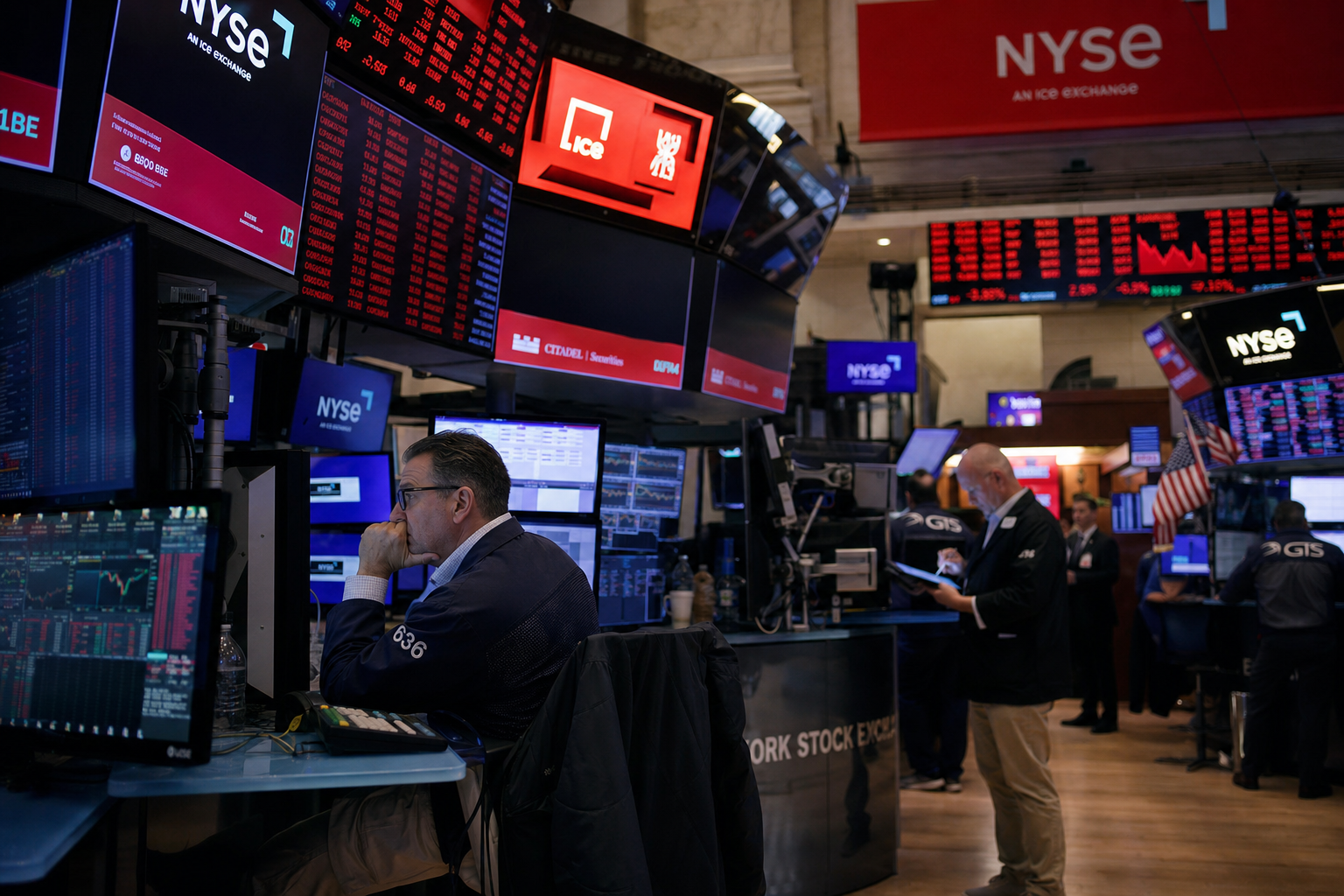
Tuesday's close offered little comfort for equity bulls. The S&P 500 (SPY) logged its third consecutive losing session, weighed down by a bond market that is increasingly difficult to ignore. The 10-year Treasury yield — the benchmark rate on U.S. government debt and the anchor for mortgage rates, corporate borrowing costs, and equity discount rates — climbed to its highest level since January 2025, marking a new high for the current presidential term.
Gold, which had been a beneficiary of earlier uncertainty, also declined. The logic is straightforward: when yields rise, the opportunity cost of holding a non-yielding asset like gold increases. Both moves — lower equities, lower gold — tell the same story: the bond market is tightening financial conditions faster than risk assets can absorb.
No single catalyst for the yield move was identified in available reporting, but the broader context is familiar. Persistent fiscal concerns, a resilient U.S. economy that has kept the Federal Reserve cautious about cutting rates, and a heavy supply of Treasury issuance have all contributed to the pressure on the long end of the curve.
Winners and Losers
The session's most visible casualties were in semiconductors. AMD, Broadcom (AVGO), and Qualcomm (QCOM) led declines across the chip complex, with the sell-off appearing driven by pre-earnings positioning ahead of Nvidia's (NVDA) first-quarter results due after Wednesday's close.
The dynamic is a familiar one in markets: traders reduce exposure to correlated names before a binary event rather than wait for confirmation. With options markets pricing a potential $355 billion swing in Nvidia's market capitalization — one of the largest implied moves on record for a single company — the incentive to cut chip exposure early is unusually strong.
The bearish case for the sector found a prominent voice in Leopold Aschenbrenner, who has taken short positions on AI chip names including Micron (MU), Marvell (MRVL), and Intel (INTC), drawing comparisons between current AI chip valuations and historical market bubbles. The argument is structural: AI infrastructure spending remains robust by most measures, but the stocks pricing in that growth have run well ahead of near-term earnings visibility.
Away from semiconductors, Berkshire Hathaway (BRK.A) continued to draw attention for portfolio moves under new CEO Greg Abel. The conglomerate has exited positions in Visa (V), Mastercard (MA), and UnitedHealth Group (UNH) while adding to its stake in Alphabet (GOOGL) and initiating a position in Delta Air Lines (DAL). The Delta entry is a notable departure from Warren Buffett's long-standing aversion to airline stocks. Analysts cited in available reporting suggest Berkshire's current valuation metrics indicate the stock may be trading below its intrinsic worth.
Under the Surface
The bond market's message on Tuesday was unambiguous: yields at a Trump-term high signal that investors are demanding more compensation to hold long-duration U.S. government debt. That has direct implications across asset classes. Higher yields compress the present value of future earnings, hitting growth stocks hardest. They also raise the floor for corporate borrowing costs, which feeds into credit spreads and capital expenditure decisions over time.
Geopolitics added a secondary layer of pressure. The Wall Street Journal reported little progress in U.S.-Iran nuclear negotiations, with military tensions between the two sides remaining elevated. Iran is a significant oil producer, and the combination of stalled diplomacy and active military posturing keeps a risk premium embedded in crude oil prices. Brent crude and WTI are sensitive to Persian Gulf supply disruption scenarios, and the absence of diplomatic momentum removes a potential catalyst for easing that premium.
The energy market overhang matters for inflation expectations. Sustained oil prices feed into headline CPI readings, which in turn complicate the Federal Reserve's path toward any eventual rate reduction. For equity markets already absorbing the cost of higher yields, a persistent energy risk premium is an additional headwind.
Wednesday's Setup
Nvidia's first-quarter results after Wednesday's close are the dominant event for markets this week — and arguably for the broader AI trade this quarter. The $355 billion implied move in Nvidia's market cap is not hyperbole; it reflects the company's weight in major indices and its role as the primary proxy for institutional confidence in AI infrastructure spending.
Three questions will define the market's reaction. First, how does data center demand look relative to expectations? Second, what is the outlook for China revenue given renewed U.S. export restrictions? Third, does management's guidance suggest the AI capital expenditure cycle from hyperscalers — Amazon, Microsoft, Alphabet — is accelerating, holding steady, or showing early signs of fatigue?
A strong print could reverse three sessions of equity losses and quiet the bubble warnings circulating in the semiconductor complex. A miss, or cautious guidance, would likely extend the sell-off across chip names and test the resilience of the broader AI trade into the summer.
Beyond Nvidia, the week's retail earnings calendar — Walmart, Home Depot, and Target are all scheduled to report — will offer a read on U.S. consumer health that the macro backdrop has made more consequential. With yields at multi-month highs and equity sentiment fragile, any softness in consumer data would arrive at a particularly sensitive moment for risk assets.