Warsh's Fed Debut Anchors a Day Packed With Macro Signals
From the Fed's first meeting under Kevin Warsh to China's $41 billion bank recapitalization and a 20-year high in Singapore trade data, Wednesday's macro calendar is unusually dense.
The Overnight Picture
Equity futures edged higher heading into Wednesday's session, extending a run that saw the Dow Jones Industrial Average close at an all-time high for the second consecutive session. S&P 500 and Nasdaq futures followed modestly in sympathy, though the Nasdaq had shed nearly 1.9% in Tuesday's session as semiconductor stocks retreated — a divergence that signals rotation rather than broad risk-off sentiment.
Asian markets were broadly constructive overnight, with the Nikkei approaching record territory. The calm in regional equities suggests investors are positioned cautiously but not defensively ahead of the Federal Reserve's announcement. European markets opened without significant dislocation.
The macro backdrop entering the session is unusually layered. Three separate international data points — China's fiscal intervention, Singapore's trade surge, and ongoing U.S.-Iran geopolitical uncertainty — are all live variables that the Fed itself will be weighing.
Theme 1: The Warsh Press Conference Is the Real Event
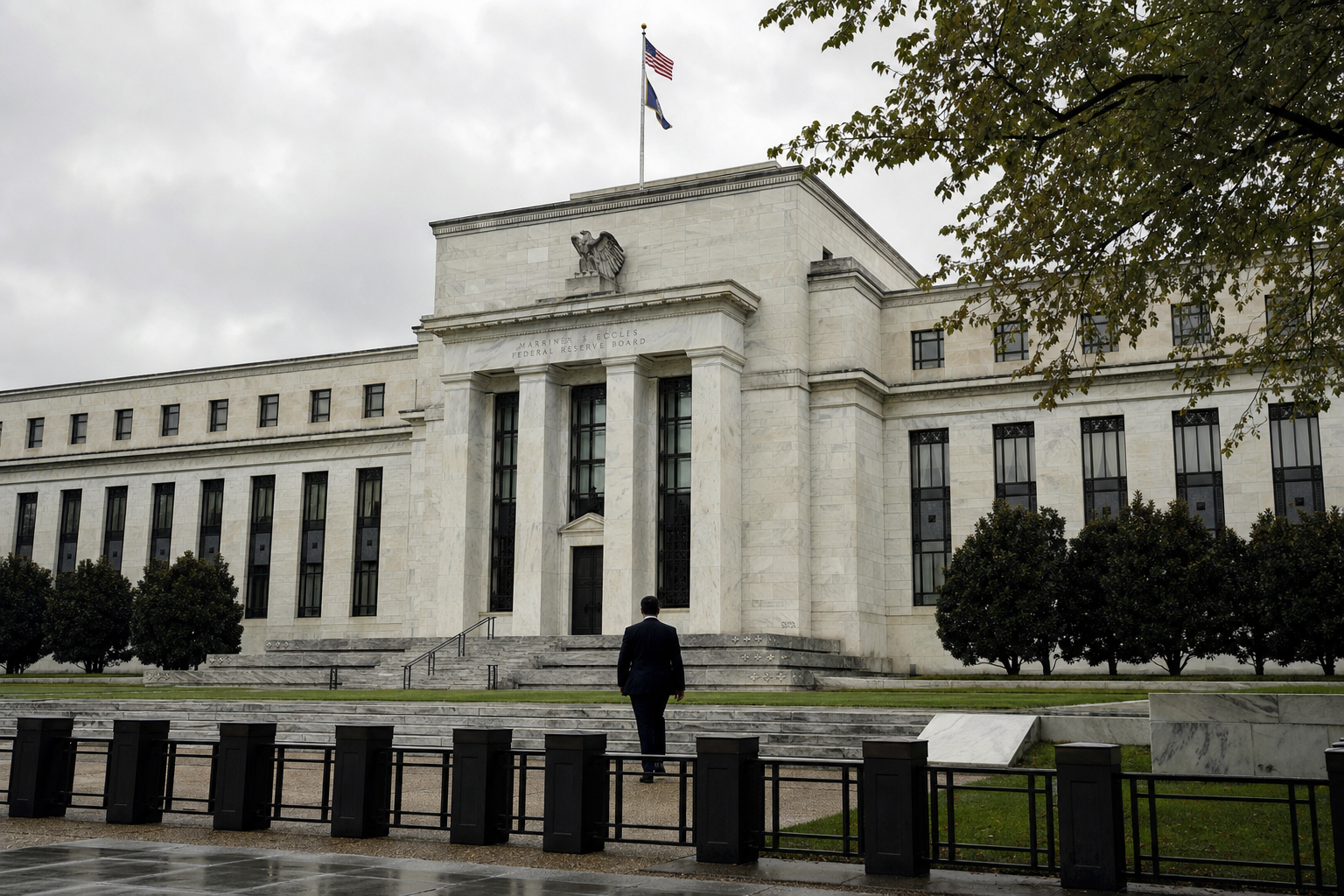
Today marks Kevin Warsh's debut as Federal Reserve chair at an FOMC (Federal Open Market Committee) meeting — the body that sets the U.S. benchmark federal funds rate. No change to that rate is expected, which shifts the entire weight of the event onto the post-decision press conference.
What markets will parse obsessively: any shift in language around the Fed's reaction function — how it weighs incoming inflation and labor market data when deciding on rates. A more hawkish framing, even subtle, could reprice rate-cut expectations across the Treasury curve and knock high-multiple equities. A more dovish lean would likely extend the Dow's record run and compress yields.
The geopolitical dimension adds complexity. Sources indicate the ongoing U.S.-Iran situation is on the Fed's radar as a potential inflation risk via energy prices. If Warsh acknowledges that risk explicitly, it could signal the Fed is less willing to cut than markets currently assume. European Central Bank officials have already cautioned that even a U.S.-Iran peace accord may not be sufficient to prevent further rate hikes in Europe — a reminder that the energy price channel runs both ways.
The Dow's back-to-back record closes suggest markets are not pricing in a hawkish surprise. That complacency itself is worth watching: if Warsh delivers anything other than a neutral-to-dovish tone, the gap between positioning and reality could close quickly.
Theme 2: China's $41 Billion Bank Backstop
China's vice premier announced that Beijing will issue CNY 300 billion — roughly $41 billion — in special sovereign bonds to inject capital into the country's financial institutions. The move is designed to shore up bank balance sheets and provide a buffer against the overhang of local government debt, a structural vulnerability that has weighed on China's credit markets for years.
Special bonds of this kind sit outside China's standard budget deficit, allowing Beijing to deploy direct fiscal firepower without formally widening the headline deficit figure. The recapitalization signals that policymakers are moving proactively rather than waiting for conditions to deteriorate.
For global markets, the implications are multi-directional. Stronger Chinese bank balance sheets support credit extension, which feeds into commodity demand — a positive for industrial metals and energy. Emerging market currencies with China exposure may also see a modest tailwind. At the same time, the scale of the intervention is a reminder of the stress that has accumulated in China's financial system, which is not unambiguously bullish for Chinese assets.
The announcement arrives on the same day as the Fed decision, creating an unusual juxtaposition: the world's two largest economies are both deploying significant policy tools simultaneously, albeit through different channels.
Theme 3: Singapore's Trade Data as an AI Barometer
Singapore's non-oil domestic exports (NODX) — a closely watched gauge of Asian electronics trade — surged 38.4% year-on-year in May, far exceeding expectations and marking the largest annual increase in approximately two decades. The primary driver was AI-related electronics: semiconductors, components, and related hardware feeding the global buildout of AI infrastructure.
Singapore's role as a regional manufacturing and logistics hub makes its export data a useful real-time signal for the broader AI supply chain. The May reading adds to a growing body of evidence that AI hardware demand remains robust even as investors debate the durability of the AI investment cycle.
The caveat is significant. Proposed U.S. tariffs threaten a meaningful share of these exports, and any escalation in trade policy could quickly erode the gains. The 38.4% figure reflects demand conditions before those tariffs are fully priced into supply chain decisions — which means the current pace of growth may not be a reliable guide to the second half of the year.
For investors tracking the AI trade, the Singapore data provides ground-level confirmation that capital expenditure is translating into actual orders. The tariff risk is the variable that could interrupt that signal.
The Equity Stories: TSLA and INTC
Two company-specific developments deserve attention heading into the session.
Tesla (TSLA) faces a widening regulatory challenge after U.S. senators initiated a federal investigation into the safety claims the company makes for its Full Self-Driving (FSD) driver-assistance system. FSD automates steering, braking, and lane changes but requires driver supervision and does not constitute full autonomy — a distinction regulators in both the U.S. and Europe are now scrutinizing. European regulators have separately accused Tesla of providing misleading information about FSD's capabilities.
The dual-jurisdiction pressure raises the risk of mandatory disclosure requirements, marketing restrictions, or operational constraints on FSD deployment. Tesla's software revenue narrative — a central pillar of the bull case for the stock — depends heavily on FSD's commercial trajectory. Any regulatory action that limits how the system can be marketed or deployed would directly threaten that thesis.
Intel (INTC) is moving in the opposite direction this morning. Bank of America issued a double upgrade on the stock — raising its rating by two notches in a single action, an unusually strong signal of conviction — citing improving AI infrastructure demand and arguing the stock is meaningfully undervalued at current levels. Separately, Intel's advanced 18A-P chip manufacturing process entered the risk production stage, an early phase that precedes full commercial output. The 18A-P node represents Intel's attempt to reclaim process leadership in advanced semiconductor fabrication. Both developments drove INTC higher in premarket trading.
The Calendar
The FOMC rate decision is the session's anchor event, with the statement and Warsh's press conference scheduled for the afternoon. No change to the federal funds rate is expected; the statement language and press conference Q&A are where the market-moving information will reside.
The U.S.-Iran geopolitical situation remains a live secondary risk, particularly for energy markets. Any escalation or de-escalation could move crude prices and complicate the Fed's inflation calculus in real time.
No major U.S. economic data releases are scheduled to compete with the Fed announcement.
Watch List
The Treasury market is the clearest real-time read on how the Fed press conference lands. Watch the 2-year yield — the maturity most sensitive to near-term rate expectations — for any move larger than 5 basis points in either direction following Warsh's opening remarks. A spike higher would signal markets are repricing toward fewer cuts; a decline would extend the equity rally.
For TSLA, the question is whether the Senate investigation triggers a formal regulatory response or remains in the inquiry stage. Watch for any official statements from the National Highway Traffic Safety Administration, which would be the agency most likely to act on safety findings.
For INTC, the premarket move will be the first test of whether the Bank of America upgrade has legs. The stock had declined sharply in the prior period, and a sustained move higher would require the broader semiconductor sector to stabilize after Tuesday's retreat.
On the macro side, watch commodity markets — particularly copper and crude — for any reaction to China's CNY 300 billion announcement. A meaningful move in industrial metals would suggest the market is taking the bank recapitalization as a genuine growth signal rather than a defensive measure.