Warsh Hawkishness Dominates Midday as Intel Surges on Apple Chip Deal
The Fed's new chair reset rate expectations in his debut, while corporate AI deal flow ran in the opposite direction — creating the session's defining tension.
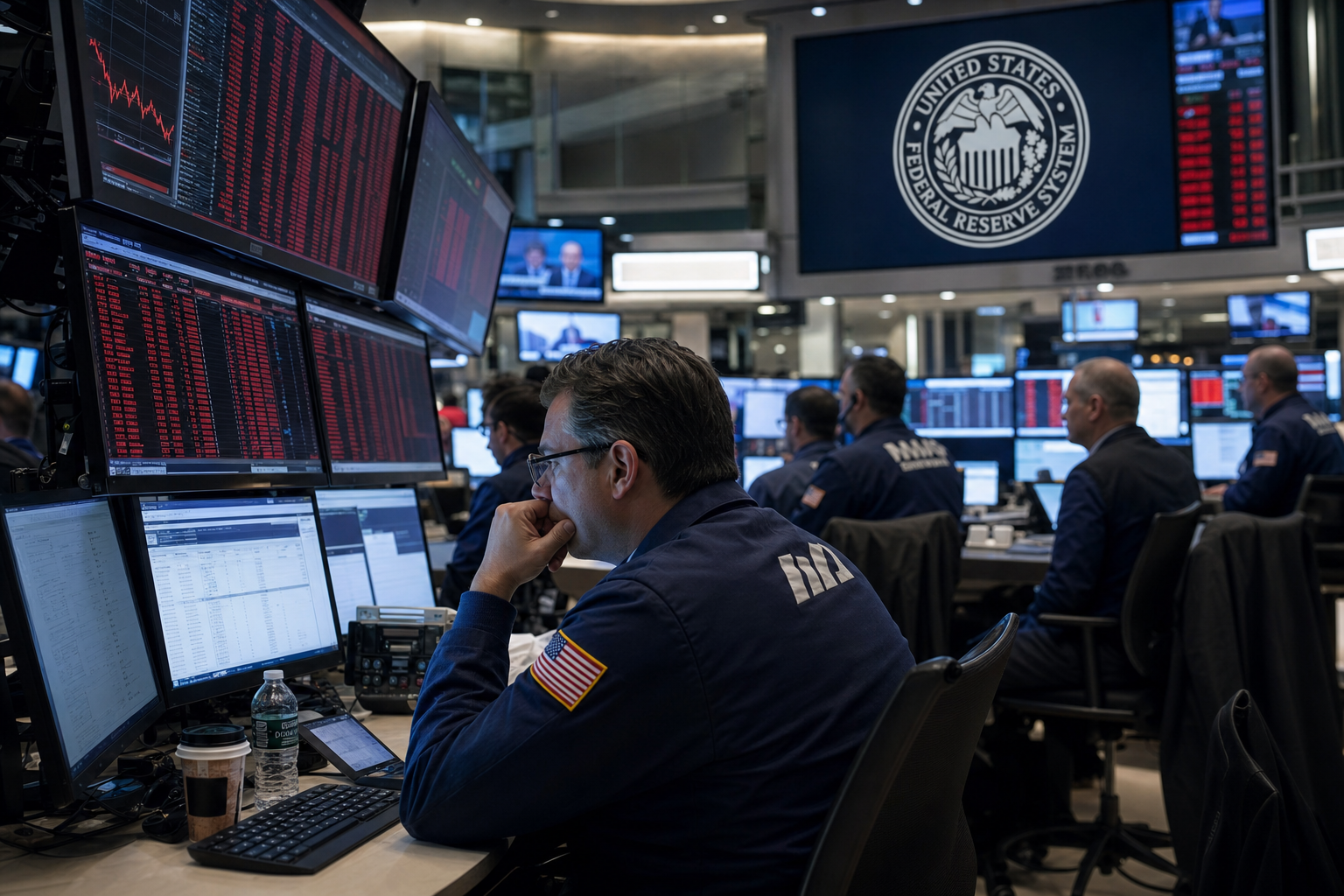
The Morning That Wasn't Priced In
Markets came into Thursday with a relatively patient Fed narrative baked in. By midday, that assumption had been thoroughly repriced. Kevin Warsh, in his debut as Federal Reserve chairman, delivered remarks that investors interpreted as unambiguously hawkish — signaling that inflation remains the central bank's primary concern and that rate cuts are not the next move on the table.
The reaction was swift and broad. U.S. equities fell across major indices tracked by the ^GSPC, ^DJI, and ^IXIC. Treasury yields — tracked by the FVX, TNX, and TYX indices — moved higher across maturities. The simultaneous selloff in both stocks and bonds is the telling detail: this was not a rotation between asset classes. Investors repriced risk broadly, signaling that Warsh's tone landed as a genuine policy shift rather than rhetorical posturing.
Rob Kaplan, vice chairman at Goldman Sachs (GS), amplified the concern, stating the Fed may need to raise its benchmark rate as soon as September if inflation remains elevated. Markets had not been pricing a September hike as a base case. They are now.
Intel Breaks the Tape
Against that macro backdrop, Intel (INTC) delivered the session's most dramatic single-stock move. President Donald Trump announced that Apple (AAPL) would collaborate with Intel to design and manufacture semiconductors in the United States, framing the arrangement as part of a broader push to rebuild domestic chip production capacity.
Intel shares surged roughly 8% to 10% on the news — one of the stock's stronger single-session moves in recent memory. The gain stands out on a day when the macro environment was working against equities broadly.
The strategic logic is clear even if the operational details are not. Intel has been working to rebuild its foundry business — manufacturing chips for external customers — after ceding ground to Taiwan's TSMC (TSM). Apple, which designs its own silicon but has historically relied almost entirely on TSMC for fabrication, would represent a landmark customer win. Washington's sustained push for onshore semiconductor manufacturing gives the arrangement political durability beyond any single administration announcement.
What remains unresolved: which chips would be produced, at what process node, on what timeline, and at what commercial terms. The White House announcement provided the headline without the architecture.
Nvidia's $25 Billion Statement
Nvidia (NVDA) completed what is described as a record $25 billion bond sale, with proceeds earmarked to refinance existing obligations and fund continued AI infrastructure expansion. The deal closed into a bond market that was simultaneously selling off on rate-hike fears — which makes the strong investor demand for Nvidia's paper a notable data point in its own right.
Fixed-income buyers absorbing $25 billion in Nvidia debt on a day when Treasury yields are rising signals genuine confidence in the company's long-term cash flow trajectory. Corporate bond issuance at this scale is unusual outside of major financial institutions and utilities. For a chipmaker, even one at Nvidia's scale, it reflects how capital-intensive the AI infrastructure race has become.
Separately, Amazon (AMZN) is reported to be in discussions to sell its Trainium AI chips to third-party customers — a move that would put it in more direct competition with Nvidia in the external chip market. The two stories together illustrate how AI infrastructure spending is reshaping capital allocation decisions across the sector.
Deal Flow Holds Despite the Macro Headwind
Salesforce (CRM) signed a definitive agreement to acquire Fin, a company focused on AI-powered customer service agents, for approximately $3.6 billion. The deal is intended to strengthen Salesforce's Agentforce platform, which automates customer interactions. At $3.6 billion, it represents a meaningful commitment and continues the pattern of established enterprise software vendors acquiring specialized AI startups rather than building comparable capabilities in-house.
In healthcare, Biogen (BIIB) announced plans to acquire RayThera for up to $1 billion, adding anti-inflammatory drug candidates to its immunology pipeline. The breadth of deal activity — spanning enterprise software, semiconductors, and pharmaceuticals — suggests that corporate confidence in the medium-term outlook has not been fully dented by the morning's rate shock.
The AI Frenzy Finds Unusual Hosts
The week's AI capital cycle produced at least one moment that will test investors' pattern recognition. Allbirds, the footwear brand, rebranded as Smartbird and announced a pivot toward AI infrastructure, triggering a significant rally in its shares. The move fits a well-documented playbook from prior technology cycles: attach the dominant theme to a struggling brand and capture momentum-driven flows.
SpaceX's market value also surged following its IPO, placing it among the most valuable companies globally. The juxtaposition — a sneaker company and a rocket manufacturer both riding the AI wave on the same day that the Fed's new chair is raising the cost of capital — captures the central tension in markets right now.
The Afternoon Setup
The defining question for the rest of the session is whether the Warsh rate-hike signal continues to dominate price action or whether the corporate deal flow provides enough counterweight to stabilize equities. So far, the macro story is winning.
Watch Treasury yields for any extension of the morning's move higher — a continued climb would add pressure to rate-sensitive sectors including technology and real estate. On the corporate side, any additional detail on the Apple-Intel chip arrangement's scope, timeline, or financial terms could extend INTC's rally or trigger a reassessment if the substance falls short of the headline.
GS's Kaplan comments on a September hike are likely to draw follow-up questions for any Fed officials who speak this afternoon. Clarity — or the absence of it — on the rate path will set the tone heading into Friday's session.