Treasury Yields Hit Near One-Year High as Fed Inflation Fears Grip Friday Trade
The bond market is repricing the Fed's policy path, and every other asset class is feeling it — from equities to semiconductors to the U.S.-China trade outlook.
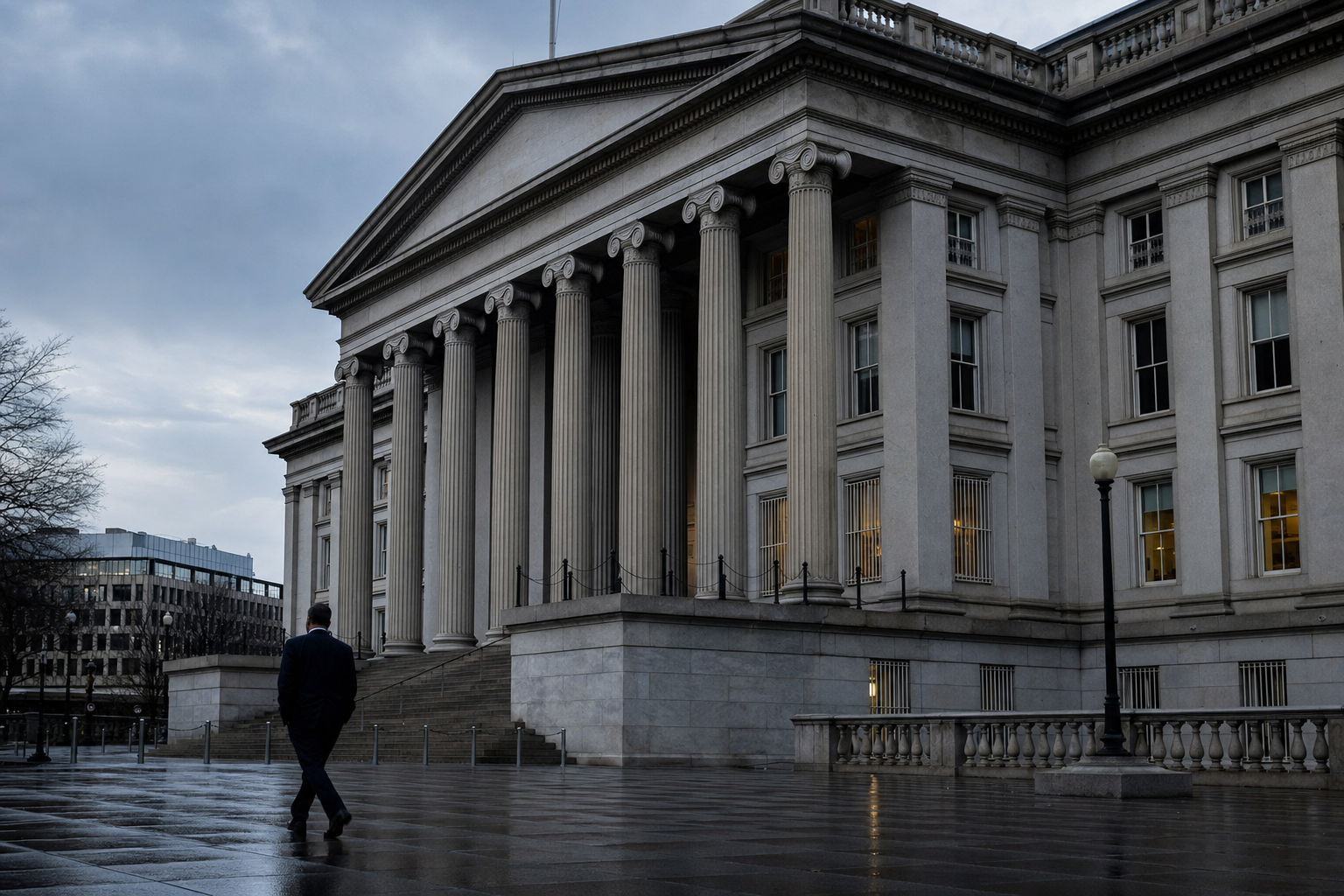
The overnight picture
Friday opened with the bond market in the driver's seat. The 10-year Treasury yield climbed to its highest level since May of last year, a move that was broad-based — short-, medium-, and long-dated bonds all sold off simultaneously, pushing yields higher across the curve. Futures for the S&P 500 (^GSPC), Dow (^DJI), and Nasdaq (^IXIC) all pointed lower heading into the open.
The catalyst is a combination of persistent inflation concerns and the Federal Reserve's May forecast, which analysts described as notably pessimistic for equity investors. The message from the bond market is unambiguous: rate cuts are not imminent, and the higher-for-longer rate environment that defined much of 2024 and 2025 may have more runway than many had hoped.
In Asia, the session was mixed. South Korea's KOSPI had briefly touched a record high in the prior overnight session before retreating on Iran-related geopolitical concerns. Japan's inflation data drew attention from monetary policy watchers without triggering major moves. Oil prices had climbed earlier in the week after President Trump said China agreed to purchase U.S. crude, and Trump's subsequent comments expressing impatience with Iran added a geopolitical risk premium that kept energy markets elevated heading into Friday.
Theme 1: The yield surge and what it means for equities
The mechanics here are straightforward, and the implications are wide. When Treasury yields rise sharply, the present value of future corporate earnings falls — because those earnings are discounted at a higher rate. That dynamic hits growth stocks hardest, particularly technology names whose valuations are built on earnings projected years into the future.
The Fed's May inflation forecast has accelerated the repricing. Markets had been gradually pricing out near-term rate cuts for months; the forecast appears to have hardened that view into something closer to conviction. The shift in tone matters because it changes the calculus for asset allocation across equities, fixed income, and currencies simultaneously.
For bond investors, yields at near one-year highs represent actual return opportunities in fixed income that have been scarce for much of the post-pandemic period. For equity investors, the same move is a headwind — particularly for the growth-heavy Nasdaq, which is most sensitive to discount-rate changes.
Theme 2: U.S.-China trade — agriculture advances, technology stalls
U.S. Trade Representative Jamieson Greer signaled progress in talks with Beijing on an agricultural agreement, with China committing to soybean purchases. That is a tangible, if modest, diplomatic win. What Greer did not offer was clarity on future tariff rates for Chinese goods broadly, or on technology export policy — specifically, the rules governing sales of advanced semiconductors to Chinese buyers.
For Nvidia (NVDA), the picture is fluid in both directions. U.S. authorities approved roughly ten Chinese firms to purchase H200 chips — a meaningful, if limited, easing of export controls that had previously blocked sales of advanced AI processors to Chinese buyers. Cantor Fitzgerald raised its price target on NVDA to $350. Yet the broader export framework remains unsettled, and Greer's comments confirmed that semiconductor trade is still a live negotiating issue.
The two-track outcome — commodity progress, technology deadlock — reflects the structural complexity of U.S.-China economic relations. Progress on soybeans is achievable in a summit communiqué. Consensus on high-technology exports, where national security considerations dominate, is a different order of difficulty entirely.
Theme 3: AI supply chain broadening — INTC, AMAT, and the manufacturing bet
Against the macro headwinds, a distinct AI infrastructure narrative continued to develop. Intel (INTC) attracted renewed investor interest following reports linking the company to Elon Musk's Terafab project, described as a large-scale AI manufacturing initiative. The thesis repositions Intel not as a chip designer struggling to compete with TSMC and AMD, but as a domestic fabrication partner in a policy environment that is actively incentivizing onshore semiconductor production.
Intel's foundry business — contract chip manufacturing for other firms — has been a significant capital commitment that has yet to deliver the returns investors expected. A high-profile AI partnership could validate that strategy in a way that organic customer wins have not. Applied Materials (AMAT), which supplies equipment to chipmakers, also saw its price target raised by RBC Capital on a positive growth outlook tied to AI-driven capital spending.
The pattern is consistent with what has been playing out across the AI trade for several months: the market is broadening its search for beneficiaries beyond the obvious names, looking further into the supply chain for companies that capture durable infrastructure revenue.
The calendar: what to watch today
There are no major scheduled U.S. economic data releases on Friday, May 15 that are flagged in the source material, making the bond market's own momentum and any Fed commentary the primary macro variables for the session.
On the earnings front, Citi raised its price target for Walt Disney (DIS) following a stronger-than-expected Q2 report, adding Disney to a list of stocks analysts are highlighting as well-positioned for the second half. Pfizer (PFE) reported a 22% increase in Q1 revenue, driven by new products and recent acquisitions, with positive developments in legal settlements also noted. Analysts focused on Pfizer's oncology pipeline and migraine portfolio as key growth drivers.
JPMorgan (JPM) added to its institutional blockchain footprint by filing to launch a second tokenized money market fund on the Ethereum network. The move signals that one of the world's largest banks sees genuine institutional demand for on-chain financial products — and that its first tokenized fund generated enough traction to warrant a follow-on. Separately, JPMorgan raised its bull-case price target for Taiwan's Taiex index to 50,000, citing the AI infrastructure buildout as the primary driver.
Watch list
The 10-year yield is the number to track above all others today. If it continues to push higher through the session, expect growth stocks and rate-sensitive sectors — real estate, utilities, long-duration tech — to bear the brunt. A stabilization or pullback in yields would likely provide relief to equity futures and give the session a different character entirely.
On the trade front, watch for any follow-on statements from the Greer talks or the White House on semiconductor export policy. The H200 approvals for select Chinese firms are a positive signal, but the market is acutely aware that the broader framework remains unsettled. Any language that either narrows or widens the scope of permissible chip sales to China will move NVDA and the broader semiconductor complex.
Intel's Terafab narrative is worth monitoring for durability. Rallies built on partnership speculation can fade quickly if no formal agreement or revenue timeline materializes. Watch for any official announcement or denial from Intel's management or from the Terafab project itself.
Finally, oil. Trump's comments on Iran introduced a geopolitical risk premium into energy markets that has not fully resolved. Any escalation in U.S.-Iran rhetoric over the weekend could carry over into Monday's energy open — a variable that matters for inflation expectations and, by extension, for the yield trajectory that is driving everything else today.