The $805 Billion Bet: How AI Capex Became the Market's Central Thesis
A confluence of earnings beats, record-breaking deals, and trillion-dollar market caps has made AI infrastructure spending the single most consequential variable in global equity markets.
The Number That Changed Everything
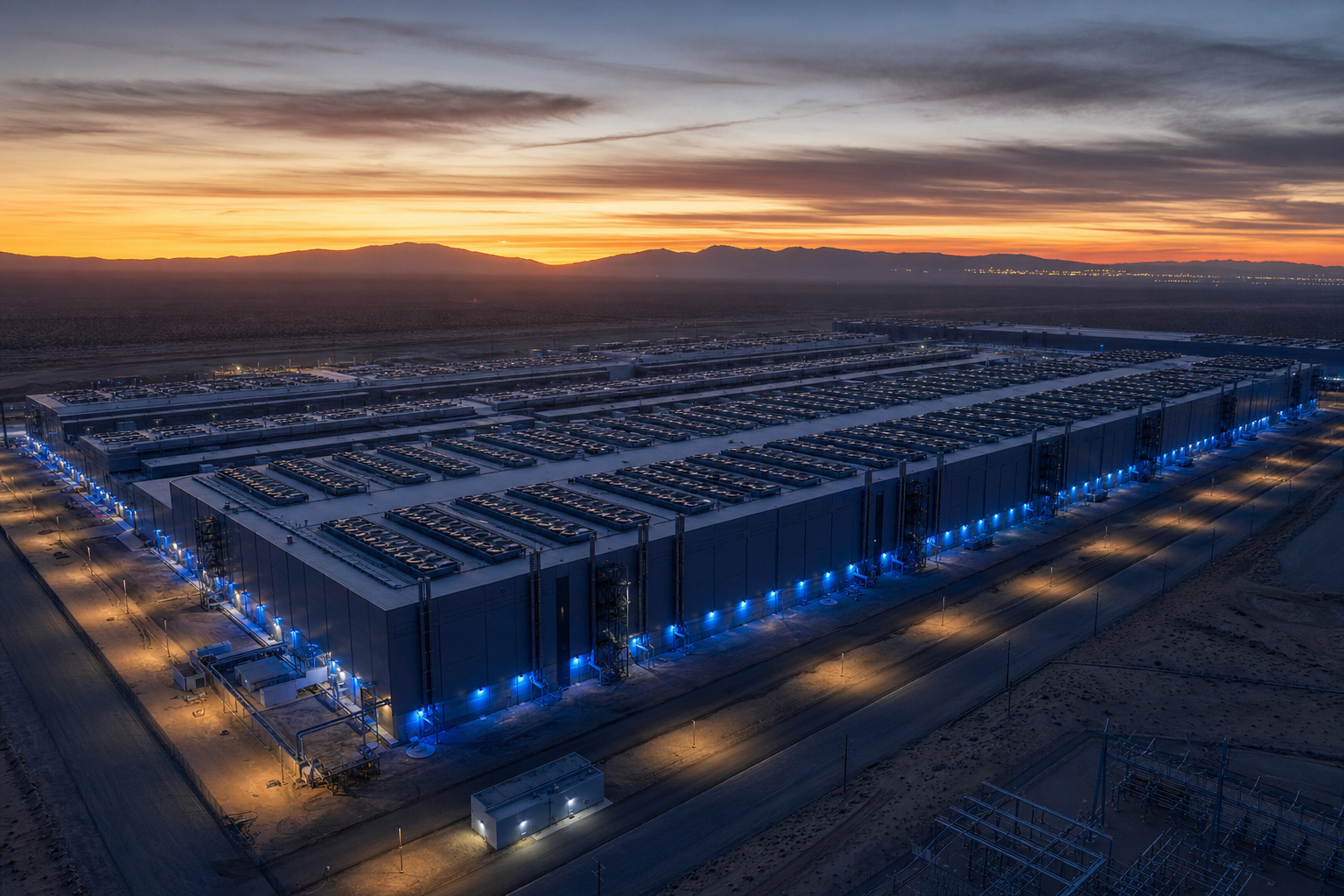
Morgan Stanley's projection landed quietly, but its implications are anything but. The firm estimates that Amazon (AMZN), Alphabet (GOOGL), Meta (META), Microsoft (MSFT), and Oracle (ORCL) will collectively spend approximately $805 billion on AI-related capital expenditures in 2026 alone. That figure — covering data centers, custom chips, and the computing infrastructure required to train and deploy large AI models — is not a multi-year total. It is a single-year run rate.
To put that in context: $805 billion is roughly the size of the Netherlands' entire GDP. It exceeds the annual defense budgets of every NATO member combined except the United States. And according to White House AI adviser David Sacks, AI investment could account for as much as 75% of U.S. GDP growth going forward — a claim that is aspirational and contested, but one that reflects how central this spending cycle has become to both corporate strategy and economic policy.
This week, that thesis stopped being abstract. It showed up in earnings reports, stock prices, and market capitalizations across three continents.
AMD Confirms What Bulls Needed to Hear
Advanced Micro Devices (AMD) reported first-quarter results that exceeded Wall Street estimates, and its shares surged to all-time highs. The earnings beat matters beyond AMD's own financials. For months, the AI chip trade has been synonymous with Nvidia (NVDA) — a single-vendor story that left investors wondering whether demand was concentrated or broad-based.
AMD's results answer that question. A second major chip supplier is capturing meaningful revenue from AI infrastructure buildout, which suggests enterprise and cloud customers are expanding compute capacity across multiple suppliers rather than concentrating purchases with one dominant player. That broadening of demand is structurally more durable than a single-vendor cycle.
Nvidia has not yet reported its own quarterly results, but AMD's performance is already shaping expectations. If demand is strong enough to lift AMD into record territory, the implied read-through for the market leader is constructive. Analysts will be watching Nvidia's report later this quarter as the next major confirmation — or complication — of that thesis.
Alphabet's $200 Billion Anchor
The most consequential single deal of this news cycle involves a company that is not publicly traded. Anthropic — the AI safety research firm backed by both Amazon and Google — reportedly plans to spend approximately $200 billion with Google Cloud over five years. Alphabet's stock climbed roughly 2% on the report and reached an all-time high.
The strategic logic cuts several ways at once. For Alphabet, the commitment transforms Google Cloud from a distant third in the cloud market into an indispensable infrastructure partner for one of the most closely watched AI labs in the world. For Anthropic, locking in cloud capacity at scale reflects a conviction that frontier AI development will require sustained, massive compute — not a speculative bet, but a production necessity.
There is also a competitive dimension. AI companies are becoming major customers of the very cloud platforms that compete to host their models. Anthropic's reported commitment to Google Cloud deepens a relationship that Amazon — which also backs Anthropic and hosts its models on AWS — will be watching carefully. The deal, if confirmed at that scale, represents a meaningful shift in the competitive topology of cloud infrastructure.
Separately, Google is moving to sell its Tensor Processing Units — custom chips designed specifically for AI workloads, known as TPUs — directly to enterprise customers. Previously used only internally, making TPUs commercially available introduces a new competitive variable for Nvidia, whose dominance in AI compute hardware has been the defining semiconductor story of the past three years. The impact will depend on pricing and performance at scale, but the direction of travel is clear: Google is no longer content to be only a cloud provider in the AI infrastructure stack.
Apple, Intel, and the Domestic Supply Chain Play
Not every AI infrastructure story this week involved software or cloud. Apple (AAPL) is in preliminary discussions with Intel (INTC) about using Intel's U.S.-based foundry facilities as a chip supplier, according to reports. No formal agreement has been announced, and the talks are described as early-stage.
The strategic motivation is straightforward. Apple has relied heavily on Taiwan's TSMC for its most advanced chips, creating a concentration of supply chain risk in a geography that carries significant geopolitical exposure. Adding a domestic U.S. supplier would reduce that exposure and align with broader policy pressure to onshore semiconductor manufacturing.
For Intel, the potential relationship carries outsized significance. The company's foundry ambitions — its effort to manufacture chips for outside customers and compete directly with TSMC and Samsung — have faced persistent investor skepticism. Landing Apple as a customer, even partially, would be among the most powerful validations Intel's foundry business could receive. The preliminary nature of the talks means investors should treat this as a signal of direction rather than a confirmed outcome, but the direction itself is notable.
Samsung's Trillion-Dollar Moment
The AI trade has now produced its second Asian trillion-dollar company. Samsung Electronics crossed $1 trillion in market capitalization, joining Taiwan's TSMC as the only Asian firms to reach that threshold. The milestone arrived on the same wave of AI optimism lifting U.S. chip and tech stocks.
Samsung's path to $1 trillion runs through memory. The company is a dominant supplier of DRAM and NAND flash memory — the components that fill AI servers and enable the rapid data access that large model inference requires. As hyperscalers expand their data center footprints, memory demand scales with them. Rising orders from Amazon, Google, and Microsoft have materially improved Samsung's revenue outlook.
The global reach of this rally is itself a signal. When the AI infrastructure buildout lifts a Korean memory manufacturer to a trillion-dollar valuation, it is no longer a story about a handful of U.S. technology companies. It is a structural shift in how capital is being allocated across the global economy.
The Market's Tolerance Test
Not every data point this week was clean. Amazon's free cash flow — the cash generated after capital expenditures — collapsed from $26 billion to $1.2 billion. Under normal circumstances, a decline of that magnitude would trigger a serious investor reaction. Instead, markets shrugged.
The muted response reveals something important about the current moment: investors are extending significant tolerance to near-term cash burn if it is attributed to AI infrastructure investment. The implicit assumption is that data centers and compute capacity being built today will generate returns over a multi-year horizon that justify the current compression.
That assumption is not irrational — it mirrors the logic that proved correct during the buildout of cloud infrastructure in the 2010s. But it is an assumption, and it carries risk. The market's willingness to look through near-term cost pressure depends on continued confidence that AI spending will translate into proportional revenue growth. U.S. Bank Wealth Management's Bill Northey has flagged what he describes as a K-shaped backdrop — where gains are concentrated among higher-income and asset-owning households while lower-income consumers face mounting pressure. That divergence is not yet disrupting the technology-heavy rally, but it represents a fault line beneath the surface.
What to Watch Next
Nvidia's earnings report later this quarter is the clearest near-term test of whether this week's signals hold. AMD's beat sets a high bar for demand confirmation, and any softness in Nvidia's data center revenue would complicate the narrative that AI chip demand is as robust as current valuations imply.
The Anthropic-Google Cloud deal also warrants continued scrutiny. The $200 billion figure is striking, but the deal has not been formally confirmed at that scale. If reporting firms up the details — or if Amazon responds with a competing commitment to keep Anthropic's workloads on AWS — the competitive dynamics in cloud infrastructure could shift quickly.
Apple's foundry discussions with Intel are a slower-moving story, but one with long-term supply chain implications that extend well beyond either company. And Samsung's trillion-dollar crossing is a useful benchmark: if memory demand softens as AI model architectures evolve, that valuation will face pressure.
For now, the weight of evidence points in one direction. The $805 billion projection is not a forecast that markets are betting against. It is a projection that markets are pricing in — and the earnings results arriving this week suggest the underlying demand is real enough to justify that confidence, at least for another quarter.