SpaceX Enters the Nasdaq-100: What It Means for Passive Investors
With three Wall Street giants initiating buy coverage and index inclusion forcing passive buying, SpaceX's market debut reshapes the Nasdaq-100's risk and opportunity profile.
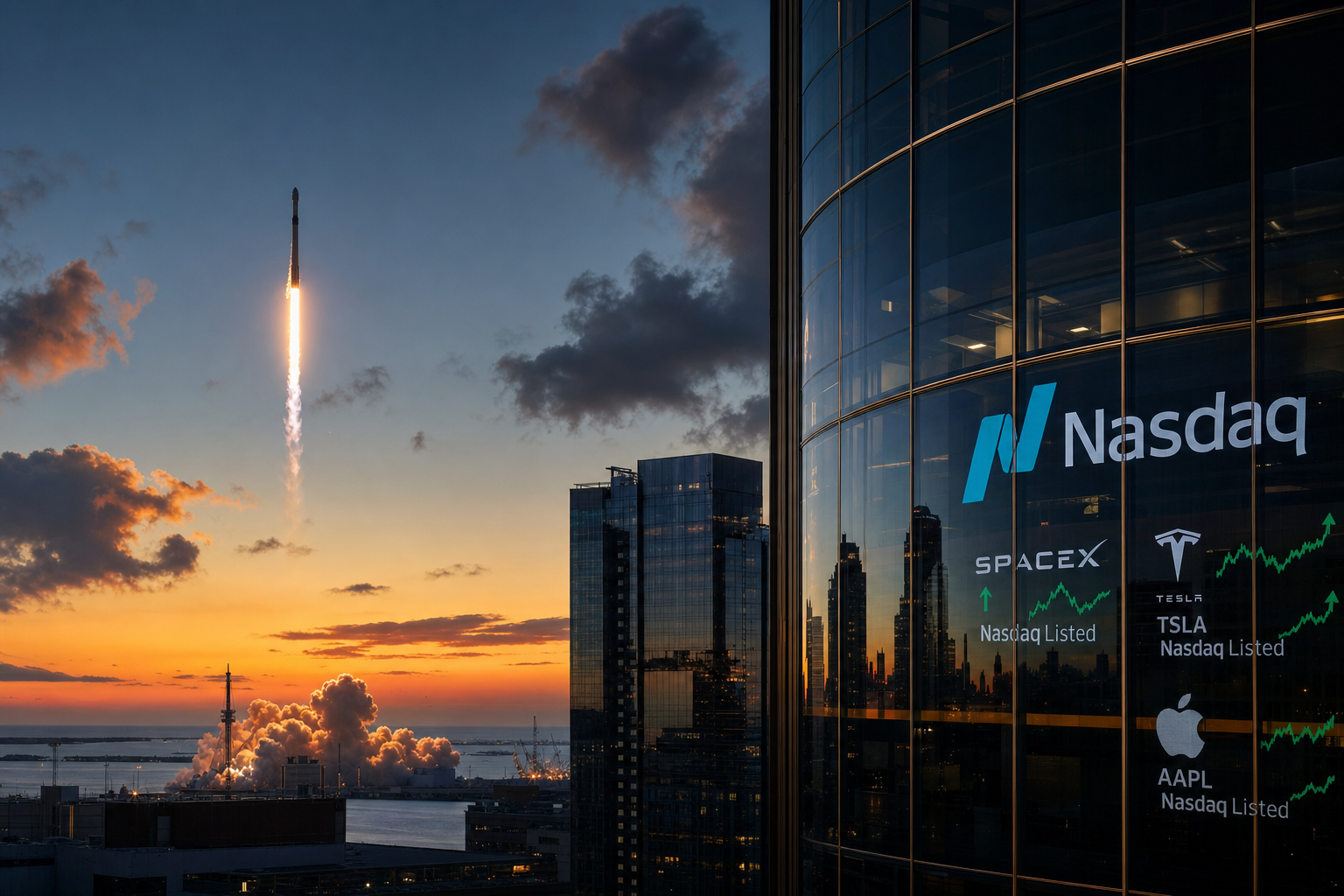
A Landmark Moment for Private-to-Public Capital Markets
SpaceX's addition to the Nasdaq-100 index marks one of the most consequential index inclusion events in recent memory — not merely because of the company's scale, but because of what it signals about the evolving boundary between private and public markets. For professional investors, the implications span passive fund mechanics, sector concentration risk, and a re-rating catalyst for adjacent equities, most notably Tesla (TSLA).
Forced Buying With a Float Constraint
The mechanics of index inclusion are straightforward: every fund tracking the Nasdaq-100 — from retail-facing ETFs like QQQ to institutional index mandates — must now hold SpaceX proportional to its index weight. However, the critical nuance here is that SpaceX's initial weighting will be constrained by its limited public float. A thin float means even modest passive inflows can exert outsized upward pressure on price, creating a technical supply-demand imbalance that active traders will look to exploit.
This float-driven dynamic is not unprecedented. When similarly thinly traded names have entered major indices, the period immediately following reconstitution has historically produced elevated volatility and price discovery challenges. Investors should expect SpaceX's effective weight to expand gradually as secondary offerings or insider sales broaden the float over time — a process that could take quarters, not weeks.
Wall Street Initiates with Conviction
The coordinated initiation of coverage by Morgan Stanley, Goldman Sachs, and Wells Fargo — all with buy ratings — lends institutional credibility to SpaceX's public market valuation. Their collective thesis centers on three long-duration growth vectors: AI infrastructure (Starlink's data transmission capabilities), space commercialization (launch services, satellite constellations), and global communications (broadband connectivity in underserved markets).
Morgan Stanley in particular has long been a SpaceX bull, and its formal initiation now provides a published price target framework that institutional allocators can reference. The alignment of three bulge-bracket firms at launch suggests that sell-side consensus will form quickly, reducing the uncertainty premium that typically accompanies newly public names.
The Tesla-SpaceX Merger Thesis Re-Emerges
RBC Capital's decision to raise its Tesla price target to $500 — explicitly citing a potential Tesla-SpaceX merger scenario — injects a speculative but non-trivial variable into the analysis. RBC's updated model appears to assign probability-weighted value to a combination that would unite Tesla's energy and autonomous vehicle platforms with SpaceX's satellite and propulsion assets under Elon Musk's consolidated leadership.
While a formal merger remains speculative, the market is beginning to price in strategic optionality around Musk's interlocking empire. Investors long Tesla should monitor SpaceX's public market performance closely — a sustained premium valuation for SpaceX strengthens the theoretical rationale for combination, while also raising the complexity and regulatory scrutiny such a deal would invite.
Portfolio Implications
For passive investors, SpaceX's inclusion is largely automatic — but active managers face a more nuanced decision. The float constraint limits near-term liquidity, making large position sizing difficult. The buy-side consensus is bullish, but valuation discipline is essential given that SpaceX's revenue mix (government contracts, commercial launch, Starlink subscriptions) carries different margin profiles and risk characteristics than the software-heavy Nasdaq-100 incumbents.
Key considerations for portfolio positioning:
- QQQ and Nasdaq-100 trackers will see marginal but real exposure to aerospace and satellite risk — a sector historically absent from the index
- Tesla's re-rating as a SpaceX proxy may create a more volatile correlation structure between the two names
- Sector concentration in Musk-affiliated entities within major indices warrants governance scrutiny from institutional investors with ESG or concentration mandates
Forward Outlook
SpaceX's Nasdaq-100 entry is less a conclusion than a beginning. As the float expands, analyst coverage deepens, and quarterly disclosures establish a financial track record, the market will progressively refine its valuation framework. The next 12-18 months will be critical in determining whether SpaceX trades as a growth compounder on par with the index's top-tier software names, or whether its capital-intensive, government-dependent business model warrants a structural discount. Either way, the conversation has permanently changed.