Semiconductor Selloff Dominates Wednesday as Wall Street Raises S&P Targets
A $900 billion wipeout in Korean chip stocks and a 3% Nasdaq drop collided with bullish S&P 500 upgrades and a hawkish Fed call, leaving investors to reconcile sharply conflicting signals.
The Session
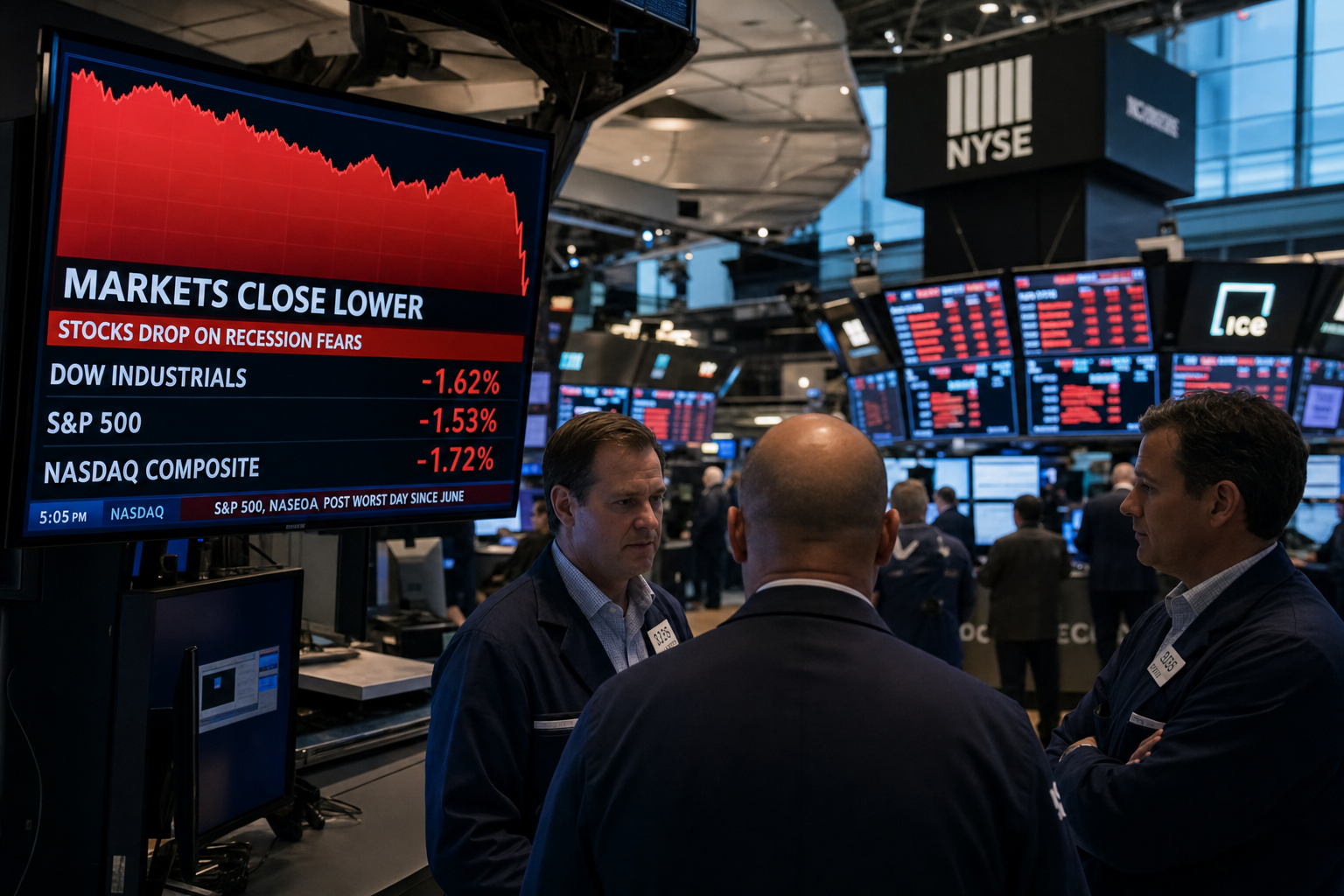
Wednesday's market session was defined by a collision of narratives that rarely arrive simultaneously: a historic semiconductor selloff, a wave of bullish equity upgrades from major banks, and a hawkish Federal Reserve forecast that complicates both. The Nasdaq dropped roughly 3%, its sharpest single-session decline in recent weeks, as chip stocks cratered across multiple geographies and market caps.
The headline number from Korea was staggering. SK Hynix and Samsung Electronics saw their combined market capitalization shrink by more than $900 billion in a single session — one of the steepest equity wipeouts on record for the Korean chip sector. The damage was not contained to Asia. In the U.S., Micron (MU), Intel (INTC), and Advanced Micro Devices (AMD) all tumbled in tandem, dragging the broader tech index with them.
The breadth of the decline — spanning memory, logic, and foundry names across two continents — made it difficult to attribute to routine profit-taking. The more uncomfortable read is that investors are reassessing whether AI-driven chip demand can sustain the valuations built up over the past two years. The Magnificent Seven cohort, alongside Broadcom (AVGO) and Oracle, has shed approximately $2.7 trillion in market capitalization in June alone.
Winners and Losers
The semiconductor sector had no meaningful winners on Wednesday. The selloff was broad enough to implicate memory names (MU), legacy logic producers (INTC), and advanced compute designers (AMD) simultaneously — a configuration that suggests macro concern rather than company-specific news.
Yet even within the wreckage, the competitive landscape shifted. Qualcomm (QCOM) confirmed that Microsoft (MSFT) and Meta Platforms (META) will deploy its new AI chips, a significant commercial validation for a company pushing beyond its smartphone roots. Broadcom, meanwhile, unveiled a custom chip designed specifically for OpenAI's future AI models — a direct play on the hyperscaler trend of building proprietary silicon to reduce dependence on any single supplier.
Taken together, those announcements signal that Nvidia (NVDA) faces a more fragmented competitive environment than its current market position implies. Custom silicon and merchant alternatives are gaining traction among the largest technology buyers, even as Nvidia's near-term dominance remains intact.
Tesla (TSLA) added to the session's bearish tone, falling 5.8% on the week as global electric vehicle price competition and the broader tech compression weighed on the stock. Shares were trading near $381.61, with at least one analyst citing $190 as a potential technical support level — a scenario that would represent roughly a 50% decline from current prices, though it is not a consensus view. The decline also stripped Elon Musk of his trillionaire status, with losses in both Tesla and SpaceX shares eroding his holdings below the $1 trillion threshold. SpaceX separately raised $25 billion in debt, a sign that credit markets remain open to the company even as equity investors have grown more cautious.
Under the Surface
The macro backdrop made the session's mixed signals harder to parse. JPMorgan (JPM) raised its year-end S&P 500 target to 7,800, citing stronger-than-expected corporate earnings growth and the prospect of a peace deal ending the Iran war as tailwinds. BCA Research also moved its outlook higher. Both firms argued that the index is earning its gains through fundamental profit growth rather than multiple expansion — a distinction that matters when rates are elevated and valuations are already stretched.
JPMorgan's upgrade came with an explicit caveat, however: the bank warned that conditions remain ripe for a flash crash, a sudden, severe market drop driven by automated selling or a liquidity gap. The dual message — raise the target, flag the tail risk — captures the uncomfortable position Wall Street strategists occupy right now.
Bank of America added a harder edge to the macro picture. Its economists forecast three Federal Reserve rate hikes this year, attributing the call to Fed Chair Kevin Warsh's hawkish policy posture and the continued resilience of the U.S. economy. Three hikes would put meaningful upward pressure on Treasury yields and compress equity valuations, particularly for growth stocks whose future earnings are discounted more heavily at higher rates. The BofA call stands in direct tension with the bullish S&P targets issued the same day — a contradiction the market has not yet resolved.
Meta's session was complicated by two distinct storylines. On the chip competition front, the company was named as a customer for Qualcomm's new AI processors. Separately, Meta made a $900 million strategic investment in CRED, a prominent Indian fintech startup, and appointed CRED's founder Kunal Shah to lead WhatsApp globally. The dual move points to an accelerating push to monetize WhatsApp's massive user base through digital payments, particularly in India — one of the world's largest and fastest-growing mobile payments markets. The deal's structure is notable: rather than an acquisition, it pairs a capital investment with a leadership appointment, keeping CRED independent while aligning Shah's incentives with WhatsApp's growth.
Tomorrow's Setup
The immediate catalyst is Micron's earnings report, which was due after Wednesday's close. The results carry unusual weight: as one of the most direct beneficiaries of AI data-center buildout, Micron's forward guidance on memory chip demand will function as a real-time stress test for the AI trade. A beat with strong guidance could provide a floor for the battered chip sector. A miss or cautious outlook risks deepening the slide.
Beyond Micron, the Bank of America rate-hike forecast puts upcoming economic data — particularly inflation prints — under sharper scrutiny. Any Fed communications that either confirm or push back on the three-hike thesis will move bond markets and likely ripple into equity valuations for rate-sensitive sectors.
The JPMorgan target raise to 7,800 gives bulls a narrative anchor, but Wednesday's session illustrated how quickly that anchor can drag when the sector driving the index decides to reprice. The chip trade, the Fed path, and Micron's numbers are now all pulling in different directions — and the resolution of that tension will shape the market's direction into the back half of June.