Oil at $100 and Micron at $1 Trillion Pull Markets in Opposite Directions
A geopolitical oil shock and an AI-driven semiconductor milestone are testing whether the equity rally can hold against a deteriorating macro backdrop.
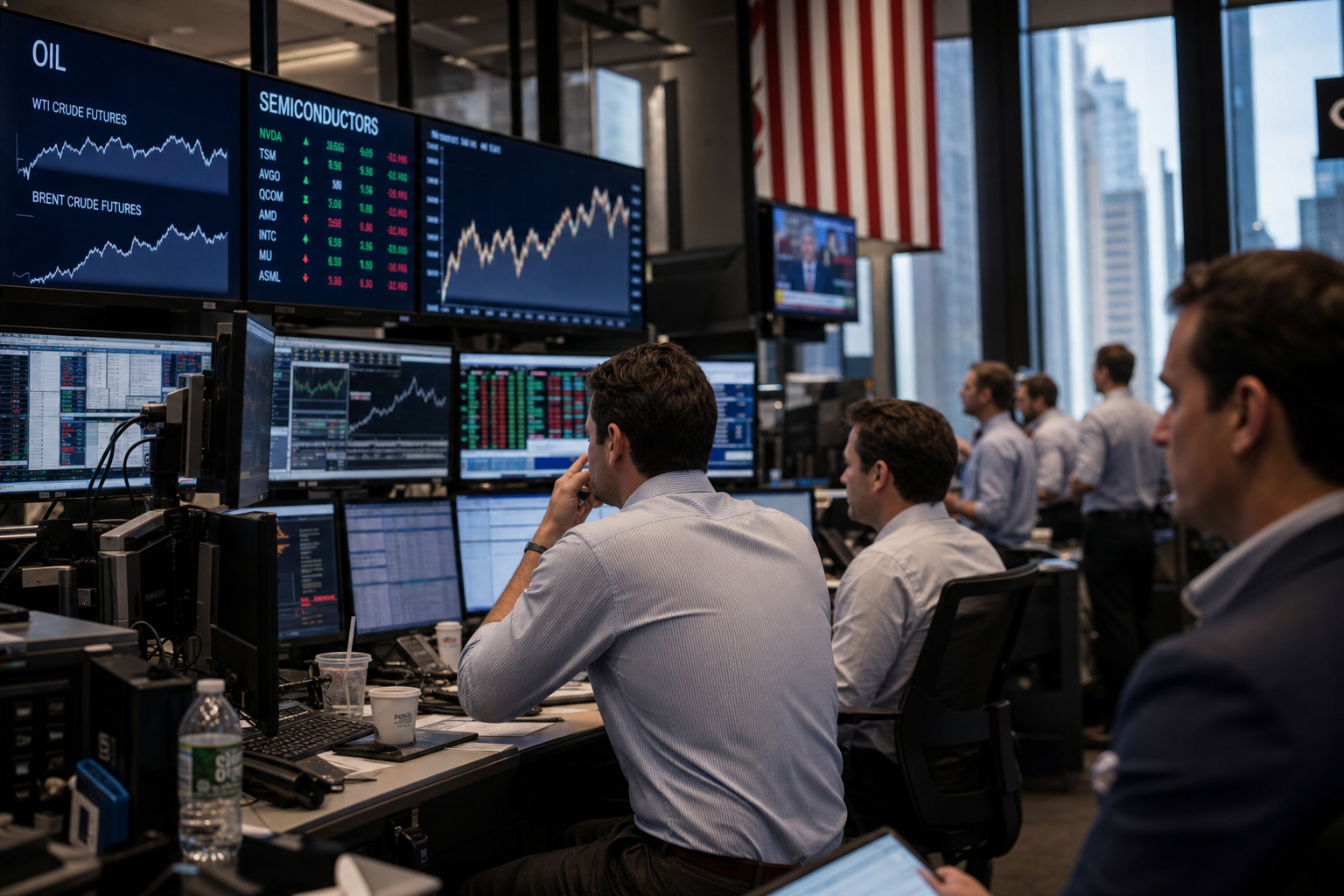
The morning in two numbers: $100 and $1 trillion
Tuesday's session opened with two figures that would have seemed unlikely in tandem just weeks ago. Crude oil touched $100 a barrel — a level not seen in years — following U.S. military strikes on Iranian missile sites. At almost the same moment, Micron Technology (MU) was crossing a $1 trillion market capitalization for the first time, powered by an 18% single-session surge. The two moves tell opposite stories about where the economy is heading, and markets are struggling to reconcile them.
The oil print arrived with force. Brent crude futures were already elevated when news of the Iran strikes broke, with prices rising to $98.39 before touching $100. Analysts quoted in early coverage warned the energy market may be past a structural turning point — language suggesting this is not a spike that diplomatic back-channels or OPEC production tweaks can easily reverse. Geopolitical risk premiums, once embedded in commodity pricing, tend to be sticky.
The AI trade produces another milestone
Micron's ascent to the trillion-dollar club is the morning's most concrete equity event. Shares rose as much as 18%, driven by what analysts describe as a tightening global supply of high-bandwidth memory — the type of chip that AI data centers consume in enormous quantities. UBS provided the most dramatic catalyst, raising its price target on MU from $535 to $1,625, the most bullish call on Wall Street. Shares were trading around $843 at the time of the report, implying the bank sees roughly double the current price as a plausible destination.
The milestone puts Micron alongside Nvidia and Apple in the trillion-dollar cohort, and the breadth of Tuesday's chip rally extended beyond MU. Intel (INTC) also gained in sympathy, a sign that investors are treating the memory shortage thesis as a sector-wide tailwind rather than a Micron-specific story. The AI infrastructure trade — which began with software names and moved into GPU manufacturers — is now visibly reshaping the memory segment of the semiconductor supply chain.
The macro headwind neither story can ignore
Beneath both headlines, the bond market is issuing a warning that neither energy bulls nor chip enthusiasts can dismiss. U.S. Treasury yields have been climbing sharply through the session. When yields rise, they raise the cost of borrowing across the economy and mechanically reduce what investors are willing to pay for future earnings — a relationship that hits high-multiple growth stocks hardest.
The concern is compounding. Oil at $100 feeds directly into consumer price inflation, and if that feeds through to the Federal Reserve's rate calculus, the central bank may feel pressure to keep rates higher for longer than equity markets had priced. That scenario — persistent energy-driven inflation meeting an unaccommodative Fed — is precisely the environment in which elevated equity valuations face the most pressure. The bond market appears to be pricing some probability of that outcome.
The session is therefore running two parallel narratives: a genuine AI-driven earnings story in semiconductors, and a macro deterioration story in energy and rates. Which one dominates the close will depend in part on whether the Iran situation produces any further escalation headlines.
Corporate dealmaking adds a third current
Two significant transactions crossed the tape this morning, neither of which is directly connected to the macro shock but both of which reflect the corporate confidence — or at least the balance-sheet capacity — that still characterizes large-cap America.
Uber Technologies (UBER) submitted an $11.6 billion offer for Delivery Hero, the European food-delivery platform, at 33 euros per share. Delivery Hero confirmed the approach publicly. The bid would expand Uber's delivery footprint into European and emerging markets where it currently has limited presence, sharpening its rivalry with DoorDash on a global scale. Regulatory scrutiny from EU competition authorities is the primary execution risk.
Eli Lilly (LLY) announced it will acquire three vaccine-focused biotechnology companies in separate all-cash deals valued at up to $3.83 billion in total — its tenth acquisition of 2026. The move signals a deliberate diversification beyond Lilly's GLP-1 obesity and diabetes franchise, deploying the cash flows from Mounjaro and Zepbound into a therapeutic area with different risk and revenue characteristics. The names of the three targets were not disclosed in available reporting.
Afternoon setup: three things to watch
The afternoon session will be shaped by whether any new developments emerge from the Middle East. A further escalation in Iran — or, conversely, any signal of de-escalation — could move oil sharply in either direction from the $100 level, and the equity market's reaction would follow.
Treasury yields deserve as much attention as any individual stock. If yields continue to climb through the afternoon, the tension between the chip-stock rally and the macro backdrop will intensify. The question is whether MU's 18% gain can hold in the face of a rising discount rate environment, or whether profit-taking accelerates into the close.
Fed commentary is a wildcard. No scheduled Fed speakers have been confirmed for Tuesday afternoon in the available reporting, but any remarks touching on energy-driven inflation or the pace of rate normalization could move both bonds and equities quickly. The look-ahead from this morning's brief specifically flagged Federal Reserve commentary as a potential catalyst — that flag has not been cleared.
The session opened with two historic numbers. Whether it closes with both intact is the question the afternoon will answer.