Microsoft's $570 Billion Rout and Fed Fears Dominate a Fractured Monday Session
A hawkish Fed signal from Philadelphia's Patrick Harker collided with Microsoft's worst monthly decline since 2000, even as Alphabet's record equity raise and Micron's blowout quarter offered a counternarrative.
Morning Recap: The Bear Case Arrived Early
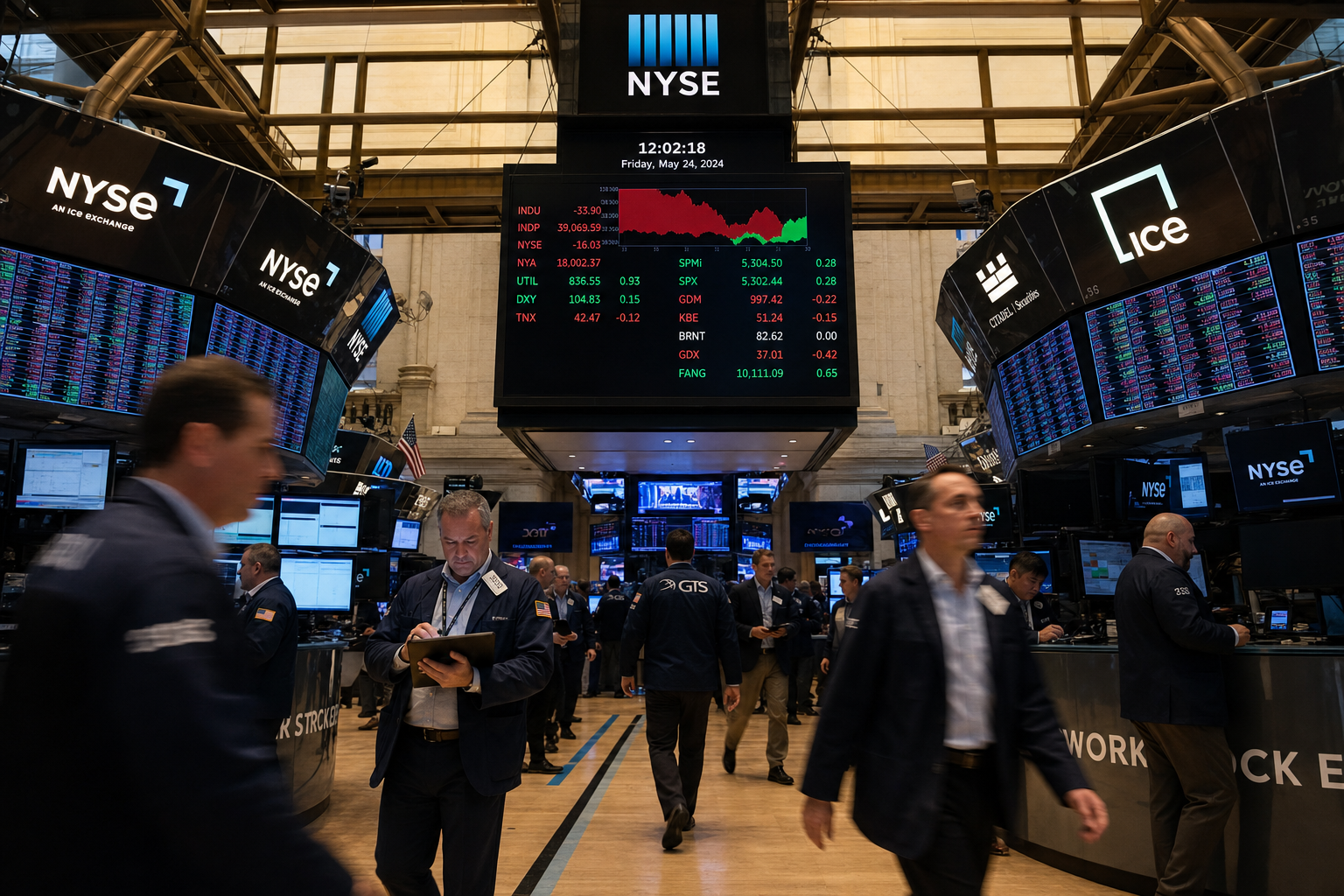
Monday's session opened on the defensive and largely stayed there. Federal Reserve Philadelphia President Patrick Harker set the tone before the open, signaling that a rate hike remains on the table and citing a balanced labor market as his rationale. That was not what equity markets had priced in — consensus through much of the first half of 2026 had leaned toward the Fed holding steady or beginning to cut. Harker's comments forced a rapid reassessment.
The mechanism is straightforward: higher rates raise the discount rate applied to future corporate earnings, compressing valuations most severely for long-duration growth stocks. Technology names, which had led the market higher on AI optimism, bore the brunt. The S&P 500, Dow Jones Industrial Average, and Nasdaq Composite all traded lower through the morning session, with no meaningful bounce materializing as the hours passed.
Bank of America added to the cautious backdrop, warning separately that the S&P 500 could face a significant near-term correction. The bank stopped short of specifying a precise trigger or timeline, but the warning landed on a day already short on bullish catalysts for the broad index.
The Microsoft Problem Deepens
If the Fed was the macro headwind, MSFT was the single-stock story that crystallized the session's anxiety. Microsoft has now shed approximately $570 billion in market capitalization this month — a monthly decline not seen since the dot-com collapse of 2000.
Two forces are driving the selloff. A Chinese state-sponsored hacking campaign targeting Microsoft software has raised pointed questions about the company's security posture and the stickiness of its enterprise relationships. At the same time, investors are growing skeptical that Microsoft's heavy AI investment is translating into measurable revenue acceleration. The combination has unwound a significant portion of the goodwill Microsoft accumulated as a perceived primary beneficiary of the AI infrastructure buildout.
The timing is particularly uncomfortable. Rate-hike fears hit growth stocks hardest, and Microsoft — trading at a premium multiple anchored to AI growth expectations — sits squarely in that crosshairs. The stock's trajectory this month has become a referendum on whether the AI trade was priced to perfection.
Alphabet's Historic Counter-Move
Against that bearish backdrop, GOOGL managed to be the session's most consequential corporate story — and for entirely different reasons.
Alphabet priced an $84.75 billion equity offering, the largest in U.S. corporate history. The transaction is part of a broader surge in share issuance: U.S. equity offerings have reached a record $251 billion at the midyear mark, with Alphabet and SpaceX among the headline deals. The scale of the raise is a signal that institutional appetite for large-cap technology paper remains intact even as sentiment turns cautious.
Separately, Alphabet made its debut in the Dow Jones Industrial Average, replacing VZ (Verizon Communications). The Dow is a price-weighted index of 30 large U.S. companies, and the swap tilts the benchmark further toward technology. Alphabet shares rose on the dual news, a notable divergence from the broader market's direction. The contrast with Microsoft — two mega-cap technology companies moving in opposite directions on the same day — underscored how company-specific catalysts are increasingly cutting through macro noise.
Micron's Blowout and the AI Infrastructure Signal
The day's clearest earnings signal came from MU. Micron Technology reported a record fiscal third quarter, with revenue up approximately four times compared to the same period a year earlier and earnings per share rising roughly 15-fold over the same stretch. The results reflect intense demand for memory chips used in AI servers and data centers, where NVDA and AMD are among Micron's primary customers.
The print matters beyond Micron itself. It reinforces the view that AI infrastructure spending — the buildout of data centers and the hardware that powers them — remains robust even as some AI-adjacent stocks face valuation pressure. Micron's long-term supply contracts, which lock in pricing and volume commitments with major customers, were highlighted by analysts as evidence of sustained demand visibility rather than a single-cycle spike.
AAPL surfaced as an indirect data point: Apple flagged its reliance on third-party component suppliers, including memory providers, as a supply-chain risk in its own disclosures. That detail is a reminder that Micron's pricing power has real downstream implications for device makers.
Rocket Lab's $8 Billion Satellite Bet
The afternoon's M&A headline came from the space economy. RKLB (Rocket Lab) announced a definitive agreement to acquire IRDM (Iridium Communications) in a transaction valued at approximately $8 billion. The deal combines Rocket Lab's launch and spacecraft manufacturing capabilities with Iridium's established global satellite communications network.
Rocket Lab shares surged 12% on the announcement. Related names AST SpaceMobile and Planet Labs each gained around 10%, reflecting investor enthusiasm for consolidation in a sector where scale and vertical integration are becoming competitive necessities. The acquisition is one of the more consequential deals in the commercial space sector and signals that the satellite economy is entering a consolidation phase.
On the energy side, Williams Companies was separately reported to be in late-stage talks to acquire Momentum Midstream for approximately $5.5 billion, a deal that would expand its reach in liquefied natural gas infrastructure.
Afternoon Setup: Tesla and the Fed
Two threads will shape the remainder of the day and the setup into Tuesday. Tesla's second-quarter delivery figures are due imminently. Morgan Stanley raised its forecast to 413,000 units, citing stronger demand in Europe and China. Deliveries are a leading indicator for Tesla's revenue trajectory and will be closely parsed for signs of demand recovery in two markets where the company has faced headwinds.
On the macro side, any further Fed commentary will be watched for confirmation or softening of Harker's rate-hike signal. The market's rate path assumptions shifted meaningfully this morning, and any clarification — from Harker or other Fed officials — could move Treasuries and, by extension, equity valuations in either direction.
The session's internal structure tells a specific story: capital markets are open and active at record volume, AI infrastructure demand is real and measurable in Micron's numbers, and Alphabet is attracting institutional capital at historic scale. But the macro ceiling — a Fed that may not be done tightening — and the Microsoft-specific damage are keeping the broad indices under pressure. The two narratives are running in parallel, and neither has resolved.