Micron's 18% Surge Reshapes the AI Trade as Oil Quietly Retreats
A blowout Micron quarter confirmed AI hardware demand is real and accelerating — but the session's most telling signal may be what fell while chips soared.
How the Morning Played Out
The setup was already clear before the open: Micron Technology (MU) had reported fiscal third-quarter results overnight that obliterated Wall Street estimates, and the stock was indicated up roughly 18% in premarket trading. The question heading into Thursday's session was whether the move would hold — and whether it would pull the broader market with it.
It did both. By midday, Nasdaq futures had climbed sharply, European chip stocks had extended their own gains, and MU had crossed a symbolic threshold: its market capitalization surpassed both Meta Platforms (META) and Tesla (TSLA) for the first time. A memory-chip maker — a business long dismissed as cyclical and commoditized — now sits above two of the most prominent consumer-technology franchises in the world by market value.
That reshuffling alone tells you something about where institutional capital is flowing in mid-2026.
The Micron Story in Detail
The earnings print was not a modest beat. Revenue for the fiscal third quarter came in at $41.46 billion, up from $9.3 billion in the same period a year earlier — a more than fourfold increase. Micron also raised forward guidance, citing sustained customer commitments and what analysts described as genuine supply constraints in the high-bandwidth memory market.
High-bandwidth memory is the specialized chip architecture that sits closest to AI processors in a data center, feeding them data fast enough to keep up with the compute. Micron is one of a small number of companies that makes it. When Micron says demand is strong and supply is tight, the implication for pricing power is direct.
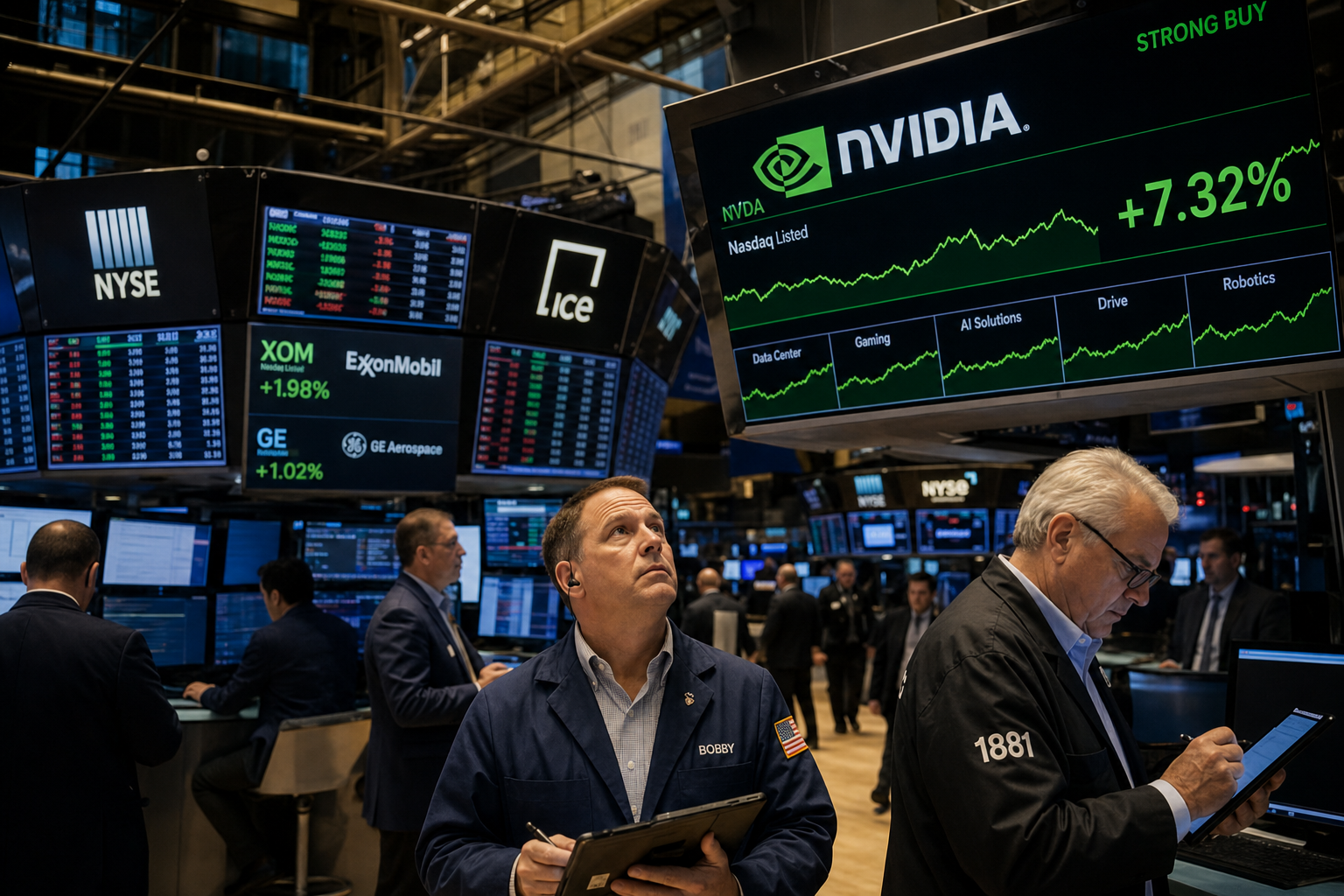
Nvidia (NVDA) and Qualcomm (QCOM) also moved higher on the session, pulled along by the read-through from MU's results. The logic is straightforward: if memory demand is this robust, the AI infrastructure buildout that drives it is not slowing.
The M&A Signal From Healthcare
Away from semiconductors, the session's second-largest story arrived from an unexpected corner: Germany's Merck KGaA agreed to acquire Bio-Techne Corporation (TECH) for $11.3 billion, a 24% premium to Bio-Techne's pre-announcement price. TECH was the top-performing stock in the S&P 500 on the day.
Merck KGaA — the German science and technology group, distinct from U.S.-listed MRK — is buying a company that supplies proteins, antibodies, and analytical tools used in drug development. These are upstream research inputs: the reagents and instruments that sit at the beginning of the drug-discovery pipeline, before a molecule ever enters a clinical trial.
The 24% premium signals that Merck KGaA views Bio-Techne's product portfolio as difficult to replicate — and that it was willing to compete aggressively for the asset. The deal continues a pattern of cross-border acquisitions in life-science tools, where strategic buyers have consistently paid up for companies with specialized, defensible niches.
What Fell While Equities Surged
Here is where Thursday's session gets analytically interesting. Crude oil declined to levels not seen since before U.S. military strikes on Iran, according to market reports — meaning the geopolitical risk premium that had been embedded in energy prices has now largely unwound. Precious metals also dropped, even as equities rallied sharply.
This is not a standard risk-on move. In a conventional risk-on session, commodities — especially oil — tend to rise alongside equities, reflecting expectations of stronger economic growth and demand. Thursday's split suggests something more specific: markets are responding to an earnings catalyst, not a macro re-rating. The AI trade is driving the equity move; it is not being accompanied by a broad upgrade in global growth expectations.
For energy investors, the oil slide carries its own message. Chevron (CVX) finalized a natural gas supply agreement with Microsoft for AI data centers during the session — a deal that reframes natural gas as infrastructure input rather than pure commodity. But that deal does not offset the broader pressure on crude, and energy-sector earnings expectations for the second half of 2026 may need to be revised if prices stay at current levels.
IBM and the Longer Semiconductor Race
One story that deserves more attention than it received: IBM announced chip-manufacturing technology capable of producing transistors smaller than one nanometer. Today's most advanced commercial chips are manufactured at two to three nanometers. Pushing below one nanometer — if achievable at production scale — would represent a significant advance in processing density and energy efficiency, both critical for AI workloads.
IBM has historically used such announcements to signal roadmap direction rather than near-term production capability, and no commercial timeline was disclosed. But the announcement places IBM alongside TSMC and Intel in the conversation about next-generation semiconductor architecture, and it adds a forward-looking dimension to a session already dominated by AI hardware themes.
The Afternoon Setup
Three things are worth watching through the close and into Friday.
First, whether MU's gains hold. An 18% move on earnings is substantial, and profit-taking pressure typically builds as the session matures. If the stock closes near its highs, it signals genuine conviction in the AI hardware thesis. If it fades, the morning move may have been partly short-covering.
Second, oil. Crude has now retraced to pre-Iran-strike levels, which raises the question of whether the geopolitical premium has fully unwound or whether further downside is possible. A continued slide would weigh on energy-sector names and could eventually create a drag on broader index earnings estimates.
Third, end-of-quarter dynamics. Thursday is June 25, with the quarter closing next week. Portfolio rebalancing flows — where institutional managers sell outperformers and buy laggards to realign with target weights — can create counterintuitive price action in the final days of a quarter. After a strong run in semiconductor names, some rebalancing pressure on the sector is plausible heading into Friday.