Magnificent Seven's $2.3 Trillion June Wipeout Reshapes the Market's Center of Gravity
As megacap AI names bleed out, semiconductors quietly claim a record fifth of the S&P 500 — and the Dow just hit 52,000 for the first time.
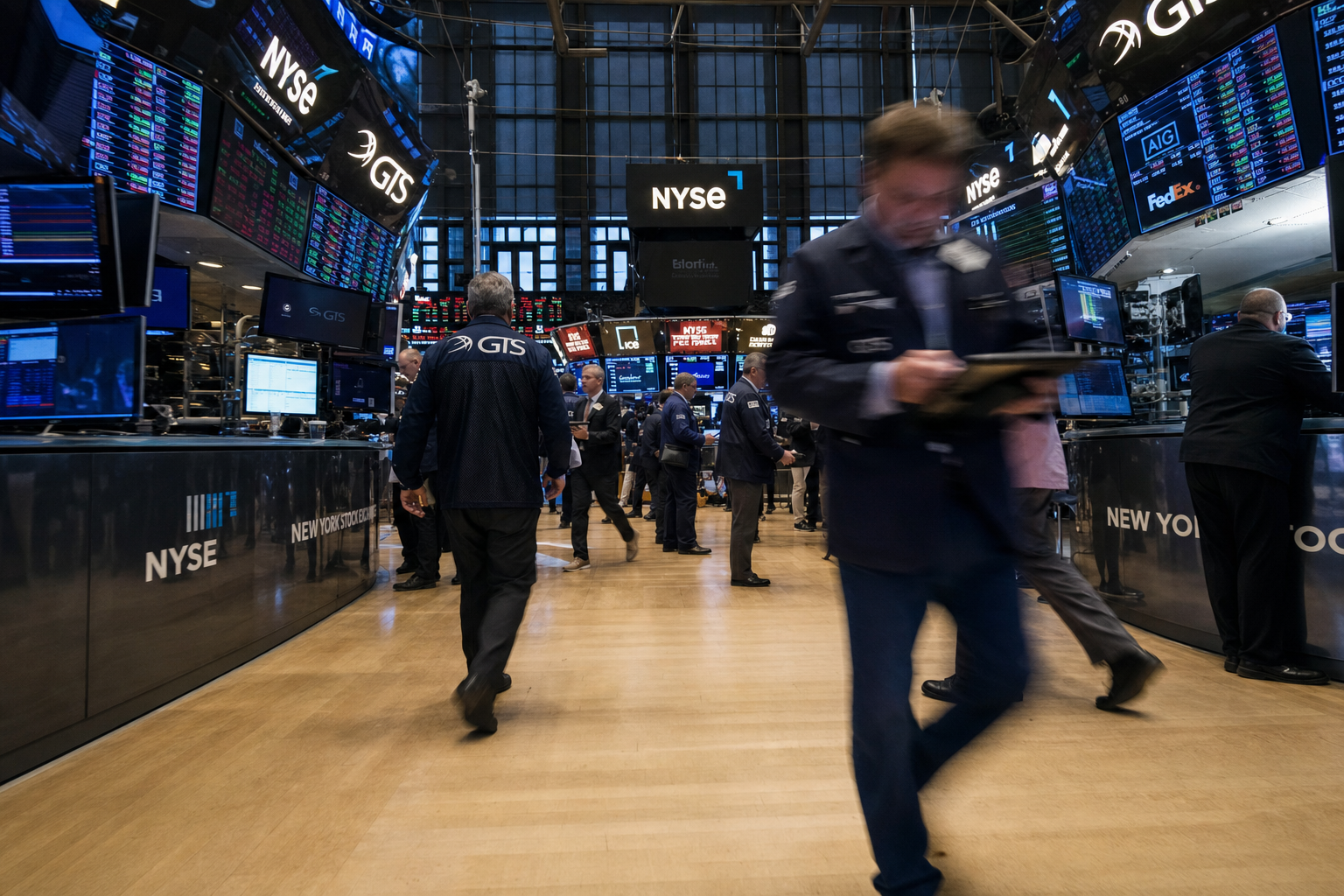
The Morning That Confirmed the Rotation
By midday Tuesday, the final session of June had done what the whole month had been threatening: it made the split in U.S. equity markets impossible to ignore. The Dow Jones Industrial Average closed above 52,000 for the first time, printing 52,182.74. The Nasdaq, weighted toward the growth names driving this month's losses, told a different story. Both readings are correct. They just describe different markets.
The headline number is $2.3 trillion. That is the combined market value erased from the Magnificent Seven — Microsoft (MSFT), Alphabet (GOOGL), Amazon (AMZN), Meta (META), and peers — across June. It is not a crash in the traditional sense. There is no single catalyst, no earnings disaster, no regulatory shock. What there is, instead, is a sustained and broadening skepticism about whether the enormous sums being committed to AI infrastructure will generate returns commensurate with the investment.
MSFT has fallen roughly 27% year to date, the steepest decline among the group's most closely watched names. Some analysts have begun framing it as a value opportunity at current levels. That view is contested, and the stock's continued slide through June suggests the market has not yet reached consensus.
The AI Spending Question That Won't Go Away
The rotation's underlying logic is straightforward, even if its endpoint is not. For two years, markets rewarded companies that announced large AI infrastructure commitments — data centers, chips, model development — on the assumption that first-mover scale would translate into durable competitive advantage and, eventually, earnings growth. That assumption is now being stress-tested.
The scrutiny is not about whether AI is real or useful. It is about timing and magnitude. Capital expenditure cycles in technology have historically run ahead of monetization, sometimes by years. Investors who were willing to wait in 2023 and 2024 are recalibrating their patience in mid-2026, particularly as interest rates have kept the discount rate — the factor that makes future earnings worth less in present-value terms — elevated.
The result is a rotation rather than a rout. Money is leaving the Magnificent Seven, but it is not leaving equities. It is finding its way into a broader set of names, which is precisely why the Dow — a price-weighted index of 30 established companies — is hitting records while the Nasdaq struggles.
Semiconductors: The Trade Within the Trade
The most structurally significant data point of the session comes from Citadel Securities strategist Scott Rubner: semiconductor companies now account for 19.7% of the S&P 500, up from roughly 5% in June 2020. Nvidia (NVDA), Broadcom (AVGO), Taiwan Semiconductor (TSM), ASML (ASML), AMD (AMD), and Micron (MU) are the primary drivers of that concentration.
This is the paradox at the heart of the current market. The same AI investment cycle that is now being questioned is also the reason chip stocks have quadrupled their share of the benchmark index in six years. The Magnificent Seven are being sold because investors doubt AI capex returns. The semiconductors supplying that capex are, in many cases, holding up or rallying — because their revenue is already being recognized, not promised.
For passive investors holding S&P 500 index funds, the concentration has a concrete implication: nearly one dollar in five is now exposed to semiconductor sector dynamics. A sustained reversal in chip demand — whether from an AI spending slowdown, a demand shortfall in data centers, or a geopolitical disruption to supply chains — would not be a sector story. It would be a benchmark story.
IBM (IBM) added a technology footnote to the semiconductor narrative, unveiling what it described as the world's first 0.7-nanometer chip technology. The announcement, if it eventually translates into manufacturable production, would represent a meaningful step beyond the current frontier of miniaturization. No commercial timeline was provided, so the gap between laboratory demonstration and mass-market availability remains open.
Alphabet's Index Debut and the Dow's Milestone
The Dow's crossing of 52,000 was not purely organic. Alphabet's (GOOGL) addition to the index contributed to the session's gains and marks a compositional shift in the blue-chip benchmark — one of the world's largest companies joining a 30-stock index that had long underrepresented the technology sector's weight in the broader economy.
The timing is ironic. Alphabet is simultaneously a member of the Magnificent Seven being sold down on AI scrutiny and a new entrant in the Dow helping push it to records. The index's price-weighting methodology means Alphabet's absolute share price matters as much as its market cap, but the addition is nonetheless a signal of how thoroughly technology has become the backbone of large-cap U.S. equity markets.
Tesla's Delivery Setup and Goldman's Dividend Signal
Two secondary stories round out the session's picture. Tesla (TSLA) shares have rallied sharply heading into the company's second-quarter delivery report, with analysts anticipating a beat relative to prior estimates. The geographic split in expectations is notable: European and international markets are seen as the growth drivers, while U.S. sales remain under pressure. A previous brief noted Tesla's FSD v14 Lite software update — the first rollout to older vehicles in over a year — as an additional catalyst. Delivery figures are the more immediate market-mover; the actual numbers will set the tone for TSLA into earnings season.
Goldman Sachs (GS) raised its dividend as investment banking fees rebounded, a concrete signal that management sees the recovery in deal-making activity as durable. M&A volumes and equity underwriting had been suppressed during the rate-hiking cycle. A sustained fee recovery would be broadly positive for the financial sector. Whether it is Goldman-specific or an industry-wide trend will become clearer as major banks report second-quarter results in the weeks ahead.
What the Afternoon Holds
With the session in its final stretch on the last trading day of June, the dominant dynamic is position-squaring. Month-end rebalancing flows can introduce volatility that does not reflect genuine conviction — funds adjusting equity-to-bond ratios mechanically, not directionally.
The more durable signal to track is whether the semiconductor names hold their gains into the close. If chip stocks finish strong while Magnificent Seven names continue to lag, the rotation thesis gets another day of confirmation. If semiconductors give back ground alongside the megacaps, it suggests the selling is broader than the AI-spending narrative implies.
Tesla's delivery figures remain the most immediate binary catalyst. A beat lifts EV sentiment and potentially pulls consumer discretionary higher. A miss reverses the week's rally in TSLA quickly. Either outcome will carry into Wednesday's open.
The second half of 2026 begins Thursday. The question it inherits from June is not whether AI is transformative — markets have largely settled that — but whether the companies spending the most on it can prove the returns before investor patience runs out.