Jobs Shock Resets Rate Path as Chips and Crypto Take Collateral Damage
A blowout May payrolls report has repriced the Fed outlook in real time, hitting stocks and bonds simultaneously while a semiconductor selloff and Bitcoin crash compound the pressure.
The Morning That Changed the Rate Calculus
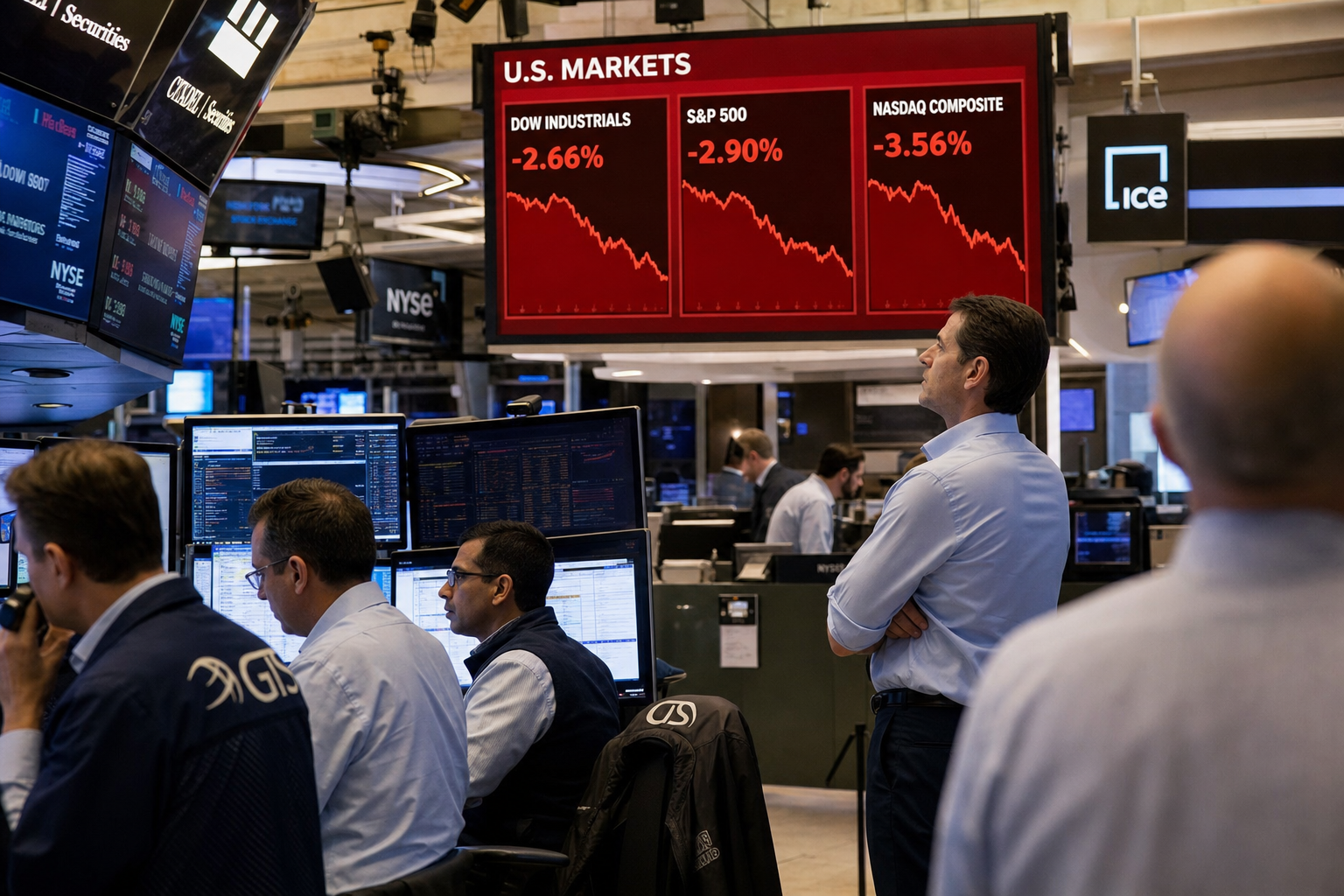
Friday's session opened with a single data point that reframed everything else on the calendar. May's nonfarm payrolls report came in well above consensus estimates, with the unemployment rate holding at 4.3% — a labor market reading strong enough to make the Federal Reserve's next move look more like a hike than a cut.
The market reaction was immediate and cross-asset. Stocks fell. Treasuries fell. That simultaneous decline is the tell: when bonds and equities sell off together, the market is repricing the interest rate path itself, not simply rotating between risk and safety. This was not a flight to quality. It was a repricing.
Fed Chairman Kevin Warsh, who replaced Jerome Powell, now faces a policy environment with almost no room to maneuver toward easing. Analysts had already flagged Warsh as more hawkish than his predecessor; Friday's data hardened that constraint. RBC Chief Economist Frances Donald noted the report carries meaningful implications for the broader U.S. economic outlook. Rate cuts are effectively off the table. A hike is no longer an abstract discussion in some corners of the market.
Canada reinforced the picture. Employment there rose 87,800 in May against an estimate of just 10,000, with the unemployment rate falling to 6.6%. North American labor markets are running hot in tandem, narrowing the path for any central bank pivot.
Chips: Two Separate Problems, One Ugly Tape
The semiconductor sector entered Friday already wounded. Broadcom (AVGO) reported record Q2 FY2026 revenue of $22.2 billion — a 48% year-over-year increase — but its forward AI revenue guidance disappointed investors who had priced in something more ambitious. The reaction cascaded for a second straight session across Nvidia (NVDA), AMD (AMD), Intel (INTC), and Micron (MU).
The global reach of the AI-trade selloff was visible overnight. South Korea's Kospi dropped more than 5%, one of its sharpest single-session declines in recent memory, reflecting how deeply chip and tech-exporter sentiment has become correlated with U.S. AI guidance cycles.
Goldman Sachs pushed back, advising clients to buy AVGO on weakness and arguing that near-term guidance softness does not undermine the company's long-term AI revenue trajectory. That view may prove correct over a multi-quarter horizon, but it did little to arrest Friday's selling.
Nvidia carries a separate and potentially more durable headwind. U.S. authorities are scrutinizing a possible loophole that allowed Chinese companies to acquire Nvidia's advanced AI chips despite existing export restrictions. The probe introduces regulatory risk that is harder to dismiss than a single quarter of soft guidance — it speaks directly to the addressable market for NVDA's highest-margin products.
The sector is not without constructive signals. Nvidia certified Samsung, SK Hynix, and Micron as suppliers for HBM4 memory — the high-bandwidth memory used in advanced AI accelerators — for its next-generation Vera Rubin architecture, which has entered full production. Separately, TSMC (TSM) began mass production of 2-nanometer chips, the most advanced process node yet achieved at commercial scale. These are infrastructure-buildout data points that matter for the medium term, even as the near-term tape is ugly.
Bitcoin and the Corporate Treasury Reckoning
The crypto selloff added a third layer of pressure to an already stressed session. Bitcoin's decline has erased an estimated $62 billion in value from public companies that hold the cryptocurrency as a balance-sheet asset.
MicroStrategy (MSTR) — the most aggressive corporate Bitcoin accumulator — absorbed the steepest absolute losses. Tesla (TSLA) and Marathon Digital Holdings (MARA) were also among the hardest hit. The scale of the drawdown has renewed scrutiny of the so-called MicroStrategy model, which involves using corporate equity or debt issuance to accumulate Bitcoin at scale.
The timing is particularly uncomfortable. The crypto losses are arriving alongside the broader risk-off pressure from the jobs report and chip-sector turbulence, compressing speculative assets from multiple directions simultaneously. For boards still weighing whether to adopt similar treasury strategies, Friday's session is a case study in correlated drawdown risk.
The Constructive Undercurrent
Not everything broke lower. Amazon (AMZN) signed a $4 billion cloud services agreement with Pinterest, under which Pinterest will use AWS to build out its AI infrastructure — a deal that reinforces AWS's position as the preferred platform for AI-driven workloads among consumer internet companies.
Anthropic, the AI safety company in which Amazon holds a significant equity stake, filed confidentially for a U.S. IPO. A confidential filing allows a company to submit its prospectus to regulators before any public disclosure, typically ahead of a formal roadshow. Amazon's stake means it stands to realize a substantial gain if Anthropic's listing proceeds at a strong valuation.
Microsoft (MSFT) AI chief Mustafa Suleyman added to the competitive backdrop, saying the company is less focused on rivals including Google, Meta, and OpenAI, and has introduced new AI models targeting enterprise customers. The commentary signals confidence in Microsoft's positioning even as the broader tech tape struggles.
Afternoon Setup
The session's dominant narrative — a macro repricing driven by labor data — is unlikely to shift in the afternoon without a significant counter-catalyst. There are none scheduled. Fed speakers are the variable to watch; any commentary that either validates or pushes back on the rate-hike discussion could move Treasuries meaningfully, which in turn would ripple into equities.
For chips, the question is whether Goldman's buy-the-dip call on AVGO attracts institutional support before the close, or whether the Nvidia probe headlines continue to weigh on the broader SOX complex. A second consecutive week of semiconductor losses heading into the weekend would set a difficult tone for Monday's open.
The SpaceX IPO, reported to be pricing at $135 per share, remains a watch item. If confirmed, it would rank among the largest listings in recent memory and could shift sentiment around the broader aerospace and private-market ecosystem — including TSLA, which has served as a proxy trade for SpaceX exposure among investors unable to access the private company.
The macro story owns this session. Everything else is reacting to it.