Inflation Shock and Iran Strikes Close Wall Street's Worst Session in Months
A 0.5% monthly CPI print and U.S. military action against Iran delivered a simultaneous macro and geopolitical blow, erasing rate-cut hopes and punishing equities across the board.
The Session
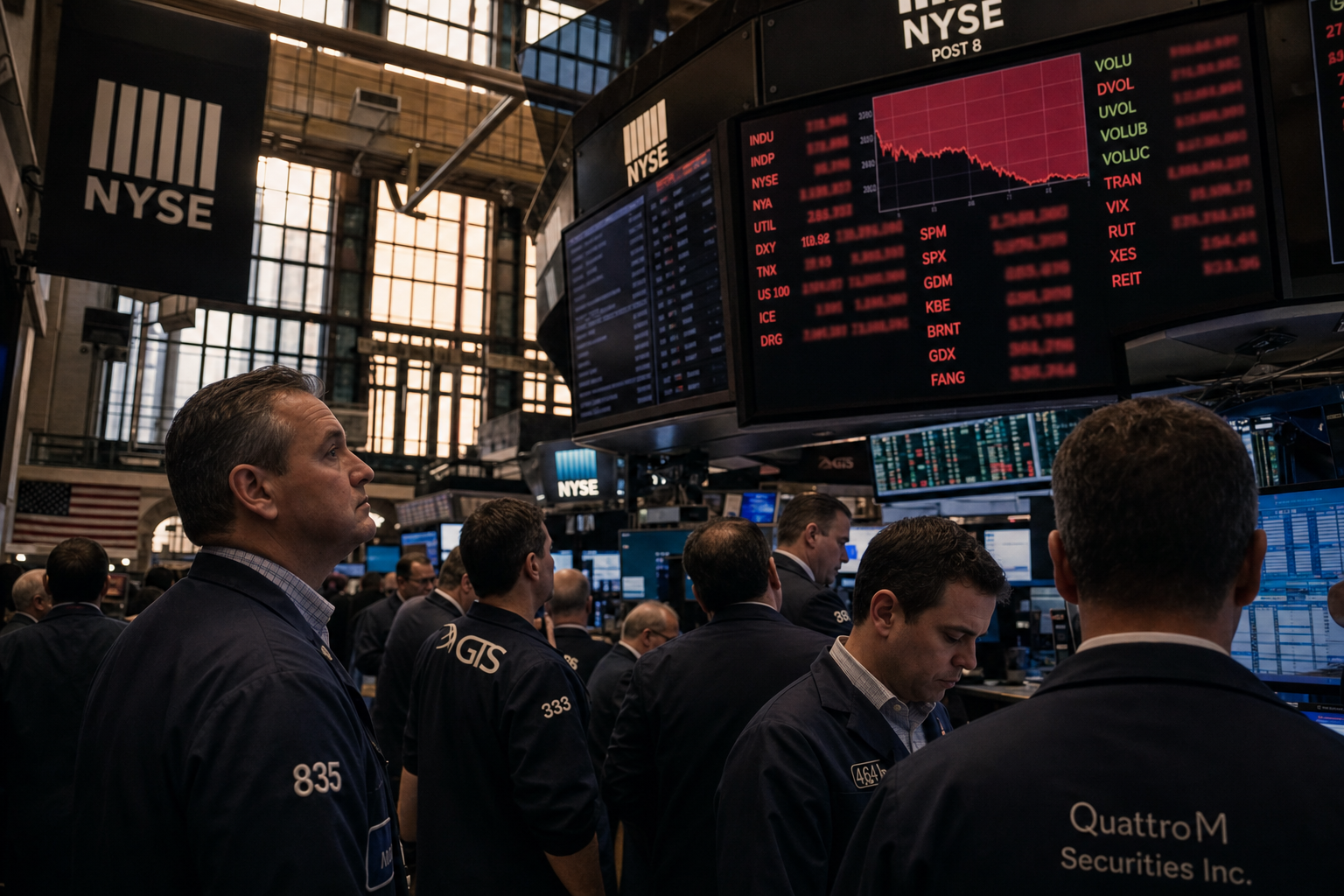
Wednesday closed as one of the more punishing sessions of 2026. The Dow Jones Industrial Average shed 600 points, while the S&P 500 and Nasdaq each fell roughly 1% — losses that began in pre-market trading and deepened as two separate shocks compounded each other through the day.
The first was the May Consumer Price Index, which showed a 0.5% month-over-month increase, lifting the annual inflation rate to a three-year high. The second was confirmation that U.S. forces had struck Iranian military targets following the downing of a U.S. Army Apache helicopter. Either event alone would have rattled markets. Together, they left investors with few obvious moves: equities fell, haven assets behaved erratically, and the Federal Reserve's rate path grew considerably murkier.
This was not a session that surprised by its direction — the pre-market had already signaled the damage, with Nasdaq 100 E-Mini futures (NQ=F) down 1.61% before the open. What surprised was the absence of any meaningful intraday recovery. The selling held.
Winners and Losers
Technology bore the heaviest losses. AI-linked names, which had been among the market's strongest performers this year, gave back ground as rising inflation expectations directly threaten the valuation models that support high-multiple growth stocks. Higher rates mean higher discount rates; higher discount rates compress the present value of future earnings.
The earnings backdrop offered a partial counterweight, though it was insufficient to arrest the broader decline. TSMC (TSM) reported a 30% jump in sales, driven by surging orders from Nvidia (NVDA) and Apple (AAPL) — a result that confirms AI hardware demand remains structurally robust even as macro sentiment deteriorates. Dell Technologies (DELL) beat analyst expectations and raised its forward outlook, signaling continued enterprise spending on AI infrastructure.
Not every server maker shared in that strength. Super Micro Computer (SMCI) missed consensus estimates for the period, a divergence from Dell that likely reflects execution and competitive dynamics rather than any broad pullback in AI spending. The TSMC result makes it difficult to argue that the underlying demand cycle has turned.
Johnson & Johnson (JNJ) faced additional pressure after a Los Angeles jury awarded $32 million to the family of a mesothelioma victim in a talc-related case. The verdict adds to a long-running series of adverse rulings that complicate J&J's strategy of managing talc liabilities through subsidiary bankruptcy proceedings and could weigh on settlement negotiations across thousands of pending claims.
Under the Surface
The bond market's reaction was telling. Treasury yields (^TNX, ^TYX) moved in response to the CPI print in a way that reflected a meaningful repricing of the Fed's options. A 0.5% monthly gain in consumer prices — at an annual rate now at a three-year high — is not consistent with imminent rate cuts. Traders who had been positioning for Fed easing in the second half of 2026 were forced to reassess.
Gold's behavior was perhaps the session's most notable anomaly. The metal, which typically rallies when inflation fears rise, instead broke through critical support levels. That kind of move — a haven asset declining during a risk-off session — typically signals forced liquidation or broad portfolio repositioning rather than a straightforward expression of inflation expectations. It suggests some market participants were selling whatever they could, not just what they wanted to.
Volatility indicators spiked across equity and futures markets. The combination of geopolitical escalation and a macro data point that removes policy flexibility is precisely the scenario that drives volatility higher.
Oil prices rose on the Iran news, as they typically do when conflict threatens Middle East energy supply routes. That dynamic introduces a feedback loop that will concern policymakers: higher oil feeds into future CPI readings, which further constrains the Fed, which keeps financial conditions tighter for longer.
The AI Trade Holds Its Structural Footing
Despite the session's damage, two large AI infrastructure deals announced Wednesday illustrate that capital commitment to the sector has not wavered. Alphabet (GOOGL) locked in a contract with SpaceX worth $920 million per month for access to 110,000 Nvidia GPUs, running through mid-2029. The deal's scale — and the fact that Alphabet is paying roughly 2.2 times what Anthropic pays SpaceX per GPU, according to available analysis — reflects how aggressively large technology companies are competing to secure compute capacity.
Separately, Apollo Global Management (APO) and Blackstone (BX) partnered with Broadcom (AVGO) to launch an AI infrastructure platform backed by a $35 billion loan, with Anthropic as the primary beneficiary. Private credit, rather than public bond markets, is bearing the financing load — a structural shift that has accelerated as AI companies seek large-scale capital without the disclosure requirements of public markets.
These deals do not offset Wednesday's macro damage. But they do confirm that the AI infrastructure buildout is running on a different timeline than near-term rate expectations. Enterprise capital expenditure decisions measured in years are not being unwound by a single CPI print.
Tomorrow's Setup
The Fed's next move is now the central question. Wednesday's CPI print forecloses near-term rate cuts as a realistic scenario, and any Fed commentary in the coming sessions will be parsed carefully for signals about how policymakers are weighing three-year-high inflation against a slowing growth backdrop complicated by geopolitical risk.
On the geopolitical front, the trajectory of U.S.-Iran tensions will drive oil prices and risk sentiment at the open. Further escalation — or any Iranian response to Wednesday's strikes — could extend the selloff. A de-escalation signal, conversely, could provide some relief to energy prices and risk assets.
The JNJ talc liability situation bears watching as the verdict adds to the evidentiary record that juries remain willing to hold the company liable, a dynamic that matters for the scale of any eventual settlement. The pending Frasers Group bid for Hugo Boss and the KKR-DCC energy deal, both reported as active but unconfirmed, are also worth monitoring for formal announcements.
What the session did not resolve is whether Wednesday's dual shock marks a turning point in the macro narrative or a severe but isolated event. The answer depends heavily on what the Iran situation looks like by the end of the week — and whether the May CPI reading proves to be the start of a re-acceleration in inflation or a one-month outlier.