Hormuz Flashpoint Splits Oil and Equity Markets Along Familiar Fault Lines
A military exchange in the world's most critical oil chokepoint sent crude prices surging even as U.S. equities hit record highs — a divergence that reveals how markets are pricing geopolitical risk in real time.
The Chokepoint That Moves Everything
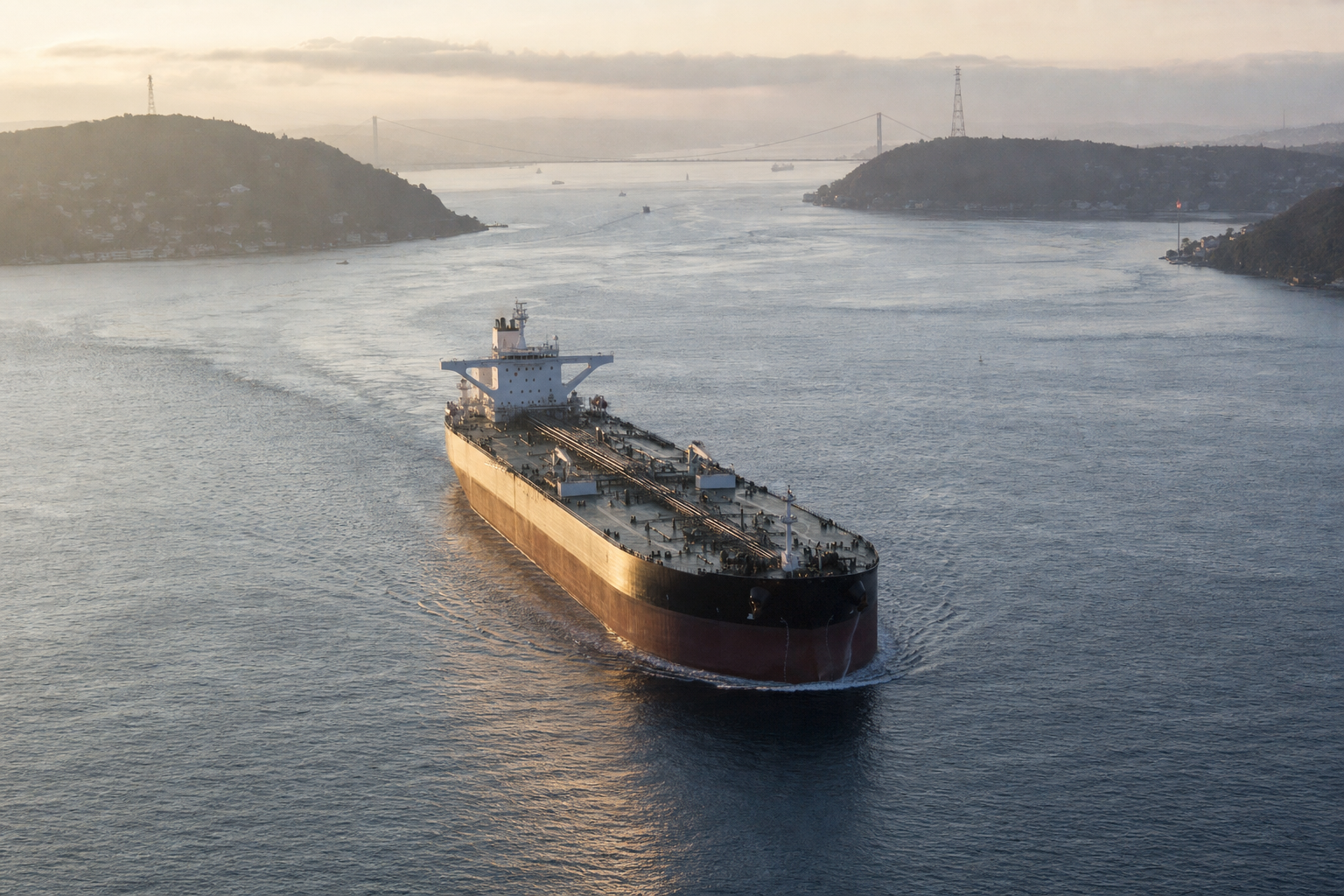
The Strait of Hormuz is roughly 21 miles wide at its narrowest point, but its economic footprint is enormous. A significant share of the world's seaborne crude oil transits this corridor between Iran and Oman, making it the single most consequential maritime chokepoint in global energy markets. When U.S. and Iranian forces exchanged fire there overnight, oil traders did not wait for diplomatic clarification before repricing risk.
Crude prices jumped sharply on the news. The immediate market response was textbook: any credible threat to Hormuz shipping lanes represents a potential supply disruption of a scale that no other oil route can easily absorb. The Persian Gulf producers — Saudi Arabia, the UAE, Kuwait, Iraq — all depend on this passage. There is no adequate pipeline alternative for the volumes involved.
The timing was particularly jarring because oil prices had been falling in the days prior, contributing to broader equity market optimism. A ceasefire between the U.S. and Iran had helped stabilize energy markets, and that calm was being read as a green light to buy risk assets. The overnight exchange of fire shattered that assumption, at least temporarily.
How Equities Decoupled From the Oil Spike
Here is where the story gets analytically interesting. Despite the Hormuz clash and the crude price jump, the S&P 500 (^GSPC) closed at a new record high. The Nasdaq followed suit. The divergence between an oil market pricing in supply disruption risk and an equity market printing all-time highs is not a contradiction — it is a window into the current structure of market leadership.
The rally was driven by semiconductor and cloud software names that have little direct exposure to oil prices. Datadog (DDOG) surged roughly 31% after reporting first-quarter revenue of $1.01 billion, up 32.2% year-on-year — its first time crossing the billion-dollar quarterly revenue threshold. The print lifted peers Snowflake (SNOW) and MongoDB (MDB), which investors read as confirmation that enterprise AI spending is flowing through to real revenue.
Chip stocks also led the advance, with Micron (MU), Seagate, and Arm Holdings among the session's standouts. Nvidia (NVDA) continued its own capital deployment campaign, with a cluster of deals cementing its position as not just a chip supplier but a direct stakeholder in AI infrastructure. The company committed up to $2.1 billion to data center operator IREN, took an equity stake of up to $3.2 billion in Corning while funding new manufacturing plants, and participated in a $13 billion data center financing for Meta Platforms (META) in El Paso, Texas — a deal led by Morgan Stanley (MS) and JPMorgan (JPM).
For equity investors concentrated in AI-linked technology names, the Hormuz clash was a macro headline rather than a direct earnings threat. That explains the apparent paradox.
The Energy Sector's Dual Reality
For energy markets and energy companies, the picture is more complicated. Shell (SHEL) reported first-quarter adjusted net income of $6.92 billion, beating analyst expectations on the back of elevated oil price volatility and strong trading desk performance — a direct beneficiary of the Iran conflict's disruption to normal supply routes. Geopolitical dislocation widens the price spreads that integrated energy majors exploit through their trading operations.
But the same conflict that boosted Shell's Q1 results also creates the conditions for a rapid reversal. If a durable ceasefire had held — and markets were beginning to price that in before the overnight exchange of fire — oil prices would have continued falling, compressing the very trading margins that made Shell's quarter look strong.
The Hormuz incident resets that calculus. Sustained disruption to the strait would push crude prices higher, benefiting producers but acting as a tax on the broader global economy. BP and Shell are also among the companies closing billion-dollar deals in Venezuela, where oil exports have reached a seven-year high as international majors return. A Venezuelan supply recovery adds barrels to global markets — a partial offset to Hormuz disruption risk — but the scale and durability of that rebound depends on political stability that cannot be assumed.
The Macro Layer Underneath
Federal Reserve officials cited the Iran situation as a specific source of economic uncertainty, particularly around inflation. That framing matters. If the Hormuz clash sustains elevated oil prices, it feeds directly into energy components of inflation indices — complicating the Fed's path at a moment when officials were already flagging caution about the inflation outlook.
This is the channel through which a regional military exchange becomes a domestic monetary policy variable. Higher oil prices raise gasoline and transportation costs, which flow into core goods prices with a lag. The Fed does not control geopolitical events, but it does have to respond to their inflationary consequences.
JPMorgan Chase CEO Jamie Dimon added a separate cautionary note, warning that government debt levels risk producing what he described as "some kind of bond crisis" if policymakers fail to act preemptively. A bond crisis — a disorderly rise in sovereign borrowing costs — would push up yields across the curve, raising mortgage rates, corporate borrowing costs, and the government's own interest expense simultaneously. Dimon's warning predates the Hormuz incident but is amplified by it: geopolitical shocks that sustain inflation reduce the Fed's room to cut rates, which in turn keeps pressure on the long end of the Treasury curve.
Goldman Sachs added its own note of skepticism to the earnings picture, warning that strong results from Amazon (AMZN) and Alphabet (GOOGL) may be masking weaker underlying trends across the broader S&P 500. Strip out the largest technology names and the earnings recovery looks narrower. That observation sits uncomfortably alongside an index trading at record highs.
What to Watch From Here
The durability of the ceasefire — or its absence — is now the dominant macro variable heading into the weekend. Any diplomatic response that credibly reduces the probability of further Hormuz disruption would likely push oil prices back toward their recent lows and remove a layer of inflationary risk from the Fed's calculus. The opposite scenario — further military activity or a formal breakdown of ceasefire negotiations — would sustain crude prices at elevated levels and begin to test whether equity markets can maintain their record highs against a deteriorating macro backdrop.
Disney (DIS) provided a reminder that the earnings season still has positive surprises to offer outside the AI complex. Shares rose sharply after fiscal second-quarter 2026 results, with CEO Josh D'Amaro articulating a strategic vision that analysts found credible. Advanced Micro Devices (AMD) drew a significant re-rating from Goldman Sachs, which raised its price target to $450 from $240 and upgraded the stock to Buy — a revision that signals growing conviction in AMD's competitive positioning in AI hardware.
The bond market's reaction to Dimon's debt warning, any further Nvidia investment announcements, and the trajectory of Hormuz diplomacy are the three threads most worth pulling in the sessions ahead. The record high in equities is real, but the geopolitical and fiscal risks beneath it are equally real — and the overnight exchange of fire was a reminder that they can reprice quickly.