Fed Hike Repricing Hammers Stocks as Alphabet Slides on AI Talent Loss
A hawkish pivot from major banks, a Nobel laureate defecting to Anthropic, and a $165 billion leverage warning are converging on markets in a single session.
The Morning That Changed the Rate Narrative
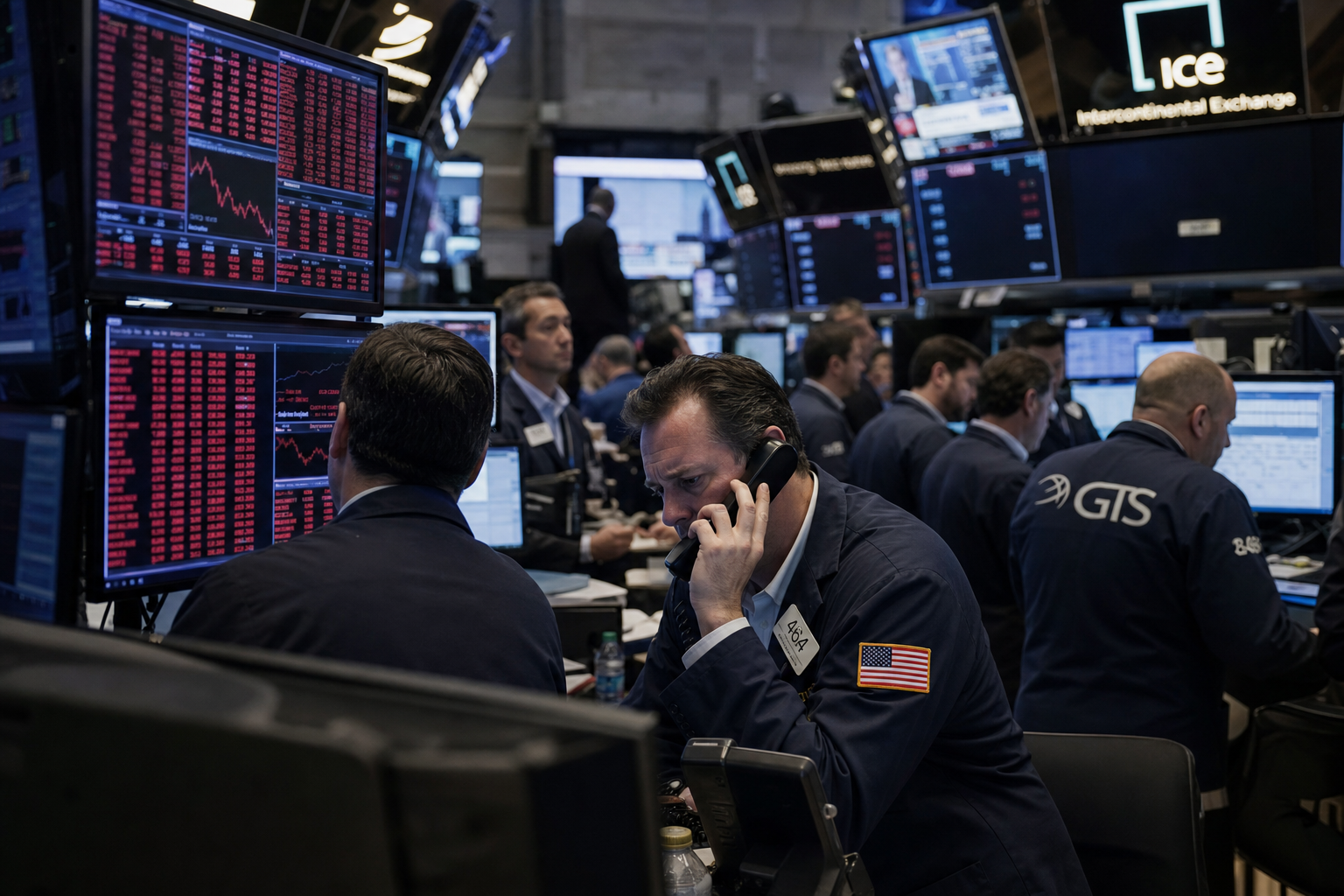
U.S. equities opened Monday under significant pressure and have not found relief. The catalyst is a broad, coordinated reassessment of where the Federal Reserve is headed — and the answer, according to the largest banks on Wall Street, is not where markets had been positioned.
Bank of America delivered the sharpest call: three rate hikes in 2026, with no cuts until 2028. That is a complete reversal from a prior stance that assumed no action. The revision follows hawkish signals from Fed Chair Kevin Warsh, who took over the role earlier this year and has signaled a more aggressive inflation-fighting posture than his predecessor.
The near-term timeline sharpened further when JPMorgan Asset Management's Bob Michael identified the July 29 FOMC meeting — the Federal Open Market Committee, which sets U.S. benchmark interest rates — as a live date for the first hike. Six weeks. That is the window markets are now pricing around.
Rising Treasury yields are doing the rest of the damage. Yields and bond prices move inversely; when yields climb, they raise borrowing costs across the economy and make fixed income a more attractive alternative to equities. The combination of a hawkish Fed pivot and elevated yields is the session's dominant force.
Alphabet Takes a Separate Hit
While the macro story is broad, GOOGL is carrying an additional, company-specific wound. Alphabet fell 6.2% after John Jumper — a Nobel Prize-winning scientist and prominent figure at Google DeepMind, the company's flagship AI research division — announced his departure to join Anthropic, the AI startup backed by Amazon.
The market reaction reflects something beyond the loss of one researcher. Alphabet has staked its growth narrative on AI leadership, and a defection of this profile signals that competing labs are gaining ground in the talent competition that ultimately determines long-term AI capability. Anthropic, which develops the Claude family of models, has been aggressively recruiting from the top of the scientific ladder. A 6.2% single-session decline for a company of Alphabet's scale is a sharp verdict.
The move also arrives at a moment when Alphabet CEO Sundar Pichai had been publicly framing AI as the company's core revenue driver. The talent story complicates that narrative in a way that a product setback alone would not.
The Leverage Warning Underneath
Goldman Sachs has flagged a structural vulnerability that the day's selling pressure makes more relevant by the hour: hedge fund leverage has reached multi-year highs. JPMorgan Chase put a specific number on the risk — a potential $165 billion in forced equity selling if leveraged positions are unwound.
The mechanism is straightforward and unforgiving. When funds borrow to amplify their bets and markets move against them, lenders issue margin calls — demands to post additional collateral. If funds cannot meet those calls, they sell positions quickly, regardless of fundamentals. That selling accelerates price declines, which can trigger further margin calls in a self-reinforcing loop.
Neither bank specified a trigger event, but the setup — elevated leverage meeting a hawkish Fed repricing on a day when equities are already sliding — is precisely the kind of environment where forced selling becomes a real rather than theoretical risk. The $165 billion figure is not a prediction; it is a stress scenario. But on a day like Monday, stress scenarios deserve attention.
JPMorgan's Contradictory Signals
JPM reported record first-quarter 2026 net income of $16.5 billion, with revenue and investment banking fees rising sharply. For large financial institutions, higher interest rates widen the spread between what banks earn on loans and what they pay on deposits — a direct earnings tailwind.
Yet CEO Jamie Dimon used the earnings platform to issue a warning: the next financial crisis could be worse than most observers anticipate. He did not specify a timeline or trigger. The juxtaposition — record profits alongside a crisis caution from one of the most closely watched executives in finance — captures the session's broader tension. Near-term fundamentals for large banks look strong. The medium-term backdrop is more complex.
The Partial Offset
Goldman Sachs did offer one constructive data point: it cut its 12-month U.S. recession probability to 15% following a U.S.-Iran agreement. The bank cited labor market resilience and improved geopolitical conditions as the basis. Geopolitical de-escalation in the Middle East typically eases energy supply concerns, which feeds into inflation dynamics and, by extension, Fed policy calculations.
A 15% recession probability is low by historical standards. Goldman's base case remains continued economic expansion. But a growing economy with a hawkish Fed is not the same as a growing economy with an accommodative one — and the distinction is what markets are working through in real time.
What the Afternoon Holds
The session's narrative is not shifting — it is deepening. The rate hike repricing that opened the morning has not been contradicted by any data or Fed communication since the open. Alphabet's decline is a discrete story running in parallel, not a distraction from the macro.
Watch Treasury yields for any sign of stabilization; a peak in yield pressure would give equities room to recover some ground. Watch GOOGL for whether the 6.2% decline attracts dip buyers or accelerates — the stock's behavior in the final hour will signal how the market is weighing the AI talent story against Alphabet's broader fundamentals. And watch overall market breadth: if the selloff is concentrated in rate-sensitive and high-multiple names, the damage is manageable. If it broadens into cyclicals and financials, the leverage dynamic Goldman and JPMorgan flagged moves from background risk to foreground concern.
The July 29 FOMC meeting is now the central event on the calendar. Every inflation print, labor market release, and Fed communication between now and then will be read as evidence for or against a hike. Monday's session is the market beginning to price that uncertainty in earnest.