Dow Crosses 50,000 as Cerebras IPO and Nvidia China Approval Ignite AI Rally
A landmark index milestone, the year's biggest IPO, and a chip export policy shift converged on Thursday to produce one of 2026's most consequential market sessions.
The Session
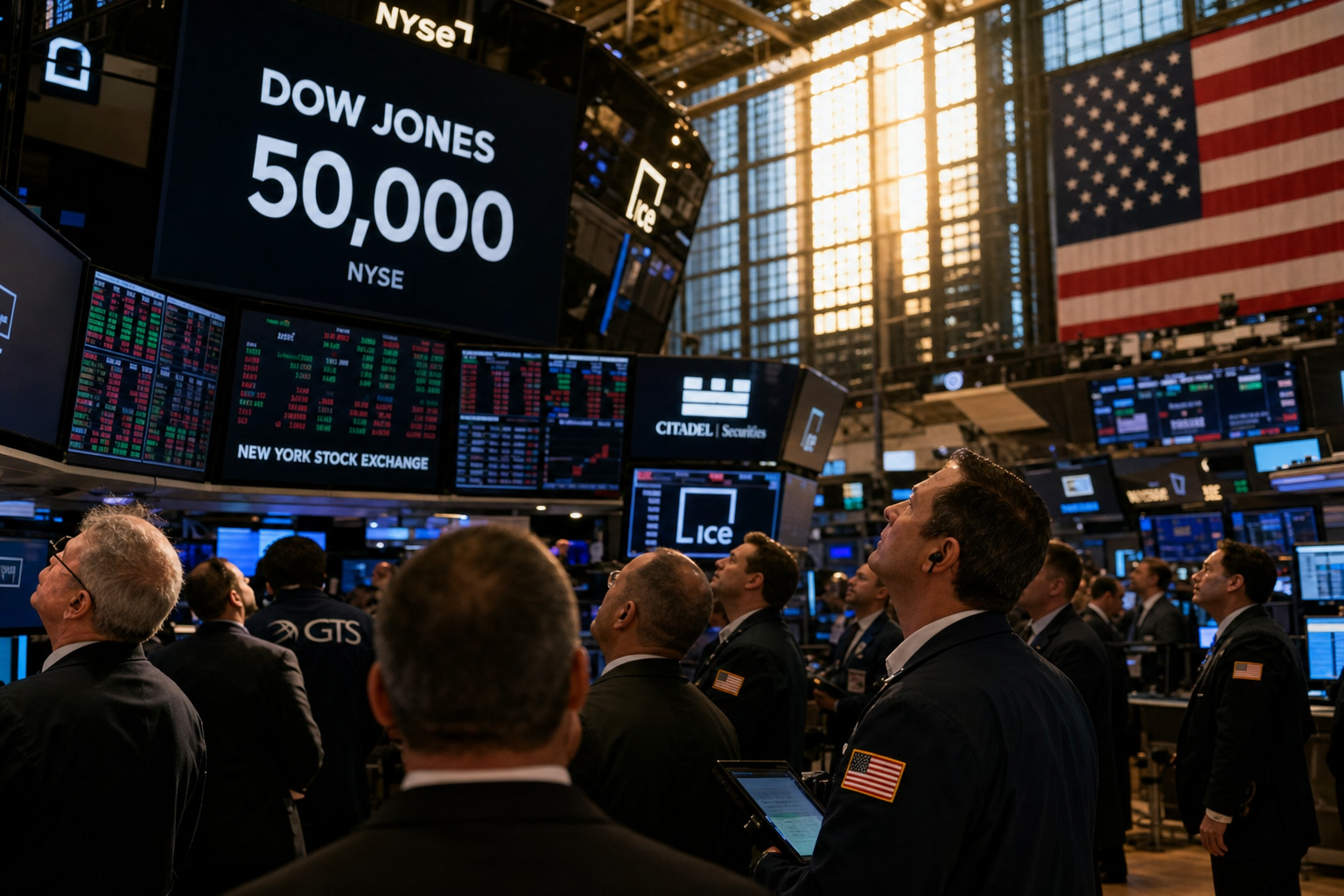
Thursday closed as a session that markets will mark as a reference point for some time. The Dow Jones Industrial Average crossed 50,000 for the first time in its history, with major indexes rising roughly 1% across the board. The move was not a single-stock story — it was the product of several reinforcing catalysts arriving in close succession: a landmark chip export policy shift, the largest U.S. IPO in 12 months, and continued momentum in AI infrastructure spending.
Nvidia (NVDA) and Broadcom were the primary index drivers. Nvidia has gained approximately 20% over the past seven days, pushing its market capitalization toward $6 trillion — a figure that would have seemed implausible even 18 months ago. The stock's recent acceleration was not purely sentiment-driven. The U.S. government approved roughly 10 Chinese companies, including Alibaba, to purchase Nvidia's H200 AI accelerators, removing an export-control overhang that had been a persistent drag on the company's China revenue outlook. CEO Jensen Huang separately confirmed plans to increase H200 manufacturing for those customers. Bank of America reset its price target on NVDA to a level implying approximately 45% additional upside from current prices — a notable call given where the stock already trades.
For the Dow specifically, the 50,000 level carries more symbolic than analytical weight. The index is price-weighted rather than market-cap weighted, meaning a $5 move in a high-priced stock like Nvidia matters more than the same dollar move in a lower-priced component. But milestones attract attention, and attention attracts capital. The breadth of Thursday's session — semiconductors, networking, and aerospace all contributing — suggests this was not a narrow squeeze.
The Cerebras Debut
The session's most dramatic single event was the market debut of Cerebras Systems (CBRS). The AI chip designer priced its IPO at $185 per share, raising $5.55 billion — the largest U.S. IPO by proceeds in the past 12 months. Shares opened at $385, a premium of roughly 108% to the offering price, valuing the company at approximately $107 billion at the open. CEO Andrew Feldman's stake was reported to be worth around $3.2 billion at opening prices.
The opening-day move puts Cerebras in rare company. Gains of this magnitude on debut typically reflect a combination of genuine institutional demand and a deliberately conservative IPO pricing — investment banks setting the offer price below where they believe the market will clear in order to generate momentum. Whether the $107 billion valuation holds as the stock settles into regular trading is a separate question. Cerebras competes directly with Nvidia in the AI accelerator market and counts OpenAI and Amazon among its ecosystem partners. The listing adds a significant new publicly traded name to the AI hardware landscape at a moment when that landscape commands premium valuations.
The scale of the Cerebras raise also signals something about the broader IPO pipeline. Companies that had been waiting for a more stable market window now have a clear data point: investor appetite for AI infrastructure plays, even at elevated valuations, remains strong.
Winners and Losers
Beyond Nvidia and Cerebras, the semiconductor sector broadly benefited from Thursday's policy and sentiment shift. AMD (AMD) reported first-quarter revenue of $10.25 billion and tripled its free cash flow — a sharp contrast to Intel (INTC), which posted $13.58 billion in revenue but continues to absorb heavy losses from its foundry division. The divergence between the two companies has become a recurring theme: AMD is harvesting the current AI demand cycle while Intel is making a longer-dated bet on becoming a domestic manufacturing alternative to TSMC.
Intel also appeared in a separate announcement: Elon Musk unveiled Terafab, a joint venture that includes Intel and targets construction of what Musk described as the world's largest chip manufacturing facility. The stated goal is one terawatt of annual AI compute capacity, with the initiative described as a $119 billion project. Details on timeline, financing structure, and confirmed partners beyond Intel were limited in available reports. Tesla (TSLA) was tagged in coverage of the announcement, suggesting potential overlap with Musk's existing corporate interests.
Boeing (BA) was the session's most visible loser. President Trump announced during his visit to Beijing that Chinese President Xi Jinping committed to ordering 200 Boeing jets — a figure that fell well short of the approximately 500-aircraft deal investors had been anticipating. Boeing shares moved toward their largest single-day decline in six months. The gap between expectation and outcome was the story: the 200-jet commitment is not trivial in absolute terms, but markets had priced in a larger figure, and the shortfall was visible against the diplomatic backdrop of a high-profile summit.
Under the Surface
The source material for Thursday's session contained no significant fixed income, currency, or commodity-specific developments — a notable absence given the scale of equity moves. What the fixed income picture did show, through the lens of corporate issuance, was continued appetite for AI-linked debt. Alphabet (GOOGL) was in the process of selling $17 billion in bonds, with reports suggesting additional issuance was planned shortly after. That move is part of a broader trend analysts have characterized as a $300 billion AI-related debt wave, spreading from U.S. credit markets to Tokyo.
Credit spreads — the extra yield investors demand to hold corporate debt over government bonds — have remained tight, indicating that bond buyers are not yet demanding a meaningful risk premium for the scale of AI infrastructure borrowing. That is a supportive condition for equity valuations, as it keeps the cost of capital low for the companies driving the AI trade. Whether it persists as issuance volumes grow is worth monitoring.
The VIX and broader volatility measures were not highlighted in session coverage, which is itself informative: a 1% gain across major indexes on a day with multiple high-profile catalysts, without a spike in implied volatility, suggests the move was orderly rather than speculative.
Friday's Setup
The most immediate question heading into Friday is whether the Cerebras (CBRS) opening-day gains hold. Post-IPO volatility is common when first-day moves are this large — early buyers may take profits, and the stock needs to find a natural clearing price among investors with longer time horizons. The $107 billion debut valuation will attract scrutiny from analysts beginning to publish initiating coverage.
For NVDA, the trajectory toward $6 trillion in market capitalization remains the dominant market narrative. The stock's next scheduled fundamental test is its earnings report on May 20, where guidance on China chip demand and H200 production ramp will be the primary focus. Bank of America's revised price target gives the bulls a fresh anchor, but the stock has already moved substantially on policy and sentiment — the May 20 report will need to deliver on the fundamentals that justify the current multiple.
Boeing (BA) warrants a watch for analyst commentary on the China order shortfall. The 200-jet figure may be revised upward in subsequent diplomatic communications, or it may prove to be the ceiling — the market's reaction on Friday will clarify which interpretation is prevailing.
The broader AI trade — spanning chips, infrastructure, IPOs, and corporate debt — showed no sign of exhaustion on Thursday. The session's breadth, the policy tailwind from the China chip approval, and the Cerebras debut collectively reinforced the same theme that has defined 2026 markets: capital continues to flow toward AI at a pace that is reshaping valuations, index composition, and the IPO calendar simultaneously.