Dell's Record Session and a $36B AI Debt Deal Define May's Final Trade
The AI capital expenditure cycle is producing its clearest earnings signal yet, while oil's steep monthly collapse reshapes the macro backdrop heading into June.
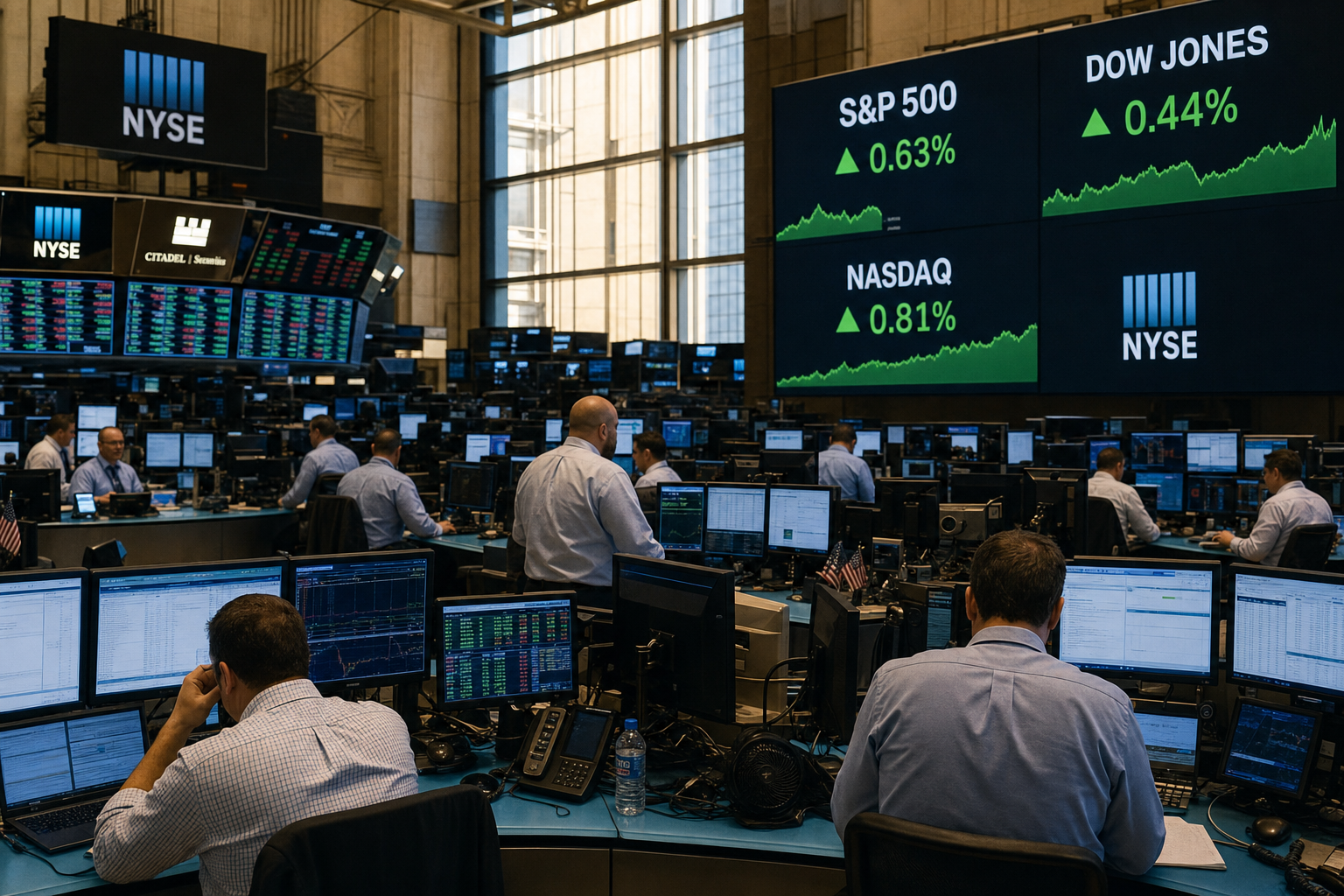
The morning played out exactly as the bulls drew it up
Friday's session is running on the same rails the overnight picture laid down. Dell Technologies (DELL) opened sharply higher and has held the bulk of those gains — shares are up roughly 33% in midday trading, marking the stock's best single session since the company returned to public markets in 2018. Super Micro Computer (SMCI) is riding the slipstream, up around 16%. U.S. equity indices have extended their run to fresh record highs with no meaningful intraday reversal. The morning's thesis — that AI infrastructure spending is translating into hard revenue, not just investor enthusiasm — is being confirmed in real time.
Snowflake (SNOW) is adding to the picture, up 36% after its own earnings beat and an expanded partnership with Amazon Web Services. Management pointed to AI-driven workloads as the primary demand accelerant. Snowflake had faced skepticism in prior quarters about whether it could monetize the AI wave; the results appear to have settled that debate for now, at least in the market's eyes.
The numbers behind Dell's move
Dell's fiscal Q1 2027 results are worth examining directly, because the headline figure understates the structural shift. AI server revenue rose 757% year-over-year — not a rounding error, but a near-order-of-magnitude acceleration driven by hyperscaler procurement. The large cloud providers — Amazon, Microsoft, Google — are competing to build out data center capacity, and Dell is capturing an expanding share of that spending at the hardware layer.
Management raised its full-year revenue and earnings guidance in response to the demand pipeline. That guidance raise matters as much as the quarterly beat: it signals that hyperscaler budgets are not front-loaded anomalies but sustained commitments extending into the second half of the year. Enterprise hardware companies have historically been seen as lower-margin, commoditized businesses. This quarter is forcing a reassessment of that framing.
Private credit steps into the AI infrastructure gap
The session's most structurally significant story may not be the earnings prints. Apollo Global Management and Blackstone are arranging a $36 billion debt deal to acquire Google tensor processing units — specialized AI chips — which will then be leased to Anthropic, the AI startup backed by Google and Amazon. The structure is a sale-leaseback: the private credit funds own the hardware and generate returns through lease payments, while Anthropic gets access to the chips without tying up its own balance sheet.
At $36 billion, this is one of the largest single financing arrangements in recent memory in private credit markets — the segment of lending that operates outside the traditional banking system. It illustrates a broader dynamic: the capital requirements of the AI buildout are so large that corporate balance sheets and public bond markets alone cannot absorb them. Alternative asset managers are filling that gap, positioning themselves as essential intermediaries in the AI economy. For Apollo and Blackstone, it is also a bet that AI chip demand will remain durable enough to support long-term lease cash flows.
Oil's 19% monthly collapse is the macro story markets are underpricing
While equities dominate the headlines, the commodity market is telling a separate and consequential story. Crude oil is on track to close May down roughly 19% — one of the steepest monthly declines in recent years for a commodity this widely traded. The primary driver is optimism around a potential U.S.-Iran nuclear agreement that could lift sanctions and allow significant Iranian crude exports to return to global markets.
The implications run in multiple directions. For equity markets, cheaper oil is disinflationary — it reduces input costs for businesses and eases pressure on consumers, giving the Federal Reserve more room to hold interest rates steady rather than raising them. That is broadly supportive of the current rally. For energy-sector stocks, however, the picture is more complicated: a sustained decline of this magnitude will compress earnings for producers and integrated majors when Q2 results arrive.
Crucially, the deal is not finalized. Any breakdown in negotiations — or an escalation of military tensions in the region — could reverse the oil move quickly and reprice the geopolitical risk premium that has been steadily drained from markets this month. Traders holding energy positions into the weekend are carrying that tail risk.
Pfizer makes a $10.5B oncology bet
Outside the AI trade, Pfizer signed a deal with China's Innovent Biologics valued at up to $10.5 billion, covering 12 early-stage oncology programs. The upfront payment is $650 million, with the remainder contingent on clinical and commercial milestones — a structure that limits Pfizer's immediate exposure while preserving optionality on a broad pipeline. For Pfizer, the deal continues an effort to rebuild its drug pipeline following the wind-down of COVID-19 revenues. It is one of the larger oncology licensing transactions of the year and signals that large pharma's appetite for externally sourced drug candidates remains strong despite the macro environment.
What to watch in the afternoon session
With the S&P 500 at record highs and May closing on a strong note, the afternoon session carries a few specific risks worth monitoring.
Position-squaring into month-end is the most mechanical factor. Fund managers who are underweight AI hardware names relative to their benchmarks may face pressure to add exposure — or conversely, those who are now significantly overweight DELL and SNOW after today's moves may trim. Month-end flows can introduce volatility that does not reflect fundamental conviction.
The bond market's reaction to the session deserves attention. If Treasury yields are rising alongside equities, it suggests the market is pricing stronger growth — consistent with the AI capex narrative. If yields are falling, it may reflect the oil-driven disinflation story dominating fixed income even as stocks rally. The two can coexist, but the relative move matters for how durable the equity gains are.
Finally, any diplomatic headlines out of the U.S.-Iran talks over the weekend could set the tone for Monday's open in oil markets. A formal framework announcement would likely accelerate the crude selloff; a breakdown would snap it back. Neither outcome is priced with certainty, which makes the weekend a live risk event for energy and, by extension, for the inflation expectations that are currently underpinning the equity bull case.