China's Deflationary Exit: Inflation Is Rising, but Risks Remain
After years of deflationary pressure, China's price data is turning positive — but the recovery is uneven, fragile, and contingent on policy follow-through.
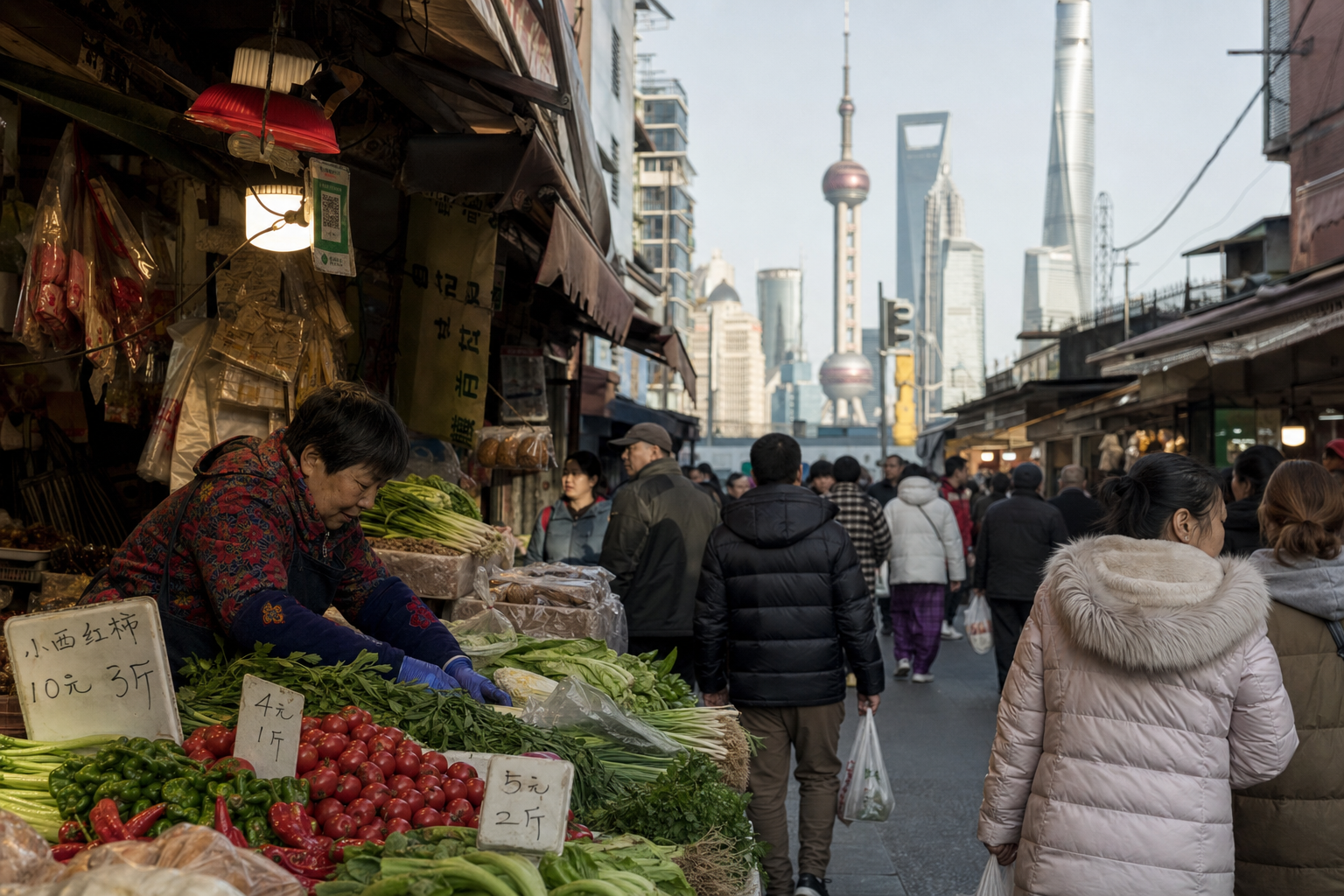
A Turning Point in China's Price Cycle
For much of 2023 and 2024, China defied the global inflation narrative. While central banks in the U.S. and Europe were tightening aggressively, Beijing was grappling with the opposite problem: persistent deflationary pressure driven by weak consumer demand, a property sector in distress, and excess industrial capacity. That dynamic appears to be shifting in 2025 and into 2026, as a combination of fiscal stimulus, recovering household sentiment, and supply-side adjustments begins to push China's price indices back toward positive territory. Investors should treat this transition carefully — it is real, but it is not yet durable.
What the Data Shows
China's Consumer Price Index (CPI) spent extended stretches in negative year-over-year territory through 2024, a signal of deeply suppressed domestic demand. The Producer Price Index (PPI), which measures factory-gate prices, was in deflation for over two consecutive years — the longest such streak in decades — squeezing corporate margins across manufacturing and exporting industries.
By early 2026, the picture has improved modestly. CPI has moved back into slightly positive territory on a year-over-year basis, and PPI deflation has narrowed considerably. Pork prices, a volatile but heavily weighted component of China's CPI basket, have stabilized. More importantly, core CPI — which strips out food and energy — has shown a gradual upward drift, suggesting that the demand recovery is not purely commodity-driven.
The Policy Engine Behind the Shift
The transition owes much to deliberate policy action. The People's Bank of China (PBOC) cut reserve requirement ratios and benchmark lending rates multiple times through 2024-2025. Fiscal authorities rolled out consumption voucher programs, trade-in subsidies for consumer electronics and appliances, and expanded social housing initiatives designed to stabilize the property market without fully re-inflating it.
Critically, Beijing has also moved to rationalize overcapacity in sectors like steel, solar panels, and electric vehicles — industries where relentless overproduction had been a structural source of deflationary drag. This supply-side discipline, combined with demand-side stimulus, creates a more balanced foundation for price normalization than stimulus alone would provide.
Why the Recovery Remains Fragile
Despite the directional improvement, several structural headwinds constrain a full inflationary recovery. Youth unemployment remains elevated, suppressing wage growth and discretionary spending among the demographic most likely to drive consumption. The property sector, while stabilizing, has not recovered — household wealth remains impaired, and the negative wealth effect from falling home prices continues to weigh on consumer confidence.
Externally, U.S.-China trade tensions and ongoing tariff escalation risk dampening export volumes, which could feed back into industrial overcapacity and renewed PPI pressure. A global slowdown scenario would further undercut China's reflation path.
There is also a credibility gap in the policy framework. Chinese households have become more cautious savers, and repeated stimulus measures have had diminishing marginal impact on spending behavior. Structural reforms that would genuinely redistribute income — expanding social safety nets, reforming the hukou system, increasing dividend payouts from state-owned enterprises — have moved slowly.
Implications for Investors
For global investors, China's inflation transition carries several important signals. A sustained move toward positive PPI would be a meaningful tailwind for Chinese industrial and materials equities, which have been compressed by margin pressure. Sectors tied to domestic consumption — consumer staples, healthcare, and discretionary retail — stand to benefit disproportionately if household spending accelerates.
For emerging market fixed income, a stabilizing Chinese economy reduces the risk of competitive devaluation of the renminbi, which had been a concern during the deflationary trough. Commodity-exporting economies closely linked to Chinese industrial demand — Australia, Brazil, Chile — may also see improved terms of trade.
Key ETFs with significant China exposure, including FXI, MCHI, and KWEB, remain sensitive to the pace and credibility of this reflation narrative. Investors should monitor monthly CPI and PPI releases, PBOC policy signals, and retail sales data as the most reliable leading indicators of whether this transition is gaining durable traction.
The Bottom Line
China's exit from deflation is underway, but it is a managed, policy-dependent recovery rather than an organic demand surge. The risk is not that inflation overshoots — it is that the recovery stalls before it becomes self-sustaining. Selective exposure, with a focus on domestic consumption and industrial margin recovery, is the appropriate posture for investors navigating this transition.