Broadcom's Guidance Miss Sends Chips Into Freefall at Midday
A shortfall in Broadcom's AI chip forecast — not its results — has triggered one of the semiconductor sector's sharpest single-day selloffs in recent memory.
The morning session: guidance beats results, in the wrong direction
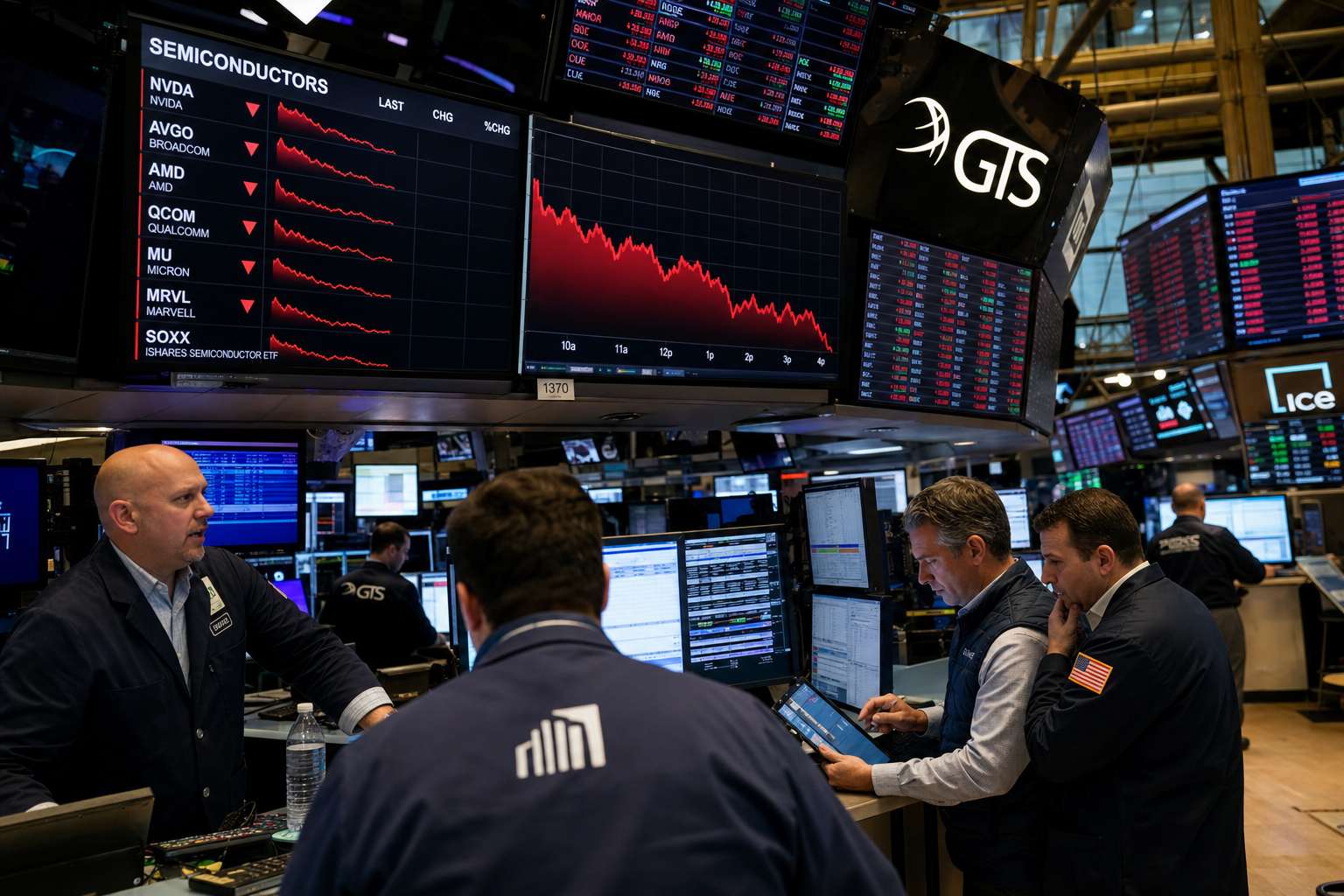
By midday Thursday, the semiconductor sector was deep in the red — and the proximate cause was a number that never appeared in Broadcom's earnings report. AVGO fell more than 14% after the company's AI chip revenue forecast for the fiscal third quarter landed below what analysts had priced in, despite a quarter that included 48% revenue growth and new AI deals with OpenAI, Meta, and Anthropic.
The dynamic at work is one of the more punishing features of high-multiple technology stocks. When a company's valuation already embeds strong future results, guidance that merely falls short — rather than misses outright — can trigger an outsized selloff. Broadcom's current-quarter results were, by most measures, strong. The market's reaction reflected the gap between what was delivered and what was expected, not between what was delivered and what is reasonable.
The damage spread quickly across the sector. AMD and INTC both fell in sympathy as investors reassessed near-term AI chip demand across the board. MU and MRVL also declined. Combined market-value losses across major U.S. semiconductor companies exceeded $650 billion by midday, with Broadcom alone accounting for an estimated $300 billion of that figure.
The regulatory overlay: a second hit to AMD and Nvidia
The Broadcom selloff did not arrive in isolation. U.S. regulators closed an export control loophole that had previously allowed AMD and NVDA to ship certain advanced AI chips into China — a market that had represented meaningful revenue for both companies. The closure adds a concrete near-term revenue headwind on top of the sentiment damage from Broadcom's guidance.
AMD responded by revising its long-term outlook for its CPU business, signaling that the company is recalibrating growth assumptions under the tightened regulatory environment. For Nvidia, the export restrictions arrive at a moment when the company is simultaneously pursuing an aggressive expansion into the CPU market — projecting $20 billion in CPU revenue for the current fiscal year, up from essentially zero the prior year. That ambition is unaffected by the export rule change, but the China revenue loss complicates the near-term picture.
The broader implication is that chip companies now face a dual constraint: valuation expectations that leave no room for guidance softness, and a regulatory backdrop that can reshape addressable markets with limited notice. Neither condition is new, but their coincidence on Thursday sharpened the sector's losses.
What confirmed, what shifted
Going into Thursday's session, the expectation from overnight trading was a broad semiconductor pullback driven by Broadcom's after-hours move. That thesis confirmed. What the morning added was the export control news, which extended the pressure specifically to AMD and Nvidia and gave the selloff a second, independent catalyst beyond sentiment contagion.
The rest of the market has not been immune. The QQQ and ^IXIC tracked the chip sector lower, reflecting how heavily semiconductor and AI-adjacent names weight the Nasdaq. The ^GSPC also declined, though the broader index's losses were more contained given its wider sector composition.
One counterpoint worth noting: Alphabet's previously reported decision to raise its 2026 capital expenditure guidance to between $180 billion and $190 billion remains in place. Hyperscaler spending commitments of that scale are a structural demand signal for the chip sector over the medium term. Thursday's selloff reflects a guidance timing mismatch, not evidence that AI infrastructure investment is slowing.
The afternoon session: what to watch
The semiconductor sector's afternoon trajectory will depend in part on whether further guidance revisions emerge from other chip companies in response to today's developments. Any commentary from AMD or Nvidia management on the export control impact — formal or informal — would be closely watched.
The SpaceX IPO story adds a separate thread to the afternoon. Reports indicate the company is targeting a raise of up to $75 billion, which would be the largest public debut on record. JPM CEO Jamie Dimon is reportedly deploying the bank's retail branch network to broaden the investor base for the deal. No formal filing or pricing timeline has been confirmed, but the story is drawing attention to the IPO market's capacity to absorb a transaction of that scale. If any formal details emerge this afternoon, expect renewed focus on capital markets dynamics beyond the chip sector.
Also in play: Greg Abel's $10 billion GOOGL investment on behalf of Berkshire Hathaway — publicly endorsed by Warren Buffett — adds a notable institutional endorsement to Alphabet at a moment when the stock faces indirect pressure from the broader tech selloff. Whether that endorsement provides any floor for GOOGL shares into the close is a secondary watch item.
For the chip sector specifically, the key question heading into the final hours of trading is whether the selling is mechanical — forced by index rebalancing, options positioning, or stop-loss triggers — or whether it reflects a genuine reassessment of AI hardware demand. Broadcom's underlying results argue against the latter. But in a sector where valuations have run far ahead of near-term earnings, the distinction may not matter much before the close.