BOJ Hits 30-Year High, China Consumers Retreat, Fed Meeting Looms
A Bank of Japan rate hike to 1%, the first decline in Chinese retail sales since 2022, and a $22 billion media deal set the table for a Fed-dominated trading week.
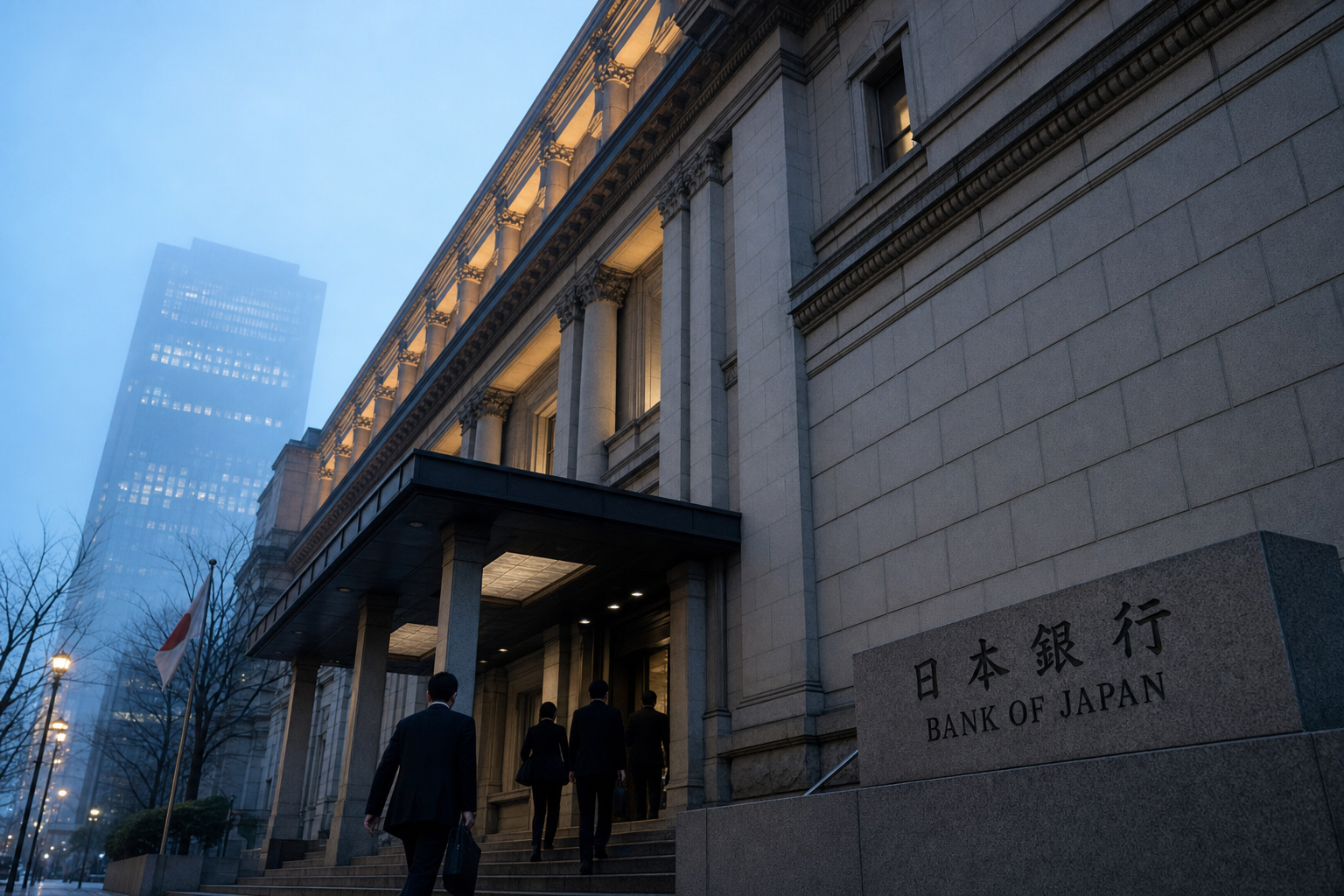
The overnight picture
Tuesday's session opened with three distinct macro signals arriving in quick succession from Asia, each carrying its own cross-asset weight. The Bank of Japan raised its benchmark policy rate to 1%, the highest since 1995. China reported its first decline in retail sales since December 2022. And U.S. equity futures, which had surged as much as 3.2% on Nasdaq-100 contracts earlier in the overnight session, pulled back modestly as investors absorbed the news and turned their attention to Washington.
The retreat in futures is less a sign of alarm than a recalibration. Monday was a genuinely exceptional session — the Dow Jones Industrial Average hit a new all-time intraday high, the Nasdaq posted its best close since March, and SpaceX (SPCX) surged roughly 19% on its Nasdaq debut to reach a $2.52 trillion market capitalization, surpassing TSMC and Broadcom. Some consolidation after a session of that magnitude is unremarkable. What matters now is what the Federal Reserve signals later this week.
Theme 1: The BOJ's slow-motion normalization
The Bank of Japan's decision to lift its policy rate to 1% was widely anticipated, but that doesn't diminish its significance. Japan has spent the better part of three decades operating at or near zero interest rates. The move to 1% — a level last seen in 1995 — is another incremental step in one of the most consequential monetary policy pivots in modern financial history.
The BOJ also announced it will pause its bond-tapering program — the gradual reduction of its Japanese government bond holdings — beginning April 2027. The pause signals that policymakers want to avoid tightening financial conditions too abruptly, even as they continue normalizing rates. For currency traders, the yen (JPY) remains the focal point. Despite higher rates, the yen has stayed near historic lows, suggesting markets remain skeptical about the pace of further tightening.
The broader implication runs through global capital flows. Japanese institutional investors hold enormous positions in overseas fixed income — particularly U.S. Treasuries. As domestic yields rise, the calculus for repatriating that capital gradually shifts. This is a slow-moving dynamic, but one that bond markets are watching with increasing attention.
Separately, Goldman Sachs cut its Brent crude oil price forecasts for both 2026 and 2027, adding a bearish note to the energy complex that compounds the pressure already building from the U.S.-Iran agreement reached earlier this week.
Theme 2: China's consumption problem
China's May economic data delivered a split verdict. Industrial output rose 4.5% year-on-year, beating expectations and confirming that the country's export-oriented manufacturing sector remains functional. But retail sales fell 0.6% — the first contraction since December 2022 — exposing a structural fault line in the recovery narrative.
The divergence between factory output and consumer spending is not new, but the May data sharpens it. China's economy is being carried by external demand at a moment when domestic consumption — the engine Beijing has been trying to build — is visibly faltering. Government stimulus efforts have so far failed to translate into durable household confidence.
For global markets, the implications are downstream and diffuse but real. Weak Chinese consumer demand weighs on commodity prices, pressures Asian currencies tied to China trade, and erodes revenue expectations for multinationals with significant China exposure — from luxury goods companies to industrial equipment makers. The data arrives without a clear policy response from Beijing, which leaves the question of further stimulus unresolved heading into the second half of 2026.
Theme 3: M&A accelerates across sectors
The deal flow from the past 24 hours reflects a market that, despite macro uncertainty, is generating significant corporate conviction. Fox Corporation (FOXA) agreed to acquire streaming platform Roku (ROKU) for $22 billion, one of the largest media transactions in recent memory. The deal pairs Fox's live sports and news content — among the most durable programming in the streaming era — with Roku's large installed base of connected-TV households and the viewing data that comes with it.
The strategic logic is clear: as cord-cutting accelerates and advertising dollars migrate from linear TV to connected-TV formats, owning the distribution platform matters as much as owning the content. Both ROKU and FOXA shares were in active focus following the announcement.
In energy, Exxon Mobil (XOM) is reportedly in early-stage discussions about acquiring Woodside Energy, Australia's largest independent oil and gas producer, according to Bloomberg. A deal would expand Exxon's liquefied natural gas footprint in the Asia-Pacific region at a time when long-term gas demand from Asian economies remains a strategic priority for major oil companies — even as near-term crude prices soften under the weight of the U.S.-Iran supply normalization and Goldman's revised Brent forecasts.
These deals share a common thread: companies are making long-duration bets on structural trends — connected-TV advertising, Asian LNG demand — even as shorter-term macro signals remain mixed.
The calendar: What's scheduled today
The Federal Reserve's policy meeting is the week's central event. The Fed is widely expected to hold rates steady, but the statement and any updated guidance on the pace of future cuts will be scrutinized closely — particularly in light of the BOJ's continued tightening and the disinflationary signal from falling oil prices.
New Fed Chair Kevin Warsh faces his first major policy communication test. Markets will be parsing every word of the statement for signals about whether the Fed sees the oil-driven inflation relief as durable or transitory, and whether it shifts the timeline for rate cuts.
In European banking, Germany's formal rejection of UniCredit's bid for Commerzbank is also worth monitoring for implications across the European financial sector, though details in available reports remain limited.
Watch list
Four things deserve specific attention through the remainder of Tuesday and into the Fed decision.
The yen's reaction to the BOJ hike. If JPY fails to strengthen meaningfully despite the rate increase to 1%, it would reinforce market skepticism about the BOJ's tightening trajectory — and could signal that the yen carry trade remains attractive, with implications for global risk positioning.
ROKU and FOXA price action at the open. M&A deals of this size typically see the target rally and the acquirer sell off as investors weigh deal premium against execution risk. The spread between where ROKU opens and the $22 billion implied valuation will indicate how much deal-completion risk the market is pricing.
XOM and the Woodside Energy story. The Exxon-Woodside discussions are described as exploratory. Any confirmation or denial of the Bloomberg report will move XOM. Goldman's simultaneous Brent price forecast cut complicates the strategic math for large-scale energy M&A — watch for analyst commentary on deal economics.
Futures trajectory into the Fed. E-mini S&P 500 and Nasdaq-100 contracts have already pulled back from Monday's highs. If futures continue to fade through the morning session, it signals that the market's risk appetite is genuinely dependent on the Fed's tone — not just on the hold decision itself. A hawkish surprise in the statement could unwind a meaningful portion of Monday's gains.