Big Tech Earnings Flood Validates AI Infrastructure Bet, Lifts Indices to Records
A session defined by blowout earnings and massive capital commitments confirmed that AI infrastructure spending is translating into real revenue across semiconductors, cloud, and media.
The Session
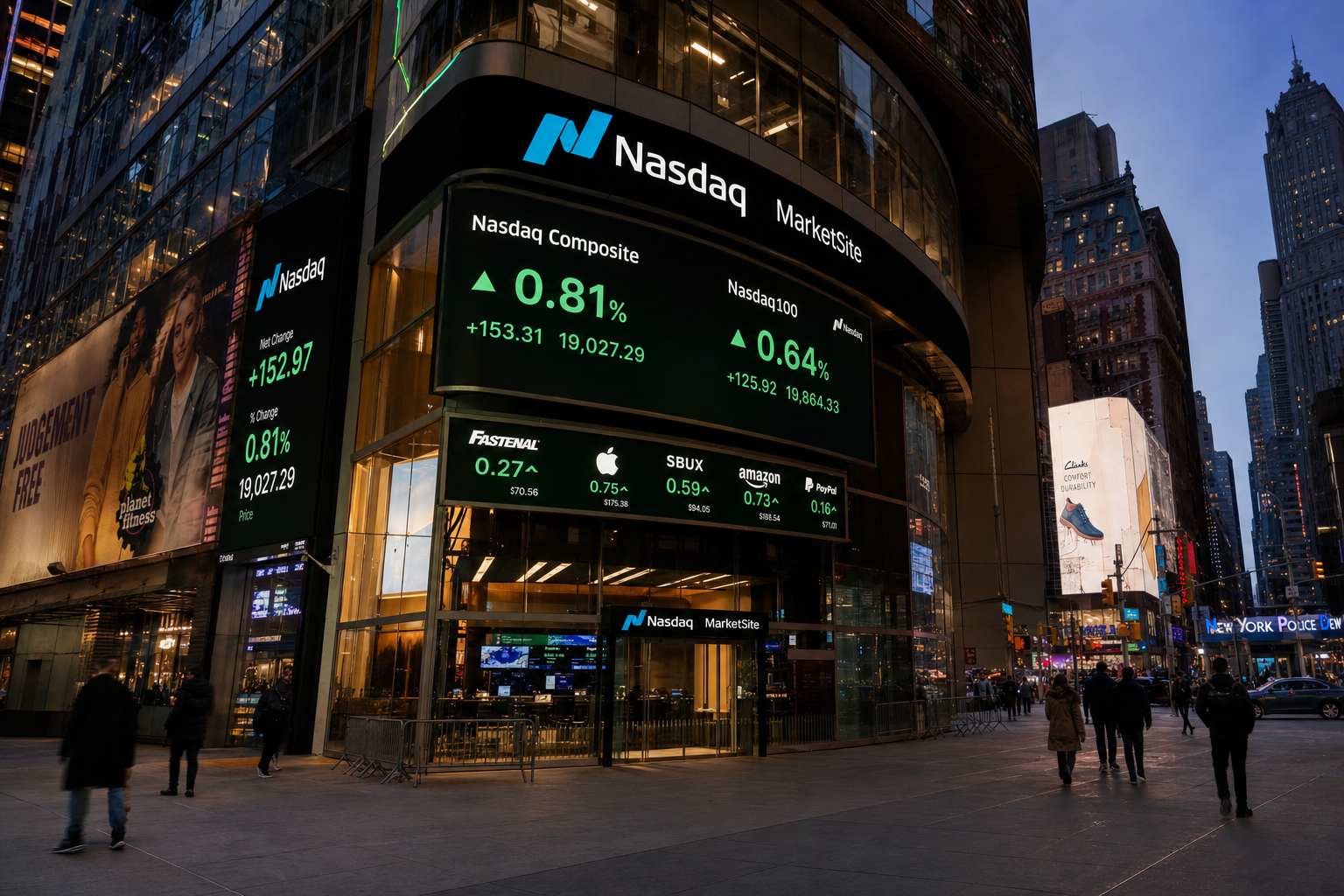
Wednesday delivered one of the more broadly constructive sessions for U.S. equities in recent memory. The S&P 500 (SPY) and Nasdaq 100 (QQQ) both closed at record highs, powered by a string of earnings beats that spanned semiconductors, cloud infrastructure, consumer media, and consumer electronics. This was not a single-stock story. The rally had breadth, and the breadth had a unifying theme: artificial intelligence capital spending is no longer a promise — it is showing up in revenue.
Chip stocks led the advance, with AMD (AMD) and Micron (MU) among the standout performers. Nvidia (NVDA) gained 5% on news of a new supply partnership. Corning (GLW) surged 14%. The day's winners were spread across the hardware stack, from processors to fiber optic cable, which itself says something about where this investment cycle has reached.
Winners and Losers
AMD set the tone early. The company reported first-quarter earnings that beat analyst estimates on both profit and revenue, then followed with second-quarter guidance that also topped consensus forecasts. The double beat prompted a broad round of upward price target revisions from Wall Street. AMD's data center GPU business — processors designed for the parallel computations that AI workloads demand — has been the engine, and the results confirmed that engine is still accelerating.
Meta Platforms (META) delivered a significant earnings-per-share beat, with the outperformance partly driven by capitalized research and development costs. The company simultaneously announced plans to invest up to $145 billion in AI infrastructure — a commitment that places it among the most aggressive spenders in the current buildout cycle alongside Amazon and Microsoft. Analysts estimate total AI capex commitments across major technology firms now approach $725 billion.
Amazon (AMZN) posted its fifth consecutive quarter of beating Wall Street's earnings-per-share expectations. CEO Andy Jassy separately announced $200 billion in capital expenditure for 2026, described as the largest single-year infrastructure investment in corporate history. The analyst community's conviction is striking: 60 of 65 analysts covering AMZN rate it a buy, with none recommending a sale. Amazon also launched a Supply Chain Services platform that opens its logistics network to external businesses, a move that could broaden revenue beyond retail and cloud.
Apple (AAPL) reported $111.18 billion in March-quarter revenue, its best result ever for that period. The headline number arrived alongside reports that Apple is in discussions to use Intel (INTC) and Samsung as domestic U.S. chip suppliers — a potential departure from Apple's long-standing reliance on Taiwan Semiconductor Manufacturing Company. Intel, which separately achieved a sixth consecutive quarter of revenue beats, would be a notable beneficiary if the arrangement is confirmed. Neither company has publicly confirmed the talks.
Disney (DIS) beat second-quarter expectations with streaming profitability as the primary driver. After years of absorbing heavy losses in its direct-to-consumer segment, the division has become a meaningful earnings contributor. Analysts are now focused on what comes next: a so-called "super app" concept being developed under parks chairman Josh D'Amaro — a platform that could integrate theme parks, streaming, and commerce into a single digital experience — is being discussed as a potential re-rating catalyst, though it remains in development.
Micron's session deserves its own line. MU shares rose 11%, pushing the company's market capitalization above $700 billion. The move was attributed to surging demand for high-bandwidth memory — a chip architecture designed to move large volumes of data quickly between processors and storage — which has become essential in AI training and inference workloads.
The Nvidia-Corning Signal
The deal that may carry the most forward-looking significance was not an earnings report. Nvidia and Corning entered a multiyear commercial and technology partnership valued at $500 million, centered on expanding U.S. production of optical connectivity products for AI data centers, including plans to establish new fiber optics manufacturing plants.
Corning's 14% stock surge reflected the market's read on what the deal implies: as GPU clusters scale up, the high-speed connections between chips and servers become a limiting factor. Optical fiber — which transmits data as light rather than electrical signals — offers the bandwidth and low latency those systems require. Nvidia investing $500 million to secure that supply chain signals that the company views optical connectivity not as a commodity input but as a strategic constraint worth addressing directly.
Corning raised its long-term sales targets following the announcement. For a company historically associated with specialty glass and display technologies, the deal represents a significant strategic repositioning toward AI infrastructure supply chains.
Under the Surface
The session's breadth was its most important characteristic. A rally driven solely by one or two mega-cap beats is easier to dismiss as rotation or short-covering. Wednesday's advance touched semiconductors (AMD, Nvidia, Micron), cloud and consumer internet (Meta, Amazon), consumer media (Disney), and consumer hardware (Apple) — all in the same session, all with distinct fundamental drivers.
The AI infrastructure theme cascaded visibly down the supply chain. Hyperscaler spending commitments — Amazon's $200 billion capex, Meta's $145 billion infrastructure pledge, Anthropic's reported five-year, $200 billion Google Cloud commitment — are now translating into concrete vendor deals and physical manufacturing investments. Corning's surge illustrated how that capital flows beyond the chip designers into fiber, cables, and connectors.
The Apple-Intel chip sourcing talks, if confirmed, would add another dimension: a potential reshaping of domestic semiconductor manufacturing that carries implications for supply chain resilience, tariff exposure, and the competitive dynamics of the foundry industry.
Tomorrow's Setup
Alphabet (GOOGL) remains a name to watch closely. Anthropic's reported commitment to spend roughly $200 billion on Google Cloud over five years gives Alphabet a concrete, long-term revenue anchor tied directly to AI growth — a meaningful signal for investors who have questioned whether cloud providers can convert AI investment into durable earnings. Cloud revenue figures will be the key data point to track as Alphabet's results come into focus.
The Apple-Intel chip sourcing story is unconfirmed but consequential. If talks advance toward a formal agreement, it would become one of the more significant manufacturing realignments of the current trade policy era, with implications that extend well beyond either company's income statement.
The broader question heading into the remainder of earnings season is whether the current momentum holds as results move beyond the largest technology names. Wednesday's session validated the AI infrastructure thesis with unusual clarity. The next test is whether that validation extends to the companies one tier down the supply chain — and whether the capital expenditure commitments being made today eventually translate into the return on investment that justifies them.