Apple-Intel Chip Deal Triggers Sector Rotation as Private Capital Floods AI Infrastructure
A preliminary manufacturing agreement between Apple and Intel — backed by a U.S. government stake — is reshaping how investors think about the AI hardware trade, with capital rotating away from Nvidia toward legacy chipmakers and private credit filling the funding gap.
The Deal That Changed the Conversation
For the better part of two years, the AI hardware trade had one center of gravity: Nvidia (NVDA). Friday's session complicated that picture in ways that could take months to fully price in.
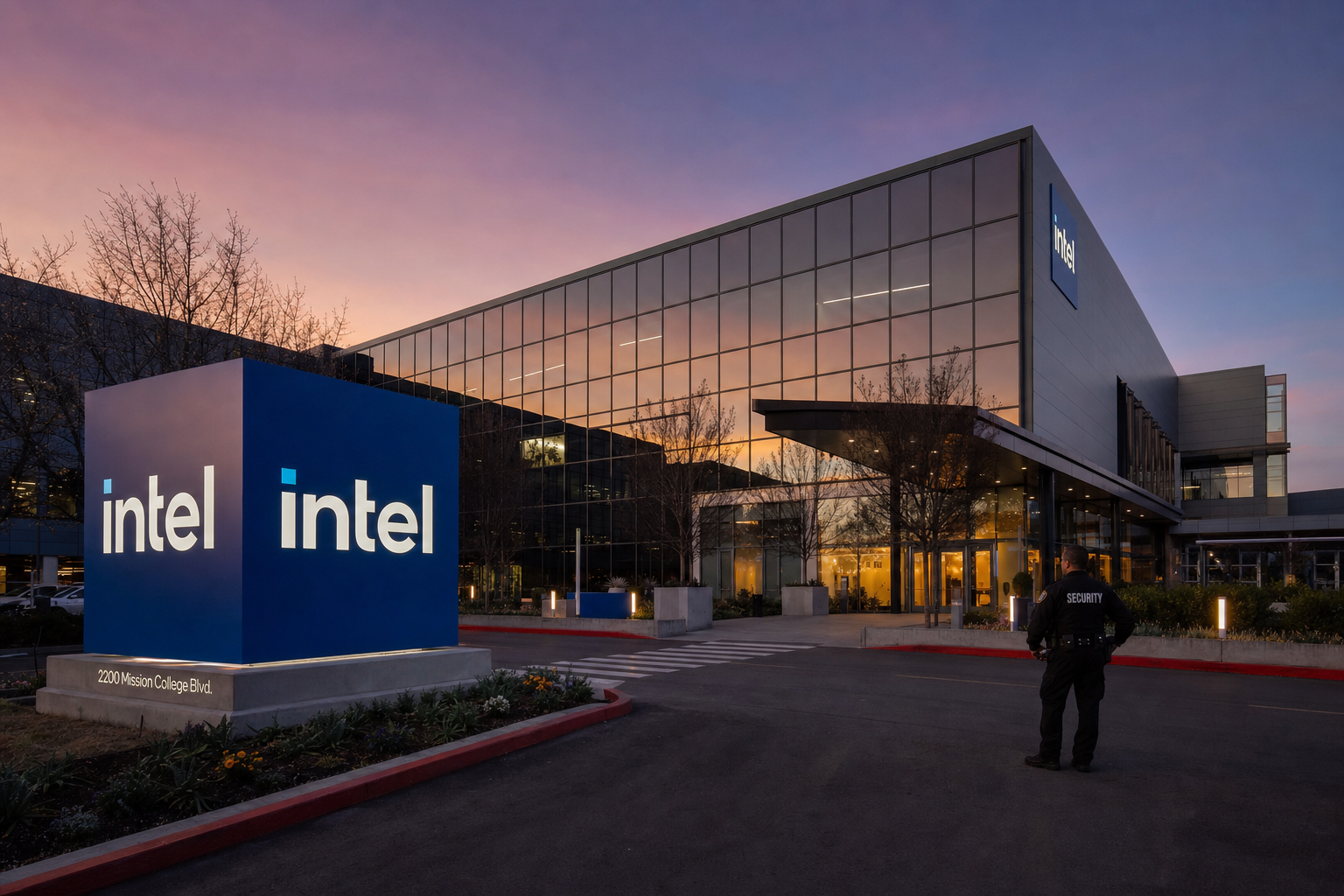
Intel (INTC) shares rose approximately 14% after the Wall Street Journal reported a preliminary chip-manufacturing agreement with Apple (AAPL). The deal, which came after more than a year of negotiations and was reportedly facilitated by the U.S. government's roughly 10% stake in Intel, would make Apple a customer of Intel's contract foundry business — the division Intel has been building to compete with Taiwan's TSMC and South Korea's Samsung.
The single-day gain extended what had already been a striking recovery: Intel shares had risen approximately 116% over the prior month heading into Friday. The U.S. government's stake in the company gained an estimated $47.6 billion in value on the news, bringing its reported total to approximately $56.5 billion.
Those are not rounding errors. They reflect how much was riding on Intel's ability to prove its foundry model could attract a marquee customer — and Apple is as marquee as it gets.
Why Apple, and Why Now
Apple's chip strategy has been one of the technology industry's most closely watched supply chains. The company designs its own silicon — the A-series chips in iPhones, the M-series in Macs — but manufactures them externally, and TSMC has been the near-exclusive production partner since Apple severed its relationship with Intel for Mac processors in 2020.
Diversifying away from TSMC is not a new ambition for Apple. The concentration of advanced chip manufacturing in Taiwan has long been flagged as a geopolitical and operational risk by executives, analysts, and U.S. policymakers alike. What changed is that Intel has spent several years and tens of billions of dollars rebuilding its manufacturing infrastructure, and the U.S. government — through its CHIPS Act investments and its direct equity stake in Intel — has a strong institutional interest in seeing that infrastructure find paying customers.
The deal remains preliminary. Terms have not been disclosed, and preliminary agreements in semiconductor manufacturing can take years to translate into actual production volumes. But the signal it sends — that Intel's foundry is capable of attracting Apple-level demand — is itself a market-moving event independent of the near-term revenue implications.
A Rotation, Not Just a Rally
The broader chip sector's reaction to the Intel news revealed something important about where institutional sentiment sits heading into the summer.
AMD (AMD) and Micron (MU) both rose alongside Intel, while Nvidia — the sector's dominant name — underperformed the group. Analysts described the session as a potential "changing of the guard" in AI chips: a shift in which investors begin pricing in a wider field of beneficiaries as the infrastructure buildout matures.
The logic is straightforward. Nvidia's H100 and Blackwell GPU families have been the primary engines of AI training and inference workloads, and the company's stock has reflected that dominance. But as AI spending broadens — from hyperscale cloud training to edge inference, custom silicon, and memory-intensive applications — the addressable market expands beyond any single architecture. AMD competes directly with Nvidia in data center GPUs. Micron supplies the high-bandwidth memory that AI systems require in enormous quantities. Intel, with its foundry capacity and its x86 server installed base, occupies a different but potentially complementary position.
Nvidia's relative underperformance on Friday does not signal a fundamental problem with the company's business. It signals that investors who have held Nvidia through a sustained rally are beginning to ask where the next leg of outperformance comes from — and whether some of that capital might find better risk-adjusted returns in names that have not already priced in AI dominance.
Private Capital Moves In
While the Intel-Apple deal dominated headlines, a separate development illustrated just how large the AI infrastructure financing requirement has become.
Apollo Global Management (APO) and Blackstone (BX) are reportedly in discussions to provide approximately $35 billion in financing to Broadcom (AVGO) for AI chip development. No final agreement has been announced, and terms remain undisclosed. But the scale of the reported talks — $35 billion from two of the world's largest alternative asset managers — places this among the largest private credit transactions the technology sector has ever seen.
Broadcom has carved out a significant position in custom AI silicon, designing application-specific integrated circuits for major cloud customers including Google. That business requires sustained capital investment, and the traditional funding mechanisms — bank loans, public bond issuance, equity raises — move too slowly or impose terms that don't suit the pace of AI infrastructure development.
Private credit has stepped into that gap across multiple sectors over the past several years, but its arrival in semiconductor infrastructure at this scale is relatively new. The Apollo-Blackstone-Broadcom discussions reflect a structural shift: the AI buildout is now large enough, and its cash flows predictable enough, that institutional lenders are willing to underwrite it at sovereign-debt-like scale.
The Dissenting View
Not everyone spent Friday adding chip exposure.
TCI Fund Management, a prominent hedge fund, exited an approximately $8 billion position in Microsoft (MSFT), citing concerns about long-term competitive pressure in artificial intelligence. Microsoft shares fell on the disclosure. The fund's stated rationale — that rivals including Google, Meta, and a range of open-source models may erode Microsoft's early AI advantage — represents a coherent institutional view, even if it runs against the prevailing bullish sentiment.
The size of the exit matters. An $8 billion conviction position is not a tactical trade; unwinding it signals a meaningful shift in a sophisticated fund's long-term thesis. TCI's concern is not that Microsoft's current AI products are failing — the company reported strong recent earnings — but that durable competitive advantage in AI software is harder to sustain than the current valuation implies.
Other analysts have argued the opposite: that Microsoft, Nvidia, and Apple may be trading at their most attractive valuations in years following the recent earnings season. The divergence between TCI's exit and that view illustrates the central tension in mega-cap technology right now. Strong near-term fundamentals and uncertain long-term moats are not mutually exclusive, and the market is still working out how to price that combination.
The Geopolitical Dimension
The Apple-Intel deal does not exist in a vacuum. It sits at the intersection of commercial strategy and industrial policy in ways that few technology agreements do.
The U.S. government's stake in Intel — acquired as part of the CHIPS Act framework designed to rebuild domestic semiconductor manufacturing — means the federal government is now a direct financial beneficiary of Intel's commercial success. The reported $47.6 billion gain in the value of that stake is not just a financial footnote; it represents a validation of the policy bet that subsidizing Intel's foundry ambitions would eventually attract private-sector demand.
For Apple, the geopolitical calculus is equally clear. Reducing dependence on TSMC — a company whose primary manufacturing facilities sit within range of potential conflict in the Taiwan Strait — is a supply-chain risk management decision as much as a commercial one. A domestic U.S. manufacturing partner for even a portion of Apple's chip needs provides optionality that no amount of TSMC capacity expansion can fully replicate.
That alignment of commercial and policy interests is part of why this deal, even in its preliminary form, carries weight beyond the immediate revenue numbers.
What to Watch
The most important near-term question is whether the Apple-Intel agreement advances toward a formal contract — or quietly stalls, as preliminary semiconductor deals sometimes do. Any official confirmation of scope, timeline, or specific product lines would be a significant catalyst for Intel shares and for the broader foundry investment thesis.
On the financing side, the Apollo-Blackstone-Broadcom discussions will be worth monitoring for structure and terms. A $35 billion private credit package at closing would represent a data point about the cost of AI infrastructure capital that the market does not currently have visibility into.
Microsoft's trajectory following TCI's exit will also be informative. If other large institutions follow TCI's logic and reduce exposure, the stock's response will test whether retail and remaining institutional buyers can absorb that supply at current levels. If MSFT holds or recovers, it suggests the market is discounting TCI's competitive concerns.
The chip rotation that defined Friday's session — legacy names up, Nvidia lagging — is not a verdict. It is a question the market is beginning to ask about who captures the next phase of AI infrastructure value. The answer will take longer than one session to arrive.