Alphabet's $80B Equity Shock Splits the AI Trade in Two
Alphabet's record share offering has fractured the AI trade: the issuer bleeds market cap while hardware suppliers surge, revealing who actually profits when hyperscalers open their wallets.
The Morning's Defining Trade
Alphabet's decision to raise $80 billion in new equity landed on markets like a controlled detonation. GOOGL fell roughly 2.9% in the morning session, putting the company on pace for its largest single-day market capitalization loss on record — an estimated $208 billion erased. The reaction was not panic; it was arithmetic. When a company that spent years aggressively buying back its own shares abruptly reverses course to sell new ones, existing shareholders do the math on dilution and sell first.
The offering's structure is worth understanding clearly. It combines a $30 billion public share sale, preferred stock, and a $10 billion private placement to Berkshire Hathaway (BRK.A, BRK.B). Warren Buffett's firm anchoring the deal is a genuine endorsement — Berkshire does not write $10 billion checks as a courtesy. But the anchor does not neutralize the dilution math for the millions of shareholders who are not Berkshire, and the market is pricing that gap precisely.
The deeper signal is what the raise admits: AI infrastructure costs have grown large enough to outpace even Alphabet's considerable free cash flow. This is not a company struggling to fund operations. This is a company that has concluded the AI arms race requires more capital than organic generation can provide, and it is willing to pay the dilution price to stay at the front.
Where the Money Is Actually Going
The session's sharpest divergence is between the issuer and its suppliers. While GOOGL absorbed the dilution hit, the hardware supply chain treated Alphabet's commitment as a purchase order for the entire sector.
Broadcom (AVGO) rose 6% on the implied surge in custom AI accelerator demand. Marvell Technology (MRVL) surged 17% after Nvidia CEO Jensen Huang publicly endorsed the company's role in AI networking infrastructure — a catalyst that compounded the Alphabet spending signal. Micron Technology (MU) continued its climb toward a $1 trillion valuation on the back of high-bandwidth memory demand tied to AI training workloads.
Hewlett Packard Enterprise (HPE) delivered the session's most dramatic single-stock move: shares jumped as much as 27% after the company reported its biggest earnings beat since 2018. HPE also said it expects to reach its 2028 financial targets by 2026 — a two-year acceleration that the market treated as confirmation that AI infrastructure demand is translating into real revenue, not just forward guidance.
Taken together, the morning session drew a clear line: the companies selling the shovels are winning this gold rush more cleanly than the companies funding the mines.
The Salesforce and SpaceX Subplots
Two secondary stories added texture to the AI spending theme without moving the broader tape.
Salesforce (CRM) announced a $5 billion strategic investment in Anthropic — the AI safety company backed by Amazon and Google — alongside a separate acquisition of content platform Contentful. The Anthropic commitment is one of the largest single investments in an AI model developer by an enterprise software company, and it signals that Salesforce is betting on foundation model access as the faster path to competitive AI features rather than building its own. Shares have been trading at what some analysts describe as undervalued levels relative to peers; the market will be watching whether these moves compress that discount or simply add to the cost base.
SpaceX remained in focus for different reasons. The company is negotiating underwriting fees below 0.75% with a syndicate that includes Goldman Sachs, Morgan Stanley, BofA Securities, Citigroup, and J.P. Morgan for an IPO targeting roughly $75 billion in proceeds. Separately, reports surfaced that a potential Tesla-SpaceX merger could activate a $1 trillion compensation package for Elon Musk without requiring Tesla (TSLA) to meet its existing operational performance milestones — a governance detail that adds complexity to how investors read any merger speculation. Tesla's own operational data was constructive: China-manufactured vehicle deliveries rose 39.4% year-over-year in May, a strong result in the world's most competitive EV market.
What the Afternoon Session Needs to Resolve
The central question heading into the afternoon is whether GOOGL finds a stabilization level or continues drifting lower as the offering's full dilution impact is absorbed. Large equity raises of this scale typically see the issuer's stock pressure ease once the deal is priced and the overhang is quantified — but Alphabet has not yet provided final pricing details, which means the uncertainty premium stays in the stock.
Watch the semiconductor complex for signs that the morning's chip rally holds. AVGO and MRVL moved on a combination of the Alphabet spending signal and Nvidia's Jensen Huang endorsement of Marvell specifically. If either catalyst fades in afternoon commentary, the moves could give back ground quickly.
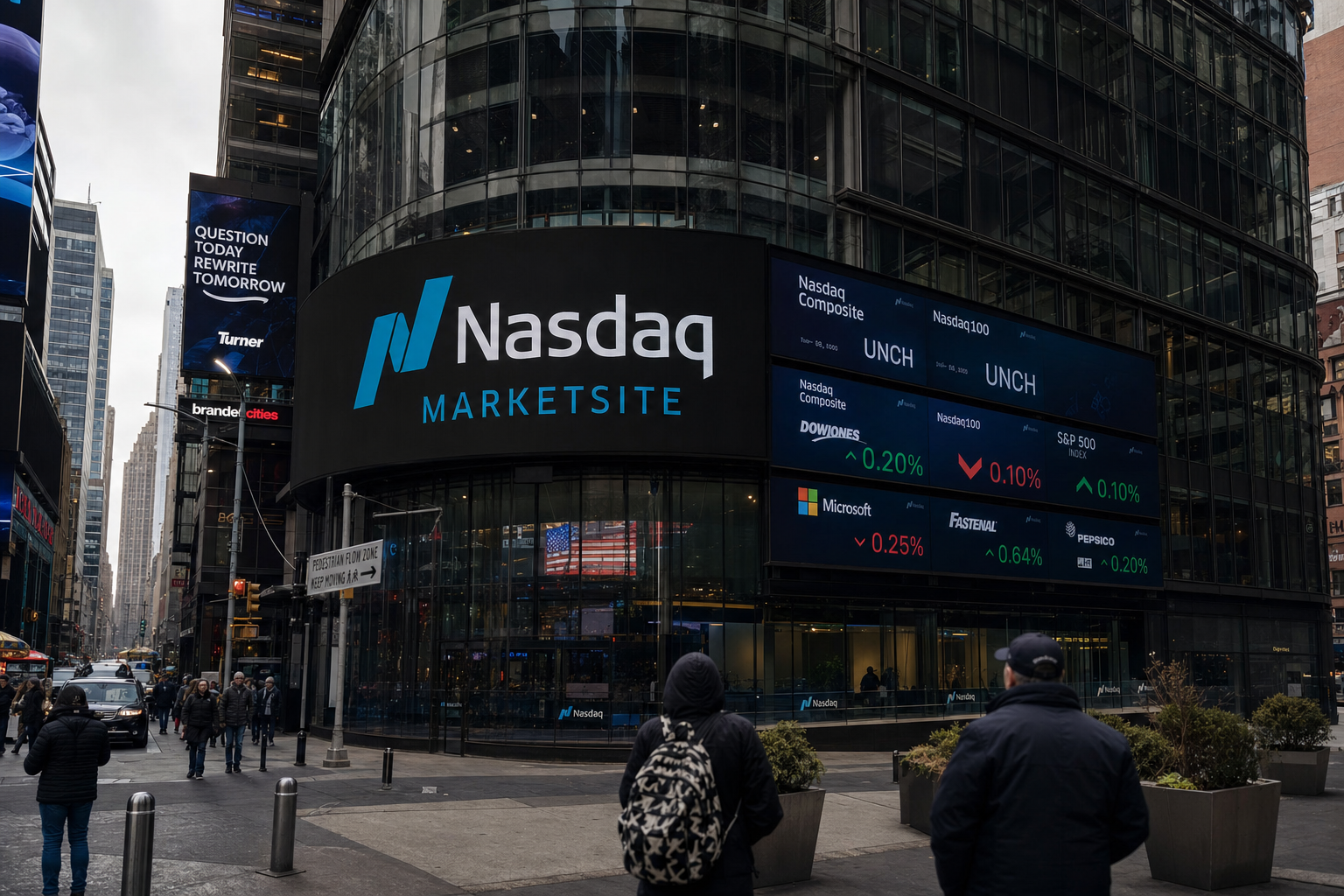
The broader Nasdaq is carrying a split personality into the afternoon: HPE's 27% surge and the chip rally are pulling one direction, while GOOGL's $208 billion market cap loss pulls the other. The net effect on index levels will depend on which weight dominates — and GOOGL's index weight is substantial.
Any Federal Reserve commentary that surfaces this afternoon carries added relevance given the scale of AI capital commitments now visible across the sector. The implicit assumption in Alphabet's raise, Salesforce's Anthropic bet, and the chip rally is that rates will remain manageable enough to justify long-duration AI spending. A hawkish signal would test that assumption directly.