AI Reshapes Capital: Utility Mega-Merger and Nvidia Earnings Define the Week
A $66.8 billion utility deal and a $79 billion revenue target for Nvidia reveal how artificial intelligence is now the primary force allocating capital across asset classes.
The Session in Brief
Monday closed with two stories dominating the conversation — one from the utility sector, one from semiconductors — and a shared origin point tying them together. NextEra Energy (NEE) announced it would acquire Dominion Energy (D) in an all-stock deal valued at $66.8 billion, creating the world's largest regulated electric utility. Hours earlier, the market had already been pricing in anticipation of Nvidia (NVDA) reporting fiscal Q1 2027 results on Wednesday, with analyst consensus sitting at $79 billion in revenue.
The day was not a clean risk-on or risk-off session. Geopolitical pressure from stalled U.S.-Iran diplomacy and Goldman Sachs flagging a Strait of Hormuz closure as the market's most obvious near-term downside risk kept a ceiling on enthusiasm. Yet the structural story — artificial intelligence driving capital allocation across power infrastructure, semiconductors, and now conglomerate portfolios — was impossible to ignore.
The Merger That Rewrites the Utility Map
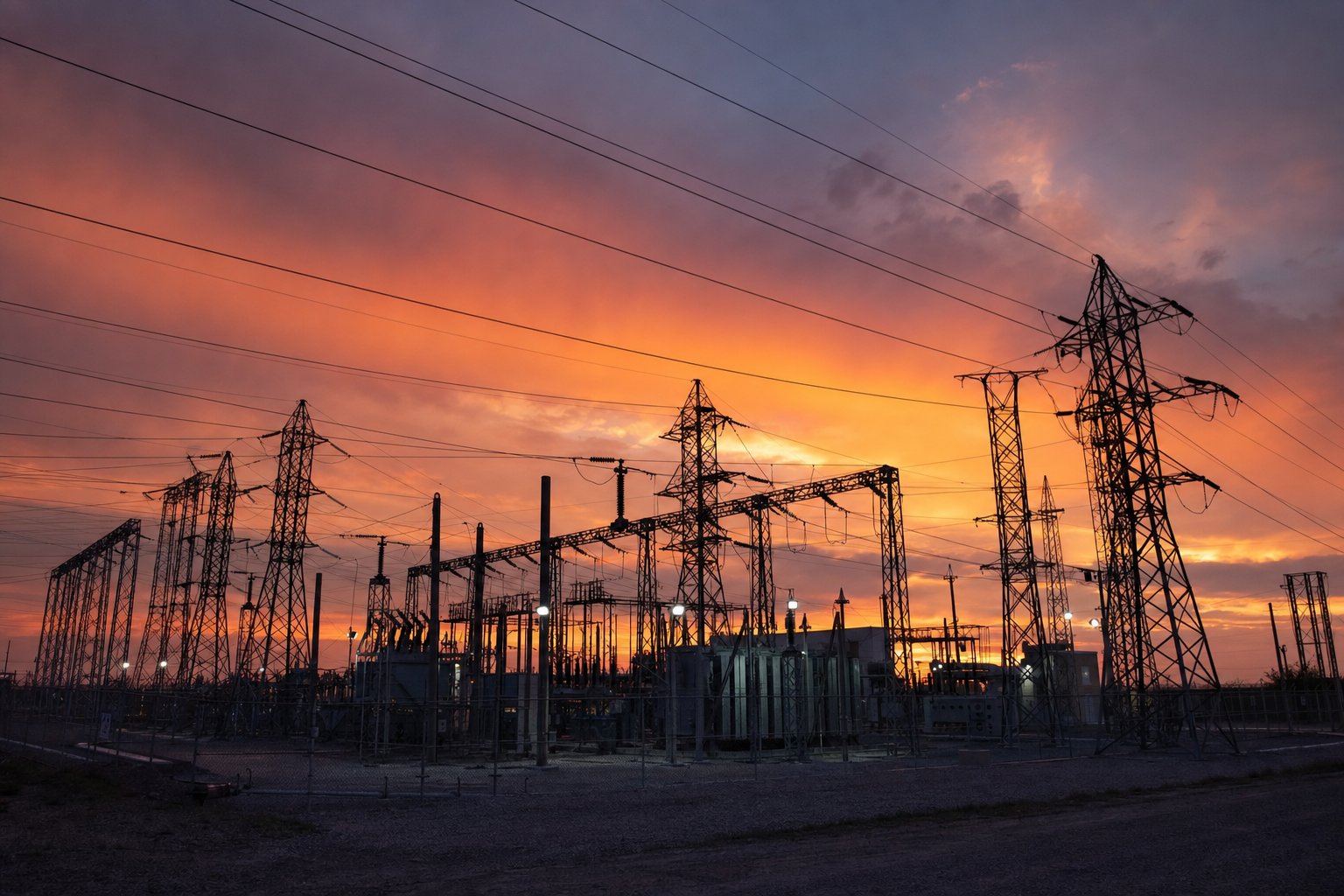
The NextEra-Dominion deal is the session's defining event. At $66.8 billion in an all-stock structure, it ranks among the largest utility transactions in U.S. history. The combined entity would serve 10 million customers, adding Dominion's mid-Atlantic and Southeast grid footprint to NextEra's existing renewable operations, which already make it the world's largest producer of wind and solar energy.
The deal's stated rationale is explicit: AI data centers operated by Amazon Web Services (AMZN), Alphabet (GOOGL), Microsoft (MSFT), and Meta (META) are consuming power at a rate that is straining regional grids. Scale and grid reliability, the logic goes, translate directly into the ability to sign long-term power purchase agreements with hyperscale technology companies.
In an all-stock deal, Dominion shareholders receive NextEra shares rather than cash, meaning they absorb both the upside and the execution risk of the combined company. Regulatory approval will require sign-off from the Federal Energy Regulatory Commission and multiple state utility commissions — a process that typically runs 12 to 18 months for transactions of this complexity.
For equity investors, the immediate question is whether NEE's shares can sustain the premium implied by the deal structure while that review plays out. For the broader market, the merger signals that regulated utilities — historically viewed as slow-growth, yield-oriented holdings — are being repriced as critical AI infrastructure.
Nvidia: The Week's Primary Catalyst
With the merger announced, attention shifts to Wednesday. Nvidia's fiscal Q1 2027 earnings carry outsized weight not just for the stock itself but for the semiconductor complex and AI-exposed equities broadly.
Analysts are forecasting $79 billion in revenue — a figure that reflects continued demand for Nvidia's chips used in AI model training and inference. QQQ, which tracks the Nasdaq-100, and semiconductor ETFs SMH and SOXX all carry significant Nvidia weightings, meaning a meaningful earnings surprise in either direction ripples through passive portfolios at scale.
The headline numbers may matter less than the call itself. CEO Jensen Huang's commentary on China chip sales will draw particular scrutiny following recent U.S.-China diplomatic activity. Export restrictions on advanced chips to China have been a recurring overhang for Nvidia's revenue outlook, and any shift in tone — even absent a formal policy change — could move the stock independently of the reported figures.
The broader semiconductor sector has been rallying in anticipation of strong AI-driven results. That positioning raises the stakes: if Nvidia delivers but Huang strikes a cautious note on China, the reaction in INTC, AMD, and AVGO could be as significant as the move in NVDA itself.
Under the Surface: Energy Risk and Macro Crosscurrents
Beneath the AI narrative, energy markets carried a distinct warning tone on Monday. Goldman Sachs named a re-escalation of Middle East conflict — specifically a prolonged closure of the Strait of Hormuz — as what it called the most obvious downside threat facing financial markets. The Strait is a narrow waterway between Iran and Oman through which a substantial share of the world's seaborne oil passes; a sustained closure would disrupt crude supply chains and drive sharp moves in energy prices and inflation expectations.
Chevron (CVX) CEO Mike Wirth reinforced that concern, warning that drained commercial inventories and reduced Middle Eastern output are creating conditions for physical oil shortages — a scenario distinct from price volatility, where actual barrels become unavailable regardless of what buyers are willing to pay.
Stalled U.S.-Iran diplomacy contributed to futures weakness earlier in the session. Wall Street strategists noted that the post-earnings tailwind that supported equities through the recent reporting season is fading, with an inflation uptick beginning to generate sell signals. Higher oil prices feed directly into inflation readings, complicating the Federal Reserve's path toward rate cuts and applying mechanical pressure to growth stock valuations.
Intel, Apple, and the Domestic Chip Push
Intel (INTC) and Apple (AAPL) reached a preliminary agreement for U.S.-based chip production, according to reports. The arrangement is supported by government initiatives aimed at reducing American reliance on overseas semiconductor manufacturing — particularly the concentration of advanced chip production in Taiwan.
For Intel, which has been investing heavily in its foundry business — manufacturing chips designed by other companies — landing Apple as a customer would be a significant commercial milestone. Apple currently relies primarily on Taiwan Semiconductor Manufacturing Company for production. The deal remains preliminary, meaning final terms have not been confirmed, but it adds momentum to the domestic reshoring push and could affect how investors assess Intel's foundry ambitions relative to its current valuation and ongoing restructuring.
Berkshire Signals a New Hand at the Wheel
Greg Abel, who succeeded Warren Buffett as CEO of Berkshire Hathaway, disclosed a notable portfolio reshaping. Berkshire sold 16 positions — including stakes in Visa (V), Mastercard (MA), Amazon (AMZN), and UnitedHealth Group (UNH) — while nearly tripling its stake in Alphabet to approximately 58 million shares.
The concentration into Alphabet is a meaningful signal. Berkshire under Buffett was historically cautious about large-cap technology, with Apple being the prominent exception. Abel's decision to build aggressively in GOOGL — a company with dominant positions in search, cloud, and AI infrastructure through DeepMind — suggests a deliberate tilt toward the AI theme at the portfolio level. The exits from payment networks and healthcare reduce sector diversification but free capital for higher-conviction bets.
Berkshire's moves are tracked closely by institutional and retail investors alike because of the firm's scale and the historical signal value of its positioning decisions. Abel's first major portfolio imprint points toward the same thesis animating the NextEra-Dominion deal and the anticipation around Nvidia: AI is the organizing principle of capital allocation in 2026.
Wednesday's Setup
Nvidia's earnings report is the week's clearest near-term catalyst. The $79 billion revenue consensus is high, and the market's positioning reflects that. Any miss on the headline, or a cautious tone from Huang on China, could unwind semiconductor gains quickly. A beat with constructive China commentary would likely extend the rally in QQQ, SMH, and SOXX.
The NextEra-Dominion deal enters its regulatory review phase. Early analyst reactions and any FERC commentary on the deal's structure will be worth monitoring, as will NEE's share price — the currency Dominion shareholders are receiving.
On the macro side, energy market developments and any diplomatic movement on Iran will remain live variables. Goldman's Hormuz warning has not been priced into crude in a way that suggests the market views it as a base case, which means a supply disruption would catch positioning off-guard. That asymmetry is worth keeping in mind as the week develops.