AI Infrastructure Surge, Iran Inflation Risk, and a $67B Utility Mega-Deal Shape Tuesday's Session
Three converging forces — an accelerating AI buildout, geopolitical inflation warnings, and a landmark utility merger — define the market's agenda as Tuesday's session gets underway.
The Overnight Picture
Tuesday's session opens against a backdrop that has grown progressively more complicated over the past 24 hours. The macro narrative has shifted from cautious optimism to something more unsettled: geopolitical risk is re-entering inflation models, a landmark utility merger has landed, and the AI infrastructure race is producing deals large enough to reshape competitive dynamics in cloud computing.
Asian markets reflected the unease. Japan's Nikkei 225 fell 0.6% overnight, while South Korea's Kospi dropped nearly 4%, with Samsung Electronics sliding 3.8%. The moves tracked a broader anxiety about energy prices and their downstream effects on manufacturing costs — a concern that has only sharpened as economists put explicit numbers on what an Iran escalation could mean for the Federal Reserve's rate path.
U.S. pre-market futures have been absorbing a dense news cycle. The three stories that matter most for today's session each pull in a different direction: the GOOGL-Blackstone cloud venture is a structural positive for AI infrastructure investment; the Iran inflation warnings introduce a rate-risk premium that equity markets have not fully priced; and the NextEra Energy-Dominion deal raises questions about regulatory timelines, sector consolidation, and what surging power demand means for the grid.
Theme 1: Alphabet and Blackstone Bet $5 Billion on AI Compute
The most consequential corporate development overnight is the confirmed formation of a joint AI cloud venture between Alphabet (GOOGL) and Blackstone, backed by $5 billion in capital. Blackstone is expected to hold a majority stake in the new entity, which is explicitly positioned as a competitor to CoreWeave — the fast-growing AI cloud provider — and a challenge to Nvidia's (NVDA) dominance in AI compute.
The deal's structure is worth parsing carefully. This is not simply another hyperscaler adding server capacity. By bringing in Blackstone as a majority owner, Alphabet is drawing large-scale private capital into AI infrastructure in a way that treats compute capacity as a long-duration asset class — similar to how institutional money has flowed into data centers and fiber networks over the past decade. For Blackstone, it is a direct stake in the infrastructure layer that the entire AI economy runs on.
For Nvidia, the longer-term implication is more nuanced. Near-term, a $5 billion buildout almost certainly involves Nvidia hardware. But the venture's explicit competitive framing against CoreWeave — and its use of Google's proprietary TPU chips — signals that hyperscalers and their financial partners are actively working to reduce dependence on a single chip supplier. That is a structural headwind that will take years to materialize but is now clearly in motion.
Microsoft (MSFT) also received a legal tailwind this week: a jury dismissed Elon Musk's lawsuit against OpenAI and Microsoft, removing a significant overhang from OpenAI's anticipated IPO. Microsoft's position as OpenAI's largest backer is now uncontested in court, strengthening its standing ahead of what would be one of the most closely watched technology listings in recent memory.
Theme 2: Iran, Inflation, and a July Rate-Hike Warning
The macro picture has darkened in a specific and important way. Moody's Analytics chief economist warned this week that the Iran conflict risks producing what they called "unmoored inflation" — a scenario where geopolitically driven price pressures become self-reinforcing and difficult for central banks to contain. Strategist Ed Yardeni went further, raising the prospect of a Federal Reserve rate hike as early as July, a call that sits well outside the current market consensus of a hold or eventual cut.
The transmission mechanism is straightforward: Iran is a major oil producer, and a sustained conflict raises energy prices, which feed through to transportation, manufacturing, and consumer goods costs. That is the same inflationary pathway that made 2022 so difficult to navigate, and the concern is that the Fed — already walking a careful line between cooling inflation and avoiding recession — could be forced to tighten into a slowing economy.
For equity markets, a July rate-hike scenario would be particularly painful for high-multiple technology stocks, where valuations are sensitive to discount rate assumptions. Nicolas Bickel of Edmond de Rothschild Private Bank has separately warned that prolonged elevated bond yields pose a specific risk to debt-heavy companies. The OECD's Secretary General Mathias Cormann echoed the broader concern at a G7 meeting in Paris, flagging simultaneous pressure on both growth and prices.
This is not a certainty — it is a tail risk that is now being priced more explicitly. But the convergence of multiple credible voices on the same scenario makes it a theme that will follow markets through the rest of the week.
Theme 3: NextEra's $67 Billion Utility Mega-Deal
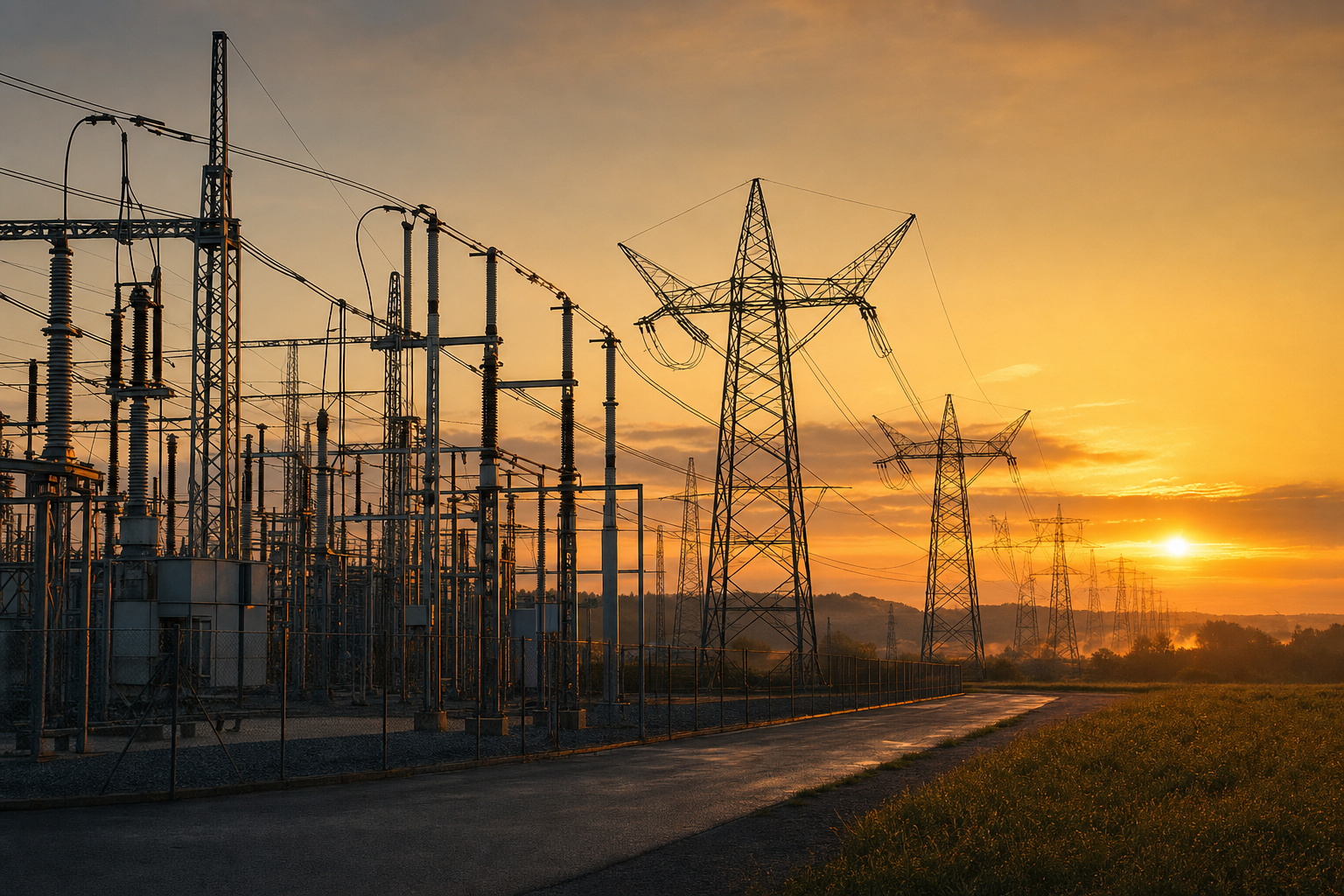
NextEra Energy has announced plans to acquire Dominion Energy in an all-stock transaction valued at approximately $67 billion, in what would rank among the largest utility mergers in U.S. history. The deal combines the world's largest producer of wind and solar energy with one of the largest power companies serving the U.S. East Coast.
The strategic logic is explicit: electricity demand is climbing sharply, driven in large part by the proliferation of AI data centers, and utilities are positioning aggressively to capture that growth. NextEra's framing of the deal around battery storage signals that grid-scale energy storage is central to the combined company's strategy — an acknowledgment that intermittent renewables alone cannot meet the baseload demands of always-on AI infrastructure.
An all-stock structure means Dominion shareholders receive NextEra shares rather than cash, avoiding large debt loads while diluting existing NextEra holders. Regulatory approval for a deal of this scale will be a lengthy process — federal and state energy regulators will scrutinize the combination carefully — but the announcement itself signals where utility capital is flowing.
The deal also connects directly to the AI infrastructure theme: every data center megawatt announced by Alphabet, Microsoft, or Amazon eventually requires a utility to deliver the power. NextEra is positioning to be that utility at scale.
The Calendar: Nvidia Earnings Are the Week's Defining Catalyst
The single most important scheduled event remaining this week is Nvidia's earnings report. The results will function as a real-time audit of the AI capital spending cycle: if data center revenue and forward guidance are strong, it validates the infrastructure buildout thesis that is driving deals like the Alphabet-Blackstone venture. If guidance disappoints — particularly on export restrictions or China market access — the reaction could be asymmetric given that Nvidia's valuation remains elevated relative to historical norms.
CEO Jensen Huang has previously said he expects China's market for high-end U.S. AI chips to open gradually over time, but the timeline remains uncertain and U.S. export controls continue to constrain that opportunity.
Any Fed commentary on the inflation outlook this week will also carry unusual weight given the Iran-related warnings from Moody's and Yardeni. Markets will be listening for whether policymakers are beginning to take the geopolitical inflation scenario seriously or treating it as a tail risk not yet worth acting on.
Watch List
Four things to track closely through Tuesday's session and the rest of the week:
NVDA pre-earnings positioning: Options activity and implied volatility around Nvidia's report will indicate how much uncertainty the market is pricing in. Watch for any analyst revisions ahead of results.
Energy prices and Iran headlines: Oil's direction is the most direct read on whether the geopolitical risk premium is expanding or contracting. A move higher in crude would immediately reinforce the Yardeni rate-hike scenario.
TSM, AMD, AVGO: The Taiwan Semiconductor Manufacturing Company (TSM), Advanced Micro Devices (AMD), and Broadcom (AVGO) all carry Taiwan supply-chain exposure that has returned to active investor discussion. Any escalation in China-Taiwan tensions would hit this group first.
NextEra and Dominion reaction: The all-stock structure means NextEra shareholders absorb dilution while Dominion holders gain NextEra exposure. Watch how both stocks settle as the market digests deal terms and begins handicapping regulatory risk.