AI Cloud Earnings Lift Markets to New Highs as Spending Divide Sharpens
Amazon, Alphabet, and Microsoft delivered the AI revenue proof investors wanted. Meta did not — and markets priced the difference with precision.
The Session
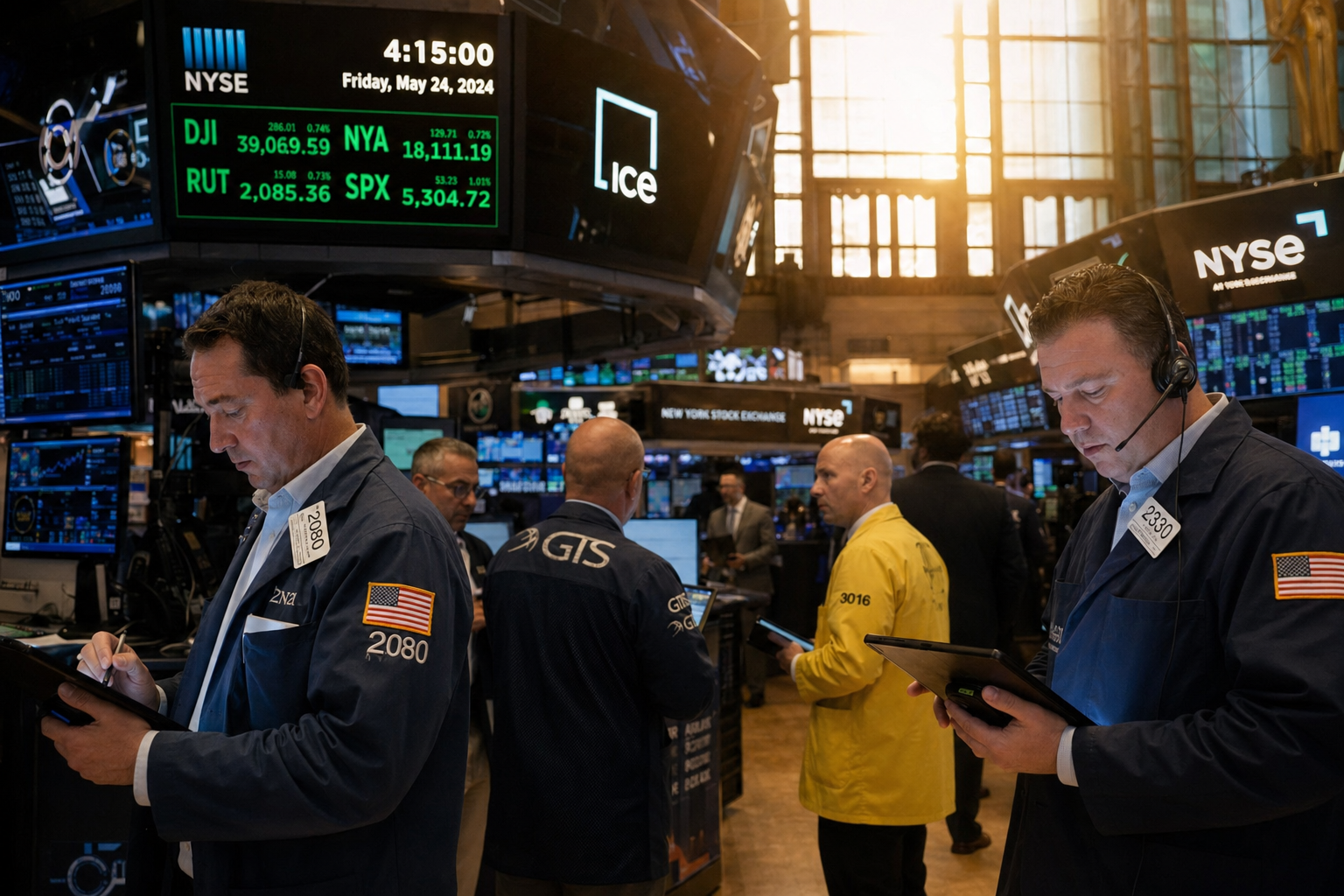
By the closing bell, U.S. equity markets had delivered one of their stronger sessions of the year. The Dow Jones Industrial Average surged 730 points, and the S&P 500 touched a new intraday high — a result that would have seemed uncertain just hours earlier, given the mixed signals embedded in the day's biggest earnings reports.
The rally was broad enough to absorb meaningful drags. META fell sharply after raising its AI spending outlook. MSFT also declined despite reporting a record quarter. Neither was enough to derail the index-level gains, partly because CAT — Caterpillar, the industrial equipment maker — surged roughly 10% on its own strong earnings, adding significant weight to the price-weighted Dow.
The session confirmed something this earnings cycle has been building toward: investors are not simply rewarding AI exposure. They are rewarding demonstrated AI revenue, and they are punishing spending commitments that lack a clear payoff timeline.
Winners and Losers
AMZN and GOOGL were the session's clear standouts among the technology names. Amazon's Q1 revenues rose 17% to $181.5 billion, with AWS — its cloud computing division — posting its fastest growth rate in 15 quarters and driving record margins. Wall Street responded by raising price targets to a range of $310 to $350. The message was direct: AWS is absorbing enterprise AI workloads at an accelerating pace, and the margin profile is improving alongside it.
Alphabet's Google Cloud crossed $20 billion in quarterly revenue, a 63% gain. Analysts at UBS noted that search and cloud together contributed more meaningfully to revenue even as costs climbed — a combination that eased persistent concerns about AI tools cannibalizing Google's core advertising business. Alphabet shares rose on the day, standing apart from the rest of the Magnificent Seven in the clarity of its investor reception.
Microsoft posted a record quarter, with cloud and AI services as the primary drivers, and outlined significant planned capital spending on AI infrastructure through 2026. Yet the stock fell. The pattern — strong results, declining shares — has become a recurring feature of this earnings cycle for companies that lead with spending commitments rather than revenue proof.
Meta's session was the starkest example of that dynamic. The company raised its AI capital expenditure outlook, a figure that rattled shareholders and prompted a downgrade from JPMorgan. Shares fell roughly 10%, erasing an estimated $175 billion in market capitalization. CEO Mark Zuckerberg's conviction in AI infrastructure investment is not in question; what the market demanded was evidence that conviction is generating returns, not just costs.
The bond market offered a counterpoint worth noting. Meta simultaneously attracted approximately $96 billion in orders for a new bond sale — a figure that signals institutional fixed-income investors remain highly confident in the company's underlying creditworthiness. Equity holders want proof of returns. Bond buyers appear satisfied with the balance sheet. The divergence between those two verdicts is one of the more analytically interesting data points of the week.
Under the Surface
Caterpillar's 10% surge deserves more attention than it typically receives in a session dominated by technology earnings. As a price-weighted component of the Dow, its move contributed meaningfully to the index's 730-point gain. More broadly, the result served as a reminder that the earnings cycle's strength is not confined to cloud and AI — industrial demand is also holding up.
The split reaction within technology — Alphabet rewarded, Microsoft and Meta punished despite broadly strong results — reflects a market that is becoming more discriminating about AI monetization. Cloud revenue growth is being treated as proof of concept. Capital expenditure guidance, absent a clear revenue bridge, is being treated as a liability.
NVDA has been a secondary thread running through this earnings season. As Alphabet and Amazon disclosed expanding in-house chip programs — Google's Tensor Processing Units, Amazon's Trainium and Inferentia silicon — investors have begun reassessing Nvidia's long-term pricing power in the AI hardware market. The concern is not an immediate loss of dominance, but a gradual compression of the addressable market as hyperscalers vertically integrate. That narrative did not resolve this session, but it did not go away either.
The Tesla (TSLA) story that crossed during the week sits outside the earnings narrative but carries its own weight. The Dawn Project, a software safety advocacy group, submitted a report to Congress linking Tesla's Full Self-Driving software to 59 deaths and calling for urgent regulatory reform. The report is an advocacy submission rather than a government finding, and Tesla has not publicly accepted its characterization of FSD as a causal factor. But congressional attention to autonomous vehicle safety could accelerate oversight at the National Highway Traffic Safety Administration, with implications for Tesla's robotaxi ambitions and the broader self-driving sector.
Tomorrow's Setup
AAPL is the most significant catalyst still outstanding from this earnings cycle. The company announced this week that hardware engineering chief John Ternus will succeed Tim Cook as CEO on September 1 — one of the most significant leadership transitions in corporate technology in years. The question analysts are circling is whether Ternus will use the earnings call to articulate a clearer AI strategy than Apple has offered publicly to date.
Apple has been notably quieter than Microsoft, Amazon, and Alphabet on AI infrastructure spending commitments. That measured posture has contributed to the stock lagging peers in the AI rally. Nvidia has surpassed Apple as the defining stock of the AI boom, a shift that adds context to the pressure on incoming leadership. When Apple reports, investors will be watching for any signal — in capital spending guidance, product roadmap commentary, or Ternus's own framing — that the company is closing that gap.
The broader market setup heading into the next session is constructive but conditional. The S&P 500's new intraday high reflects genuine earnings strength. The divergence between cloud winners and AI spending skeptics reflects a market that has grown more precise in how it allocates that optimism. Any company reporting into that environment next week will face the same basic test that defined this one: show the revenue, or explain the spending.