AI Chips Mint Trillion-Dollar Milestones as Markets Close at Records
A session defined by semiconductor valuations that would have seemed impossible a year ago, Wall Street target upgrades, and a Fed chair who wants investors to slow down.
The Session
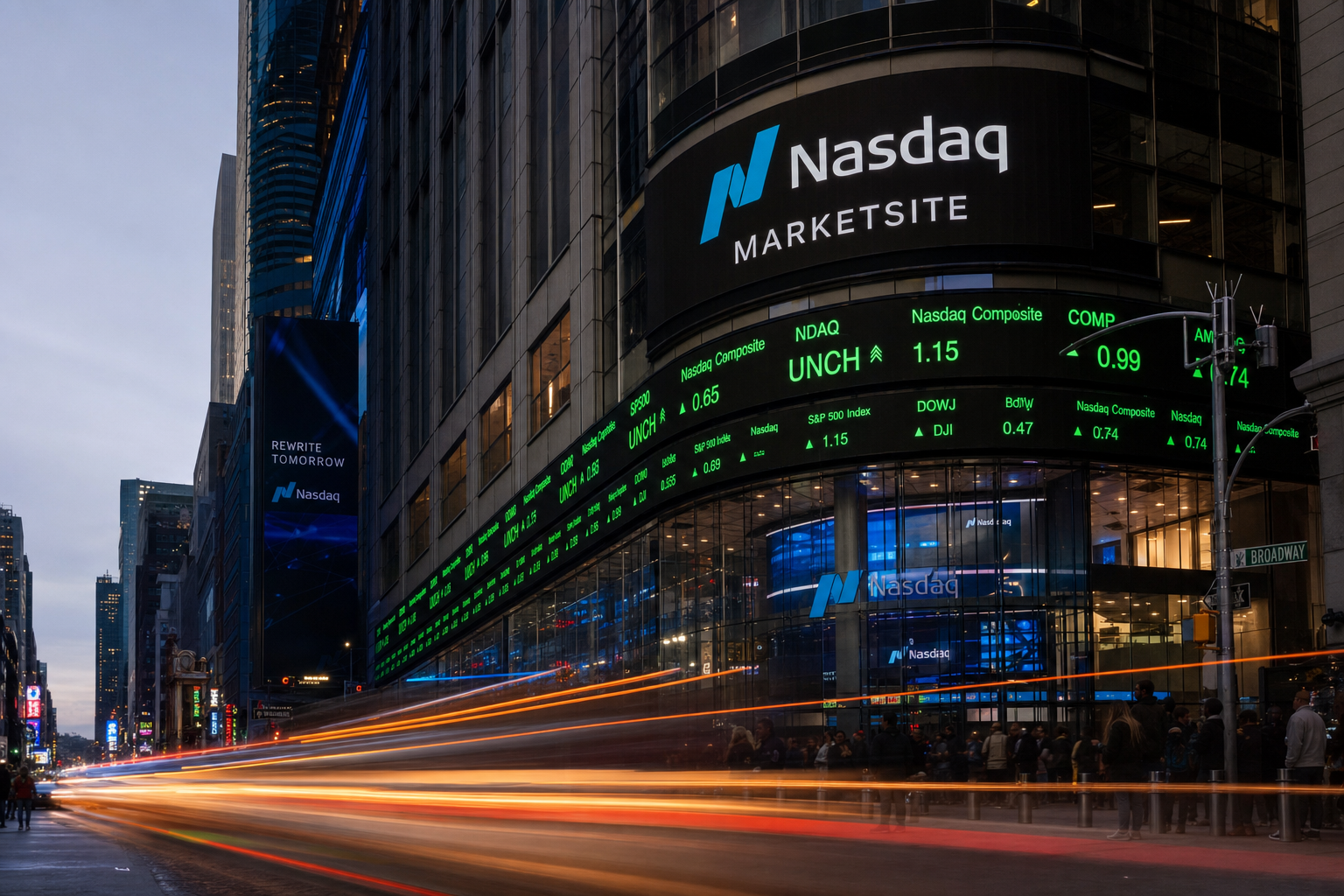
Wednesday's close was not a surprise — it was a confirmation. The S&P 500 and Nasdaq 100 extended their record highs, capping a session that was dominated by a single, compounding theme: the AI infrastructure buildout is now producing trillion-dollar market capitalizations at a pace the market has rarely seen.
Micron Technology (MU) crossed $1 trillion in market value during the session, a figure that would have been dismissed as fantasy not long ago. The company carried a market cap below $70 billion a year ago. It has now overtaken JPMorgan Chase, Walmart, and Eli Lilly in the rankings of the most valuable U.S. companies. South Korea's SK Hynix (SKHYY) crossed the same threshold in near-simultaneous fashion. Two memory chipmakers, in the same week, joining a club that once belonged almost exclusively to consumer technology platforms.
Micron's shares gained 19% in the stretch leading into today's close. Some Wall Street analysts have suggested the stock could double from current levels — a target that, as several observers noted, has historically marked both genuine inflection points and late-cycle excess in equal measure.
Winners and Losers
Semiconductors led the session broadly. The memory chip re-rating is not isolated to MU and SK Hynix — it reflects a structural reassessment of what the AI buildout requires. High-bandwidth memory has emerged as a critical bottleneck in large-scale AI infrastructure, and the companies that produce it are being repriced accordingly.
Nvidia (NVDA) remained a central reference point throughout the session, and its recent earnings call continued to generate market-moving disclosures. Nvidia revealed that Meta Platforms' (META) internal GEM model — an AI system used to optimize ad targeting — produced a 3.5x increase in ad clicks on Facebook and improved conversion rates on Instagram. The figures matter because they are rare: concrete, quantified evidence that AI capital expenditure is generating measurable revenue, not just infrastructure. For Meta, it validates the commercial logic of its heavy AI spending. For Nvidia, it is a proof-of-concept the company is clearly willing to publicize.
Enterprise software lagged the hardware names heading into the close, with Salesforce (CRM) the sector's focal point. The stock has underperformed significantly in 2026, and its earnings report after Wednesday's bell was the session's most closely watched catalyst. Options markets had priced in meaningful single-day price swings either way. The central question investors were waiting to answer: whether Salesforce's Agentforce AI platform is translating into actual revenue acceleration, or whether the company remains caught between an AI hardware rally it cannot fully participate in and an enterprise software spending environment that has been slower to recover.
Under the Surface
The macro picture is more complicated than the index levels suggest. Goldman Sachs raised its year-end S&P 500 target to 8,000 Wednesday — implying roughly 17% total returns for the index in 2026 — citing strong first-quarter earnings and AI-driven profit upgrades. Morgan Stanley and Deutsche Bank have issued comparable forecasts, which means a degree of Wall Street consensus has now formed around the same number. That convergence is itself worth noting: when major banks cluster around identical targets, it can reflect genuine analytical alignment or it can reflect the same momentum-chasing that inflates the moves they are forecasting.
Fed Chair Jerome Powell provided the session's most important counterweight. Powell flagged rising inflation expectations and elevated bond yields as risks that markets have not fully priced in. The mechanism is straightforward: higher long-term Treasury yields raise the discount rate applied to future corporate earnings, making high-valuation growth stocks — precisely the AI names driving this rally — relatively less attractive. The Fed has held rates steady as it monitors whether inflation is durably returning to its 2% target. Powell's comments did not signal an imminent policy change, but they were deliberate, delivered at a moment when equity valuations are stretched and risk appetite is high.
The tension between strong earnings momentum and a potentially restrictive rate environment is the central unresolved question heading into June. Wednesday's session voted emphatically for the earnings side of that debate. Whether that verdict holds depends on inflation data that has not yet arrived.
In M&A, JPMorgan Chase (JPM) CEO Jamie Dimon said the bank could spend up to $20 billion on an acquisition and is actively looking for targets. A deal of that scale would rank among the largest in JPMorgan's history and would draw immediate regulatory scrutiny given the bank's dominant position across U.S. banking. No target was named. Separately, an early SpaceX investor reiterated the view that a merger between SpaceX and Tesla (TSLA) is a matter of when rather than if — though no formal discussions have been reported, SpaceX remains privately held, and Tesla shareholders have previously raised governance concerns about closer ties between Elon Musk's companies. Both stories are speculative at this stage.
Tomorrow's Setup
The Salesforce print after Wednesday's close is the first order of business. A beat-and-raise scenario could rehabilitate sentiment toward enterprise software broadly, a sector that has lagged the AI hardware rally and needs its own fundamental catalyst. A miss or cautious guidance would sharpen the divergence between hardware and software within the AI trade.
Powell's inflation warning sets the macro agenda for the days ahead. Treasury yields and incoming inflation data are now the variables most capable of disrupting the consensus that Goldman, Morgan Stanley, and Deutsche Bank have all signed onto. The S&P 500 is being asked to grow into an 8,000 target in an environment where the Fed chair is publicly cautioning against complacency. That is not an impossible task — but it is not an uncontested one either.