AI Capital Flood Meets Geopolitical Headwinds as Markets Navigate Dual Pressures
A record-scale AI investment wave led by Alphabet and Berkshire collides with rising oil prices and OECD recession warnings, testing whether equity markets can hold two contradictory narratives at once.
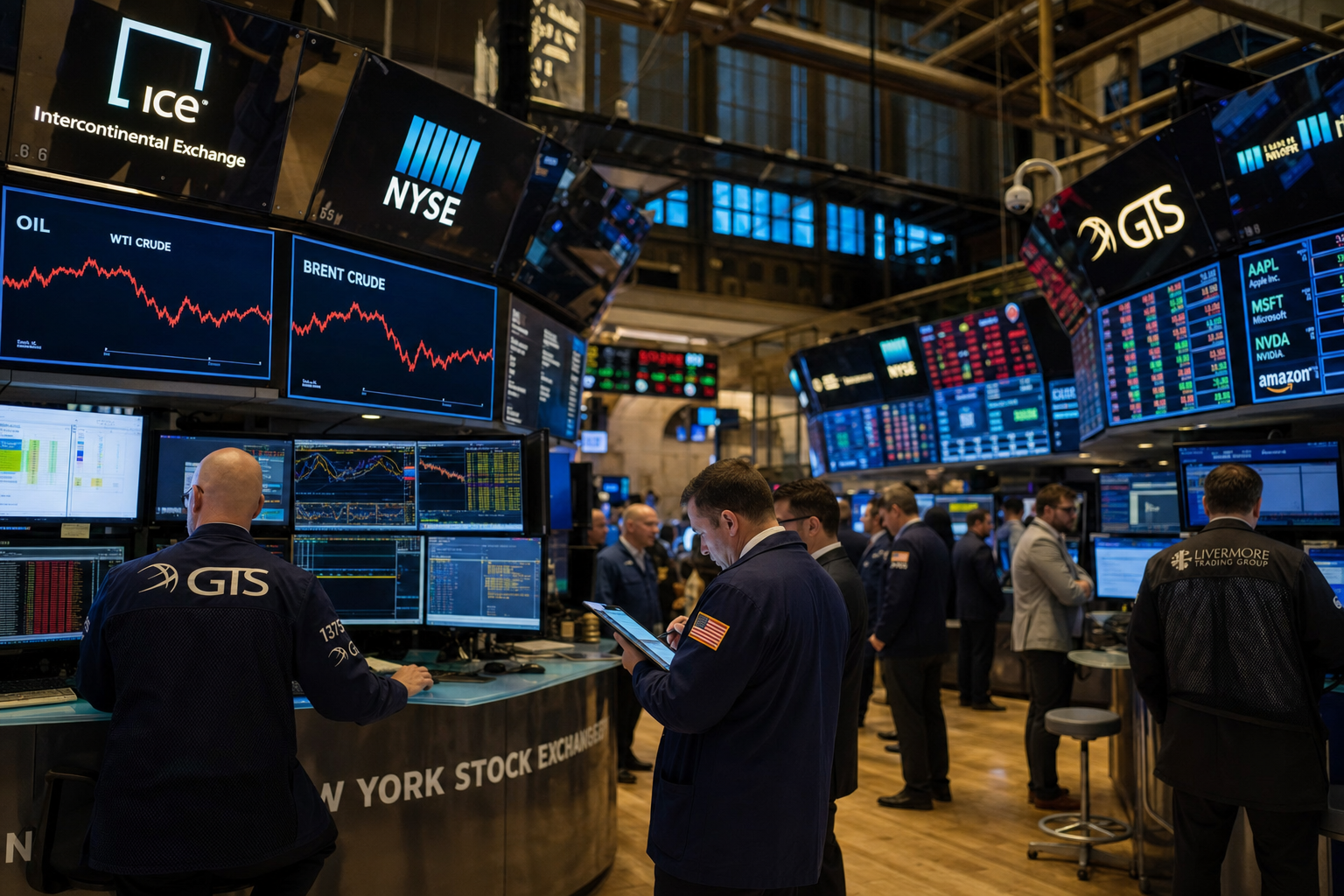
The Morning in Review
Wednesday's session opened under competing pressures that have only sharpened as the day progressed. The morning brief identified two dominant forces — a surge in AI capital formation and a deteriorating geopolitical backdrop — and both have delivered. Neither has overwhelmed the other, leaving markets in an uncomfortable equilibrium.
Alphabet (GOOGL) anchored the bullish case. The company's equity offering, upsized to $84.75 billion, stands as one of the largest on record, with proceeds earmarked for AI infrastructure and cloud expansion. The deal's reception was strong, supported in part by the company's Gemini AI platform reaching 900 million users — a commercial milestone that gave institutional buyers a concrete demand signal to anchor their commitments.
The more symbolically significant development was Berkshire Hathaway (BRK-B) separately purchasing $10 billion of Alphabet shares in a private transaction. Warren Buffett's firm has long been associated with skepticism toward technology bets, and its entry into AI infrastructure — at scale, through a private placement — marks a genuine shift in how long-horizon value investors are treating the sector. This is not a toe-dip. It is a structural allocation.
What Has Confirmed, What Has Shifted
The AI capital story has held and, if anything, broadened since the open. Micron Technology (MU) and South Korea's SK Hynix both crossed trillion-dollar market capitalizations during the session, driven by surging demand for high-bandwidth memory — the chip architecture that moves data rapidly between processors and memory in large AI systems. The milestone reflects how the AI trade is diffusing beyond the most visible names. While Nvidia (NVDA) has dominated the AI hardware narrative, memory suppliers are emerging as a credible second-order position, and today's valuation crossings suggest the market is pricing that thesis in earnest.
On the macro side, the picture has not improved. Crude oil prices climbed to a one-week high after Iranian military actions stoked fresh supply concerns. Exxon Mobil (XOM) and broader energy names attracted attention as the move reflected genuine near-term anxiety about Middle East shipping lanes and production infrastructure, not merely algorithmic positioning.
The OECD's warning — that a conflict extending into 2027 could produce significant world GDP declines and widespread energy shortages — is not a baseline forecast, but its publication has kept geopolitical risk premiums embedded in commodity markets through the session. That premium is unlikely to dissipate without a concrete de-escalation signal.
The Eurozone data released earlier this week added another layer of macro drag. Business activity fell to an 18-month low in May, with the composite PMI — a survey-based measure of output, orders, and employment across companies — deteriorating across both manufacturing and services. War-driven inflation is the primary culprit: unlike demand-side price pressures that central banks can address by raising rates, supply-side inflation driven by conflict squeezes margins without generating the revenue growth that would normally accompany rising prices. The European Central Bank now faces a genuinely difficult policy environment, with slowing growth and rising prices pulling in opposite directions.
The Afternoon Setup
The session's central question heading into the afternoon is whether the AI capital narrative can continue to insulate U.S. equities from the macro deterioration playing out in Europe and commodity markets. So far, it largely has — but the insulation is not absolute.
Visa (V) and Mastercard (MA) are worth watching in the fintech space. Reports indicate the two payment networks are close to launching a joint stablecoin platform — a digital currency infrastructure built on dollar-pegged assets. The development carries strategic weight: together, Visa and Mastercard process the majority of global card transactions, and any payment rails they build carry immediate institutional credibility. Regulatory frameworks for stablecoins are gradually taking shape in both the U.S. and Europe, which reduces some of the legal uncertainty that previously slowed incumbent participation. The story has not yet moved the stocks materially, but it is a structural development that warrants monitoring.
Nvidia's earnings report remains the most significant near-term catalyst on the horizon. Analysts are focused on three variables: China revenue exposure given ongoing export restrictions, H200 chip demand volumes, and the company's physical AI roadmap. Given that MU and SK Hynix have just crossed trillion-dollar valuations on HBM demand tied directly to Nvidia's AI accelerator ecosystem, the earnings report will function as a read-through for the entire AI supply chain — not just Nvidia itself.
The ECB's next policy meeting is also in focus for European and fixed-income traders. With Eurozone PMI data pointing toward a potential second-quarter GDP contraction, the central bank faces pressure to signal some accommodation — but war-driven inflation limits how far it can move without risking a credibility problem on price stability.
What to Watch
The afternoon session carries two distinct risk vectors. The first is oil: any further escalation in Iranian military activity could push crude higher and tighten the equity market's tolerance for the current valuation levels in rate-sensitive growth names. The second is positioning. The Alphabet offering's strong reception and Berkshire's AI commitment have generated genuine positive sentiment, but large equity raises of this scale can create technical supply pressure in the days following pricing as allocations settle.
The Visa-Mastercard stablecoin story, if confirmed with structural details, could accelerate crypto-adjacent fintech positioning. And the MU trillion-dollar crossing may draw fresh attention to the semiconductor memory segment as a distinct trade from the GPU-centric AI plays that have dominated year-to-date flows.
Markets are holding two very different stories simultaneously. That is sustainable until it is not — and the catalyst that tips the balance will most likely come from the Middle East, not Silicon Valley.